
Speaking Is the Weakest Skill: EF EPI 2025, 123 Countries
In 59 of the 113 countries with complete EF EPI 2025 skill data, speaking was the lowest-scoring of the four skills. Here is how wide the gap runs.

En esta página
Speaking trails reading, listening and writing in most of the countries measured by the EF English Proficiency Index 2025, which draws on 2.2 million EF SET test takers in 2024 across 123 countries and regions and publishes skill scores for the first time. In this article's count of the 113 countries and regions with complete four-skill data, speaking was the lowest-scoring skill in 59, and only two of them reached the high proficiency band. The sample is self-selected and the speaking and writing sections opened during 2024, so the results describe these test takers.
Key findings
- Speaking was the lowest-scoring of the four skills in 59 of the 113 countries and regions with complete four-skill data in the EF EPI 2025 proficiency detail pages.
- Only two of those 113 countries reached the high proficiency band for speaking; across the full 123, EF reports three countries in the high band (Kenya, South Africa and Zimbabwe) and none in the very high band.
- Reading was the strongest skill in nearly 80% of the 123 countries and regions and listening was the weakest in 31, while speaking held the lowest worldwide average score of the four skills.
- Speaking sat a median of 44 points below reading across the 113 countries, and 30 of them scored below 450, the very low band.
Background
Comparative claims about English proficiency usually rest on tests that adults take voluntarily, and the EF EPI is the largest ranking of countries and regions by English skills [2]. The 2025 edition is the first to publish separate reading, listening, speaking and writing scores, which makes the size of the speaking gap measurable rather than anecdotal [1]. The question here is narrow: how often is speaking the weakest of the four skills, and how far does it sit below the others.
Data and method
Source and window. This article uses the EF EPI 2025 report and the EF EPI index page [1][2]. The sample is the full EF SET testing population of 2024: 2.2 million test takers, from which the 2025 edition ranks 123 countries and regions.
Inclusion. EF includes cities and regions with a minimum of 100 test takers and countries with a minimum of 400 test takers. National scores are three-year rolling averages. Only published, aggregated country-level results are used here; no individual test taker record is involved.
Definitions. A skill score is the average result on that skill within a country: the speaking score for a country is the average of all speaking tests taken there in 2024. National scores are population weighted when they are rolled up to world and regional figures; skill scores are not, and a country's four skill scores do not add up to its national score in most cases. Country-level shares in this article use base = 123 countries and regions. Person-level shares, such as the share of test takers who chose the optional speaking and writing sections, use the EF SET testing population as the base; less than 20% of test takers in most countries chose to test speaking and writing. The two bases are kept apart throughout.
This article's own counts. The report publishes a proficiency detail page for 116 countries and regions, of which 113 report all four skill scores; Estonia, Malawi and Oman do not. Every country-level count below, including the count of countries where speaking was the weakest skill, comes from comparing the four published scores for each of those 113 entries, so its base = 113 countries and regions, not 123.
Bands and rounding. Proficiency bands follow the EF EPI band table: very high 600-699, high 550-599, moderate 500-549, low 450-499, and very low below 450. Figures are rounded to the nearest whole percent.
Design. The index is observational. This article reports differences and associations between skills; it does not estimate what would happen if a country changed its teaching.
Results
Speaking is the weakest of the four skills in most countries with complete data. Comparing the four published scores for each country, speaking was the lowest in 59 of the 113, reading in 1 and listening in 28; writing was lowest in the remaining 25. EF's own summary of the full index points the same way: speaking has the lowest worldwide average score, only three countries reach the high band for speaking, and all three have English as an official language. Listening is the weakest skill in 31 countries and reading is the strongest in nearly 80%, which leaves speaking at the bottom of the four in most of the index.
Most national speaking scores sit in the lower half of the scale. Of the 113 countries and regions, 2 scored in the high band (550-599), 34 in the moderate band (500-549), 47 in the low band (450-499) and 30 below 450, the very low band. The range runs from 377 in Thailand to 560 in South Africa. No country reaches the very high band, which begins at 600. A reader who knows only a country's national ranking would not guess how far its speaking score falls below that rank.
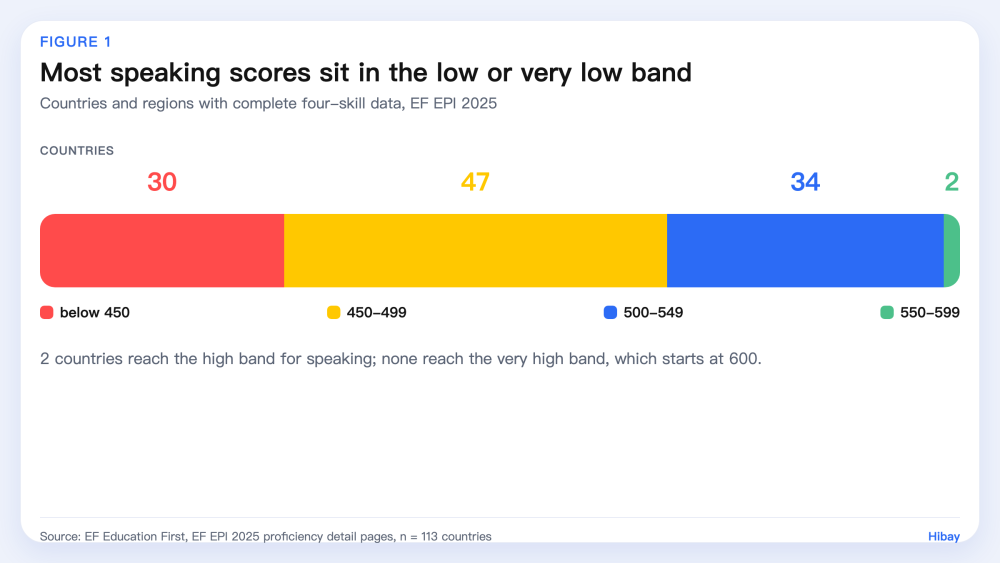
Figure 1. Speaking scores of the 113 countries and regions with complete four-skill data, grouped by EF EPI proficiency band, n = 113 countries. Source: EF Education First, EF EPI 2025 proficiency detail pages.
| Skill | Weakest skill, countries (base = 123) | Strongest skill, countries (base = 123) |
|---|---|---|
| Reading | 1 | nearly 80% |
| Listening | 31 | not reported |
| Speaking | a majority; 59 of 113 with complete data | not reported |
| Writing | not reported | 10 |
Counts in the table are EF's own tallies for the full index; the speaking row pairs EF's summary with this article's 113-country count.
The distance between reading and speaking is widest where overall proficiency is highest. Across the 113 countries, the median reading-minus-speaking difference is 44 points, and 97 countries score lower in speaking than in reading. The gap reaches 120 points in the Netherlands (reading 634, speaking 514), 102 in Germany, 99 in France and 96 in Spain, while it is 54 in Kenya and 39 in Thailand. That pattern matches EF's finding that skill gaps are wider in very high proficiency countries, where reading and listening have been built up faster than the productive skills.
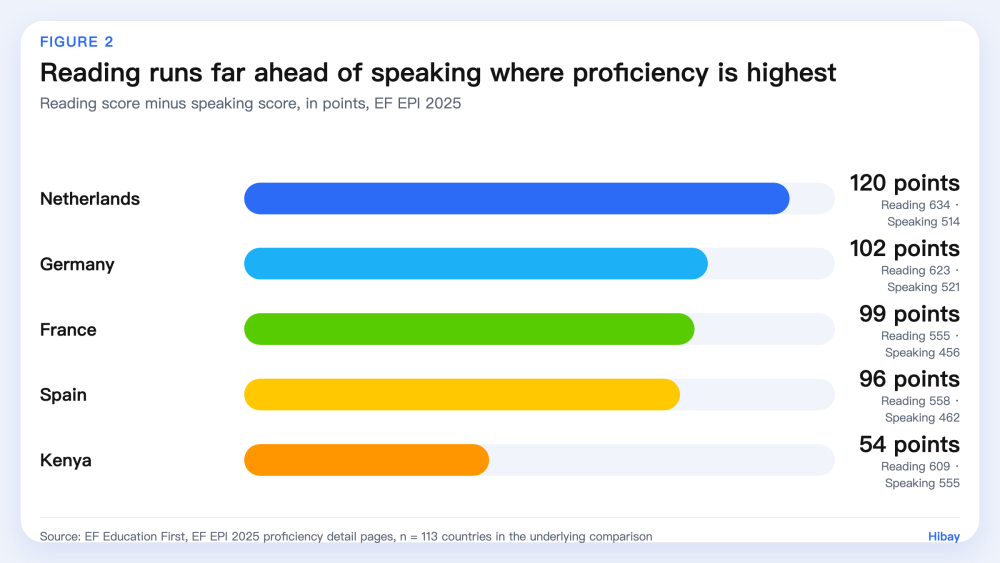
Figure 2. Reading score minus speaking score, in points, for five countries with complete EF EPI 2025 skill data, n = 113 countries in the underlying comparison. Source: EF Education First, EF EPI 2025 proficiency detail pages.
EF's age analysis points in the same direction for older adults. The report says the gap between receptive and productive skills is wider among adults over 40, so adding speaking and writing had a slightly larger effect on that cohort than on younger test takers, and scores for adults over 40 slipped again at the worldwide level. At the regional level, Asia has the narrowest receptive-productive gap, only 2 points, and is the only region where productive skills edge ahead. European countries sit at the other end, with some of the widest receptive-productive gaps in the world.
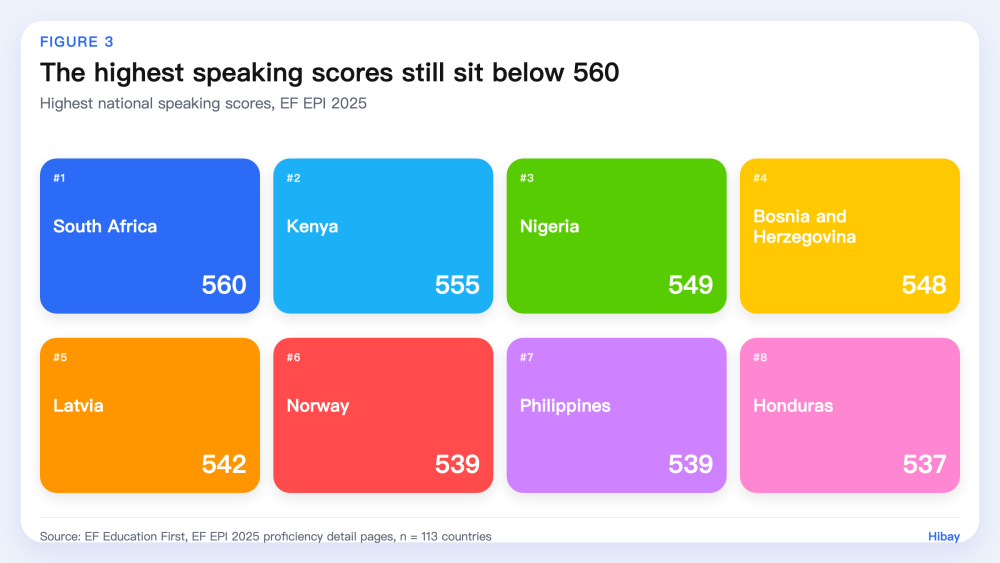
Figure 3. The eight highest national speaking scores in the EF EPI 2025 detail pages, n = 113 countries. Source: EF Education First, EF EPI 2025 proficiency detail pages.
Limitations
Four limits shape what these numbers can support. First, the EF SET population is self-selected: EF cautions that the sample may not represent the wider population, that the test is free and online, and that people without internet access are excluded, which can skew scores lower or higher than a national population [1]. Second, the speaking and writing sections are optional, and less than 20% of test takers in most countries chose them, so a country's speaking score rests on a smaller and possibly different group than its national score. Third, the 2025 edition added productive skills for the first time, and the new sections were available only from the first half of 2024, so comparison with earlier editions is limited. Fourth, this article's country counts cover the 113 countries and regions with complete four-skill data rather than all 123, and the report publishes no skill scores by age group, so the age pattern can only be described in EF's own terms. The design is observational: the patterns are associations, not evidence that one skill limits another.
What this means for learners
A national score says little about speaking. Even countries near the top of the index can sit a full band lower in speaking, so a learner preparing for work, study or travel should look at skill-level results rather than a single ranking. Because speaking is the skill most often left out of national testing, it is also the one least likely to be practiced in a test-driven routine. Hibay's speaking practice can supplement that gap, though practice feedback is not an official score.
Frequently Asked Questions
Is speaking really the weakest English skill worldwide? In the EF EPI 2025 sample, yes: speaking had the lowest worldwide average score of the four skills, and it was the lowest-scoring skill in 59 of the 113 countries with complete data (see Results). The claim applies to these EF SET test takers, not to every adult in those countries.
Which countries have the lowest speaking scores? Thailand (377), Cambodia (386), Mongolia (389), Kazakhstan (392) and Japan (393) had the five lowest speaking scores among the 113 countries and regions with complete four-skill data. The highest were South Africa (560) and Kenya (555).
Does age change the picture? EF reports that the gap between receptive and productive skills is wider among adults over 40, and that this cohort's scores slipped again at the worldwide level. The report does not publish separate speaking scores by age group, so the size of the age difference in speaking alone cannot be measured from this edition.
Is the EF EPI an official exam result? No. It is an index built from a free, adaptive online test that adults take voluntarily, and EF notes that the sample may not represent the wider population. National scores are three-year rolling averages of EF SET results, not school-leaving or immigration test scores.
How to cite
Hibay Product Team. (2026, October 30). Speaking Is the Weakest Skill: EF EPI 2025, 123 Countries. Hibay. https://www.hibay.ai/en/news/ef-epi-2025-speaking-gap
Figures are from the public sources listed below and may be cited with attribution.
References
- EF Education First. EF English Proficiency Index 2025: A Ranking of 123 Countries and Regions by English Skills. https://www.ef.com/assetscdn/WIBIwq6RdJvcD9bc8RMd/cefcom-epi-site/reports/2025/ef-epi-2025-english.pdf. Accessed 2026-10-30.
- EF Education First. EF EPI: EF English Proficiency Index, 2025 Edition. https://www.ef.com/wwen/epi/. Accessed 2026-10-30.