
English Leads in 154 Countries: What Duolingo's 2025 Report Shows
Duolingo's 2025 report puts English first in 154 countries, Japanese fourth and Korean sixth, but never publishes how many learners each rank represents.

En esta página
Which languages did the world's most-downloaded education app report people studying in 2025, and where does English sit in that structure? Duolingo's 2025 Language Report covers learners who studied on the platform between October 1, 2024 and September 30, 2025. It places English first in 154 of the 194 countries it ranks, Japanese fourth and Korean sixth. The company publishes no sample size and no learner counts per language, so the rankings describe order rather than volume.
Key findings
- English ranked first in 154 of the 194 countries in Duolingo's 2025 rankings, which the report describes as 79% of all countries.
- Japanese ranked 4th in the 2025 global top ten and Korean 6th, while German and Italian each moved down one place.
- English was the second most popular language in 15 countries and fell outside the top two in 25 of the 194, leaving little room between first and second place in most markets.
- The report describes the 154-country count as an increase of 14% over 2024; its 2024 edition had reported English first in 135 countries.
Background
Duolingo has published an annual language report since 2020, and the 2025 edition is the sixth in the series [1]. The company says its catalogue covers over 280 courses teaching 40+ languages, alongside math, music and chess, which makes course availability a plausible factor in what learners pick [1]. The report is written for a general audience: it names the language that leads each country, ranks the top ten globally, and puts its counting rules in a short note at the end [1].
Data and method
The report draws on Duolingo's own platform data for learners who studied languages between October 1, 2024 and September 30, 2025 [1]. Activity is aggregated by country and by language to protect learner privacy; age and motivation fields are self-reported, learners under 13 are excluded from all analyses, and countries with fewer than 5,000 Duolingo learners are left out of the rankings [1]. The two country tables in the report sum to 194 countries, and that figure is the denominator used in this article for country-level shares.
Duolingo does not publish a sample size. The report describes its base only as "millions of learners" and gives no learner count per language or per country, so a first-place rank means more learners than the next language, not a known number of learners. Every rank in this article is therefore treated as ordinal, and no percentage here is an estimate for the global population of language learners.
"Most popular language to study" is the report's own wording, used here without conversion into a different metric. It is not relabeled as enrollments, sign-ups or active learners, because the report does not say which of those it counts. The volume measures it does publish are country counts, meaning how many countries a language leads, plus course-level rankings by average time spent learning; both are labeled as such where they appear.
Figures are rounded to the nearest whole percent.
Results
The global top ten mixes European and Asian languages, with English at the top. English, Spanish and French hold the first three places, Japanese is fourth, German fifth, Korean sixth, Italian seventh, Chinese eighth, Portuguese ninth and Hindi tenth [1]. The list is mostly European, with Japanese, Korean, Chinese and Hindi the exceptions, and English is the only language on it that most of its learners study as a second language rather than as a family or regional language.
English's lead is a country-level lead, not a share of learners. It ranked first in 154 of the 194 countries in the rankings, which the report states as 79% of all countries, and it ranked second in a further 15 [1]. Only 25 countries place English outside their top two, and the country table behind the share lists Spanish first in 26 countries, French in 12 and German in 2 [1]. No other language is close to English on this count.
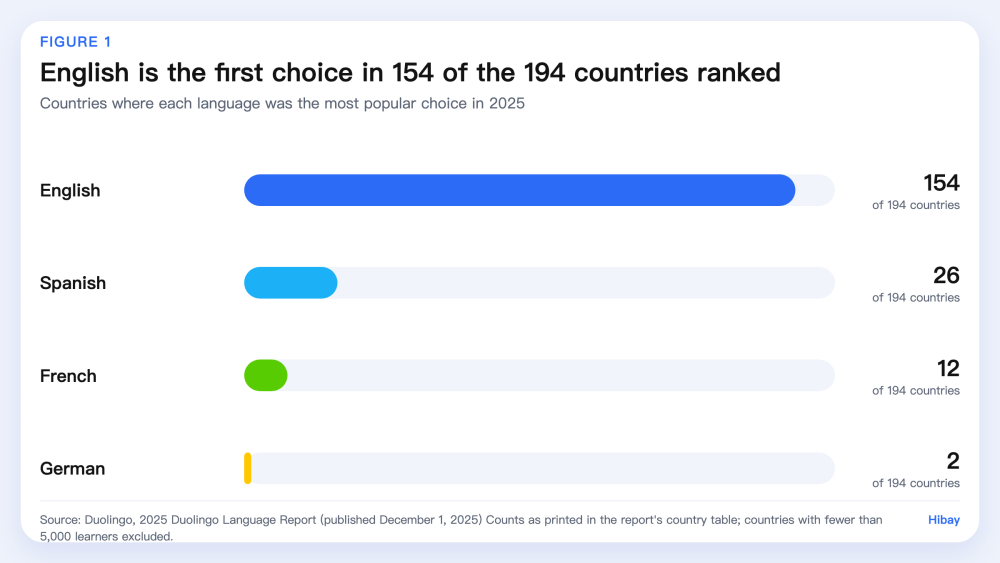
Figure 1. Countries where each language was the most popular choice in 2025, out of 194 countries ranked; countries with fewer than 5,000 Duolingo learners are excluded (n not disclosed; Source: Duolingo, 2025 Duolingo Language Report).
| Language | Global rank, 2025 | Countries where it ranked first | Countries where it ranked second |
|---|---|---|---|
| English | 1 | 154 | 15 |
| Spanish | 2 | 26 | 48 |
| French | 3 | 12 | 60 |
| German | 5 | 2 | 22 |
Reading the last two columns together separates reach from depth: English is the first choice in most countries where it appears at all, while French and Spanish are far more often the second choice.
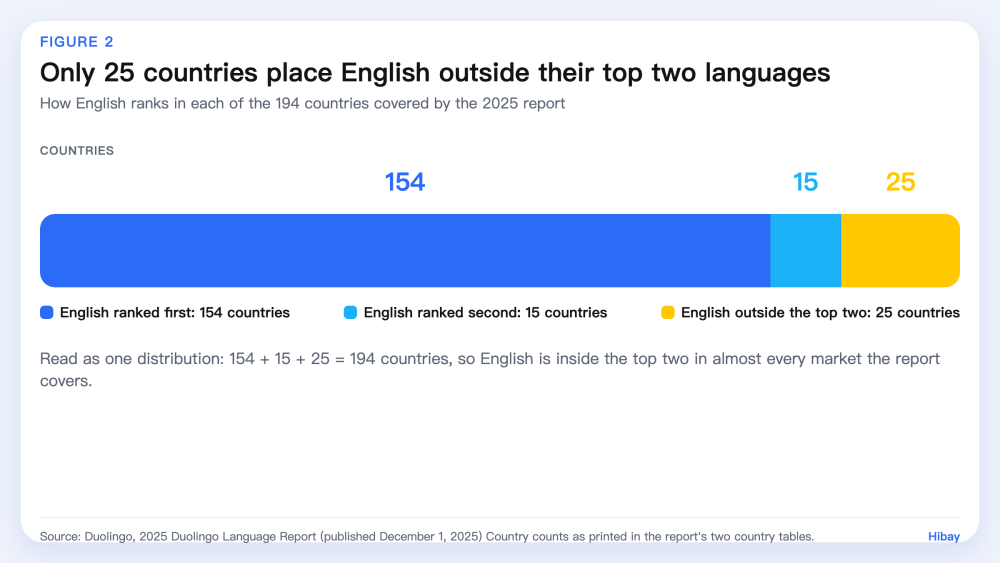
Figure 2. Where English sits in each country's ranking, out of 194 countries; countries with fewer than 5,000 Duolingo learners are excluded (n not disclosed; Source: Duolingo, 2025 Duolingo Language Report).
Second place is more fragmented than first. French is the second most popular language in 60 countries, Spanish in 48, German in 22 and English in 15, followed by Japanese and Portuguese in 13 each [1]. That pattern fits a world where English is the default first choice and the second choice is shaped by geography and by which courses exist for speakers of a given language.
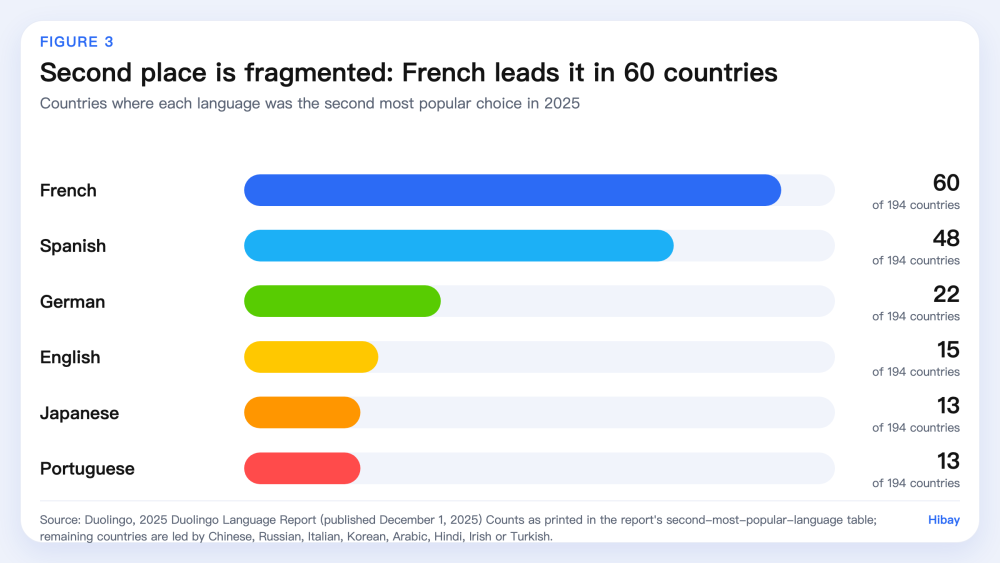
Figure 3. Countries where each language was the second most popular choice in 2025, out of 194 countries (n not disclosed; Source: Duolingo, 2025 Duolingo Language Report).
Japanese and Korean moved up within the top ten. The report says Japanese became the fourth most popular language to study, surpassing German, and Korean became sixth, moving past Italian [1]. It links both changes to course availability: for the first time, speakers of more than 20 languages can study Japanese and Korean from their own language, and Duolingo added 148 new courses in 2025 [1]. In the 2024 edition, German was fourth and Japanese fifth, and Italian was sixth and Korean seventh [2], so the two switches reversed positions that had held a year earlier.
On a different measure, how much time learners spend, English is not first. Among courses, Spanish has the most serious learners, English is second and Italian third, with Welsh fourth and Norwegian fifth, measured by average time spent learning [1]. At country level, the same measure is led by Japan, followed by Hungary, Belarus, Russia and Germany [1]. Those two lists use time rather than learner counts, and they are the only place in the report where intensity is compared instead of popularity.
Limitations
Three limits shape how far these rankings can be read. First, Duolingo publishes no sample size: the base is described as "millions of learners", with no count of learners per country, no margin of error and no test of whether a one-place gap between two languages is meaningful. Second, the ranking metric itself is undefined. "Most popular language to study" could describe active learners, new learners in the window, or anyone who opened a course, and the report does not say which; a change in course availability, such as the 148 courses added in 2025, can move a country's ranking without any change in underlying demand. Third, the sample is self-selected. It covers people who chose Duolingo, it excludes countries with fewer than 5,000 learners and everyone under 13, and its 194 countries are Duolingo's coverage rather than the world.
What this means for learners
For someone choosing a language, the report works better as a map of where a language is commonly studied than as a measure of how useful or how easy it is. English remains the default first choice in most countries, so an English learner is joining a very large pool by definition, while a language lower on the list can mean fewer fellow learners locally even as global interest rises. Because course availability is part of what the rankings capture, a language moving up is a signal about access as much as about demand.
Frequently Asked Questions
What does "most studied" mean in the 2025 Duolingo Language Report?
The report uses "most popular language to study" and "most studied" interchangeably and does not define the count behind either phrase. It publishes ranks and country counts, not learner numbers, so both phrases should be read as positions rather than volumes (see Data and method).
How many countries is English the most studied language in?
English ranked first in 154 countries in the 2025 report, which the report describes as 79% of all countries, and second in 15 more [1]. Only 25 of the 194 countries in the rankings place English outside their top two languages.
Which languages are in the 2025 global top ten?
English, Spanish, French, Japanese, German, Korean, Italian, Chinese, Portuguese and Hindi, in that order [1]. Japanese moved up to fourth and Korean to sixth, while German and Italian each moved down one place.
Does the report say how many learners it covers?
No. It describes the base as "millions of learners" and gives no sample size, no per-country learner counts and no margin of error. That gap is the main reason the rankings should not be read as population estimates.
How to cite
Hibay Product Team. (2026, October 30). English Leads in 154 Countries: What Duolingo's 2025 Report Shows. Hibay. https://www.hibay.ai/en/news/duolingo-2025-language-report-learner-trends
Figures are from the public sources listed below and may be cited with attribution.
References
- Duolingo. 2025 Duolingo Language Report. https://blog.duolingo.com/2025-duolingo-language-report/ Accessed 2026-10-30.
- Duolingo. 2024 Duolingo Language Report. https://blog.duolingo.com/2024-duolingo-language-report/ Accessed 2026-10-30.