
A 30-Day Shadowing Plan: What to Shadow Each Week, and When to Make It Harder
Shadowing needs a month-long material ladder, not one clip that was too fast. Four rungs of material, two signals for moving up, a ten-minute daily shape, and what a shadowing English app can judge.

On this page
Shadowing works best as a month-long ladder, not a one-off experiment with a clip that was too fast. This plan gives four rungs of material, the two signals that tell you it is time to move up, a ten-minute daily shape, and what a shadowing English app can and cannot judge.
What Shadowing Trains, and What It Leaves Out
The standard definition comes from interpreting research: shadowing is "a paced, auditory tracking task which involves the immediate vocalization of auditorily presented stimuli" (Lambert, as quoted in Shadowing for language teaching, accessed 28 October 2026). You speak at the same time as the recording, as closely as you can, like a shadow following someone down a street.
That same guide makes a point that decides your material choice: shadowing occupies attention with sound, and learners below an advanced level typically cannot shadow and process meaning at the same time. So the clip has to be easier than what you can comfortably understand — otherwise you are not shadowing, you are stopping and starting.
Why a One-Off Clip Fails
Most people try shadowing once with whatever audio was at hand, discover they cannot keep up, and conclude that shadowing is not for them. The clip was the problem. What is missing is a sequence: material that stays easy enough to track while it slowly gets more natural.
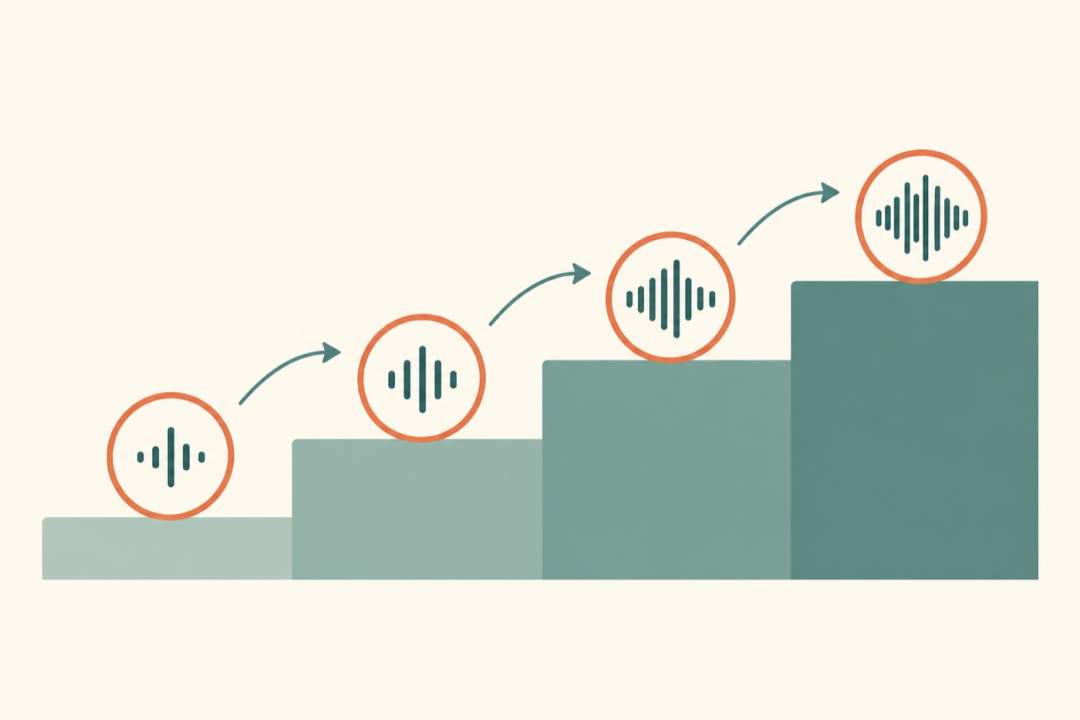
The Four-Rung Material Ladder
Each rung is a week. Stay on a rung longer if you need to; the ladder is a direction, not a deadline.
| Week | What you shadow | What to look for in the clip | Move on when |
|---|---|---|---|
| 1 | Scripted teaching audio with clear pauses, 60-90 seconds | Slow delivery, one speaker, transcript available | You finish sentences at the same time as the speaker |
| 2 | The same style at natural speed, 90 seconds to 2 minutes | Still scripted, still one speaker, slightly faster | You stop needing to read the transcript first |
| 3 | A semi-scripted interview or a short news story, 2 minutes | Natural speed, one or two speakers, no read-aloud delivery | You keep up without pausing the audio |
| 4 | Unscripted dialogue from a series or podcast, 2-3 minutes | Overlapping turns, fillers, an unfamiliar accent | You can shadow it twice and describe what was said |
A Ten-Minute Daily Shape
Ten minutes done daily beats an hour on Sunday, and the shape is the same on every rung.
- Listen once with the transcript in front of you, without speaking.
- Shadow three passes, still with the transcript. Restart the clip rather than chasing a lost phrase.
- Record the last pass on your phone and put it away.
- Listen to your recording once and note one moment where you dropped out of step.
Do not add a fifth step. Note-taking, vocabulary hunting and replaying every sentence belong to another kind of practice; this one is about staying with the stream.
Where to Find Free Material for Each Rung
Rung one and rung two need audio built for learners, and there are free public sources: VOA Learning English publishes levelled lessons with transcripts and slow or normal-speed audio, and public-domain audiobook recordings cover rung two for anyone who prefers literature.
Rungs three and four need real, unscripted speech. Public broadcaster podcasts with transcripts are the usual choice, and short interviews posted with captions work as well as anything sold for the purpose. Keep one clip for two sessions instead of hunting for new material every day.
What a Shadowing English App Adds, and What It Cannot Judge
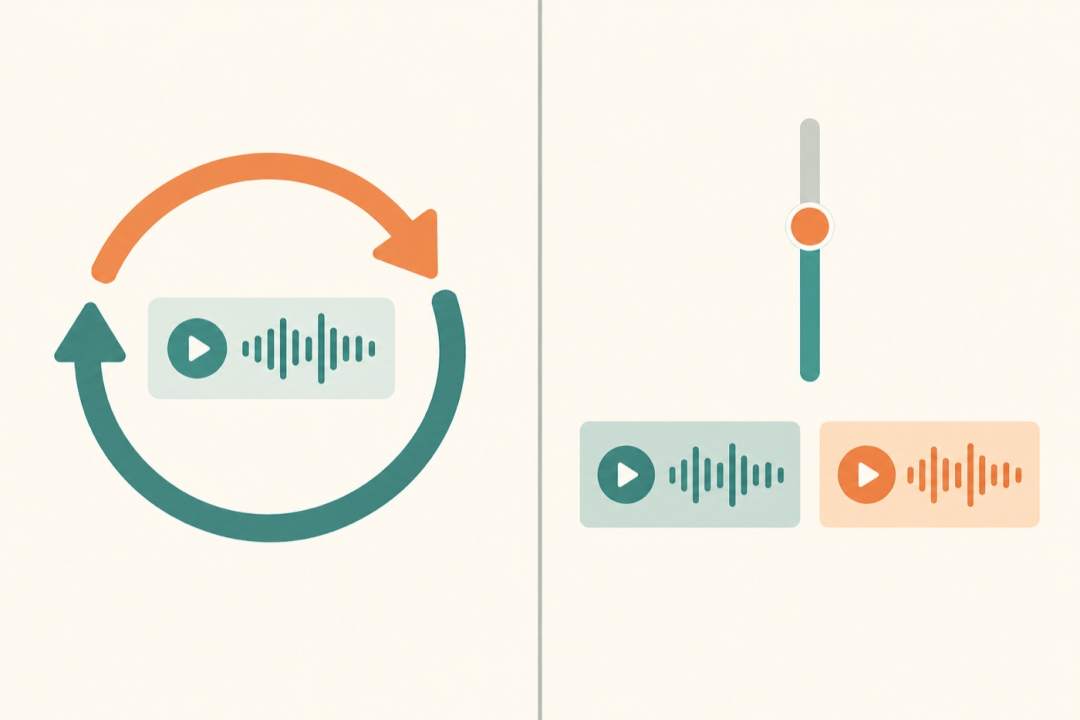
An app with a loop control, a slow-down slider and side-by-side recording does the mechanics well: it removes the fiddling with audio files and keeps your attempts together. What it cannot judge is whether your version sounds connected the way the speaker's did, because that judgement needs a listener or a recording you compare yourself.
Use the app for looping and storage, and use the rest of this plan for the decisions: which rung, which clip, and when to move on.
Frequently Asked Questions
How long should I shadow the same clip?
Two sessions is usually enough. The first pass teaches you the timing; the second confirms it. Beyond that the clip stops offering new rhythm, and a fresher piece of the same difficulty teaches more than a fifth repetition of the same audio.
Should I read the transcript while shadowing?
Yes on the first two rungs, and then stop. The transcript keeps you moving while you learn the timing, but it also lets you read ahead instead of listening, which hides exactly the skill you are practising. Drop it once you can start within a beat of the speaker.
What if the audio is still too fast on the easiest rung?
Slow the playback to three-quarters speed before you change material, and shadow the slower version for a whole session. If that still fails, the clip is above your tracking level, so choose something with longer pauses rather than something shorter, because a short clip at full speed does not give you more time.