
IELTS Writing Varies Least Across Countries, Reading Most
Across 40 nationalities, IELTS Writing means span 1.52 bands while Reading means span 2.90: the skill that separates countries most is the receptive one.

On this page
The official IELTS tables publish a mean for each skill for every nationality group, and the four columns do not vary across countries to the same degree. In the Academic 2024-2025 table, the gap between the lowest and highest national mean is 2.90 bands in Reading, 2.79 in Listening, 2.04 in Speaking and 1.52 in Writing. The tables cover published group means only, nationalities are listed alphabetically rather than by size, and no candidate-level data is used.
Key findings
- Across 40 Academic nationality groups, Writing means run from 5.11 to 6.63 — a range of 1.52 bands, the narrowest of the four skills.
- Reading means run from 5.20 to 8.10, a range of 2.90 bands, almost twice the Writing range.
- Listening spans 2.79 bands and Speaking 2.04, so the ordering is Reading, Listening, Speaking, Writing from widest to narrowest.
- The same country tops three columns — Germany at 8.10 Reading, 7.80 Listening and 7.51 Speaking — while a different country, the United Arab Emirates at 5.11, sits at the bottom of Writing.
- In the General Training table the order changes: Listening spans 3.78 bands and Writing 2.59, so Writing is still the narrowest column.
Background
IELTS reports an overall band plus four skill bands, and the official statistics publish a group mean for each of those five figures [1]. Because the four skills are scored by different papers and, for Speaking, by an examiner, the published means differ in how much room they leave between countries [2].
A typical reading of these tables compares countries on one skill. Comparing the columns instead asks a different question: which skill produces the widest spread between national cohorts, and which produces the narrowest. The answer shapes how much weight a country-level figure can carry when a learner uses it to judge their own level.
Data and method
The source is the IELTS test taker performance workbook for 2024-2025, sheets "AC mean by nationality" and "GT mean by nationality" [2]. Each sheet reports the mean Listening, Reading, Writing, Speaking and overall band for the nationality groups that IELTS lists, and every row with a published mean is used.
For each skill the range is the highest published national mean minus the lowest, in band units; the lowest and highest groups are named so that the figure can be checked against the source. The standard deviation across the 40 groups is reported alongside the range because a single extreme group can widen a range without moving the rest of the distribution. Means are quoted to two decimals as published, the summary statistics are computed from those published values, and the data are aggregated at nationality level with no individual record used. The sample is the set of published group rows in the source table, the key metric in each case is a published group mean or a share or difference computed from published means, and all values are aggregated at group level with no individual record used.
Results
Reading shows the widest spread. Germany's 8.10 is the highest Academic Reading mean in the table and Oman's 5.20 the lowest, a range of 2.90 bands across 40 groups, with a standard deviation of 0.55. Listening is a close second at 2.79 bands, from Oman's 5.01 to Germany's 7.80, and a standard deviation of 0.58, making Listening the most dispersed skill by that secondary measure.
Speaking is narrower, 2.04 bands from Japan's 5.47 to Germany's 7.51, with a standard deviation of 0.46. Writing is the narrowest by a clear margin: the United Arab Emirates' 5.11 is the lowest mean in the column and Germany's 6.63 the highest, a range of 1.52 bands and a standard deviation of 0.31, roughly half the Reading figure. A learner moving from the bottom of the Writing column to the top crosses less than a band and a half, while the same move in Reading crosses almost three.
The General Training table widens every column but keeps Writing at the narrow end. Listening runs from Saudi Arabia's 4.24 to the United States group's 8.02, a range of 3.78 bands; Reading from 5.02 to 8.35, a range of 3.33; Speaking from 5.41 to 8.73, a range of 3.32; and Writing from 4.83 to 7.42, a range of 2.59. Writing remains the narrowest column on both test versions, and the widest column changes from Reading on Academic to Listening on General Training.
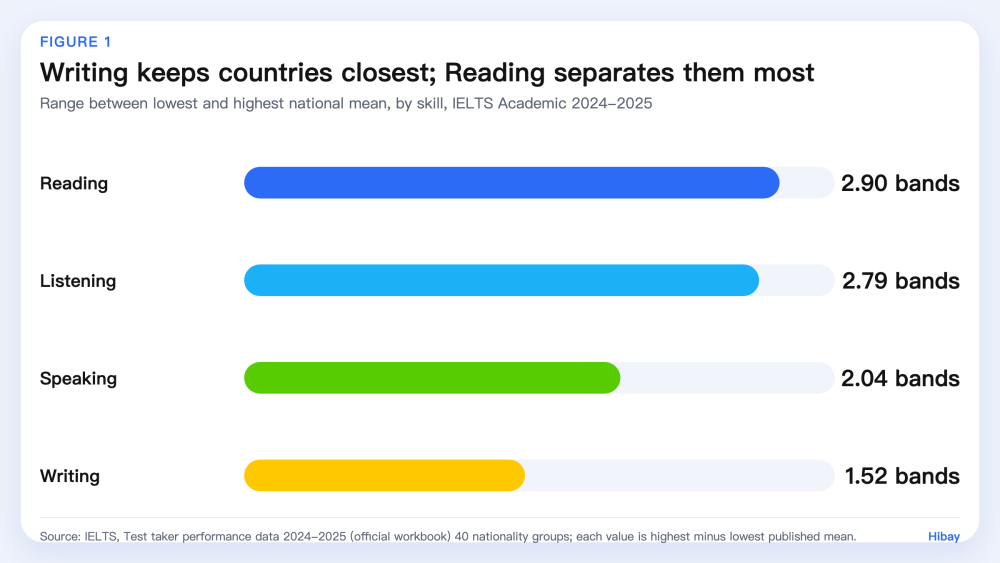
Figure 1. Spread of published Academic skill means across 40 nationality groups, in bands, n = 40 groups per skill. Source: IELTS test taker performance data 2024-2025.
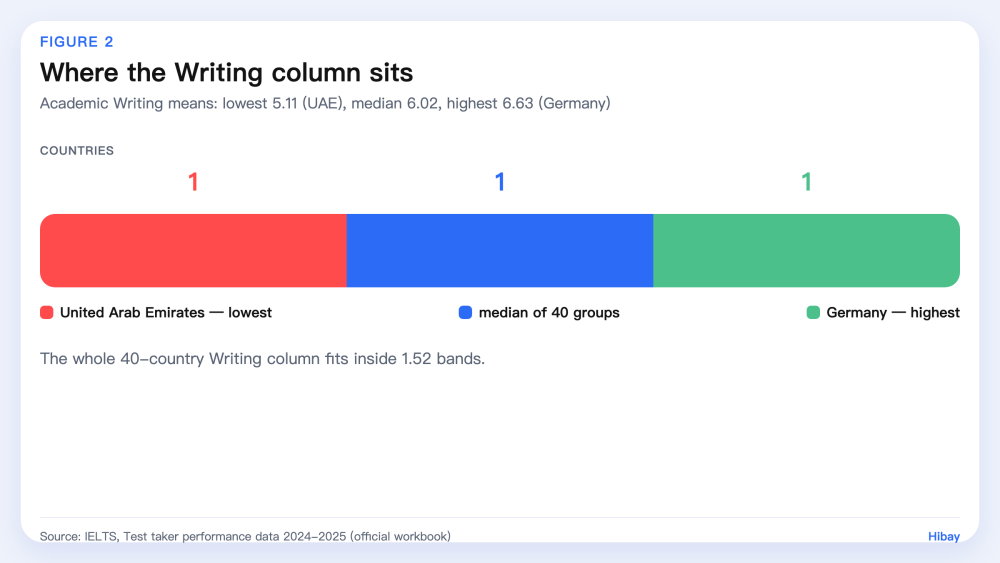
Figure 2. The lowest and highest published Academic Writing means, with the 40-group median, n = 40 nationality groups. Source: IELTS test taker performance data 2024-2025.
Limitations
Three cautions apply. First, a range is set by two rows: the figures for Reading and Writing are driven by specific national groups at each end, and if those groups are small the range may say more about them than about the column as a whole. IELTS does not publish the number of candidates behind each row, so this cannot be checked from the source. Second, the nationalities in the table are a fixed alphabetical list of the largest groups, not a random sample of countries, so the range describes those 40 groups rather than the world. Third, the comparison is of group means: a narrow range in Writing does not mean individual candidates write similarly, because a mean can be stable while the spread of scores inside each group is wide. The paper-level difference between Academic and General Training Writing also means the two columns are not scoring the same task.
What this means for learners
The narrow Writing column carries a practical message. A national Writing mean tells a learner relatively little about where they might sit, because the whole set of countries spans only a band and a half; a national Reading mean, spanning almost three bands, carries more information. When a country figure is quoted as a benchmark, the skill it refers to changes how much it should shift a learner's expectations.
The second message is about which skill to practise. If Reading is where national cohorts differ most, it is also the skill where a learner's own position is most likely to diverge from a national average, and where a diagnostic test is most informative.
Frequently Asked Questions
Which IELTS skill varies most between countries?
In the 2024-2025 Academic table, Reading has the widest range across 40 nationalities at 2.90 bands, followed by Listening at 2.79. Writing is narrowest at 1.52 bands.
Why is the Writing range so much smaller?
The published tables do not explain it. Possible contributors include how the Writing paper is scored, how similar Writing preparation is across countries, and the smaller band range that the task itself produces, but the data here cannot separate those explanations.
Does a narrow national range mean candidates score alike?
No. A range of group means says nothing about the spread of individual scores inside each group. Two cohorts can share a mean while their candidates differ widely.
How to cite
Hibay Product Team. (2026, November 5). IELTS Writing Varies Least Across Countries, Reading Most. Hibay. https://www.hibay.ai/en/news/ielts-writing-least-variable-skill-2024-2025
References
- IELTS. Understand and explain IELTS scores. https://ielts.org/organisations/ielts-scoring-in-detail. Accessed 2026-11-05.
- IELTS. Test taker performance data 2024-2025 (XLSX workbook, sheets "AC mean by nationality" and "GT mean by nationality"). https://ielts.org/cdn/ielts-downloadable-assets/ielts-research/ielts-research-data/ielts-test-taker-performance-data-2024-2025.xlsx. Accessed 2026-11-05.