
IELTS: Reading and Writing Ranks Move Together at 0.85
Ranking 40 nationalities by each IELTS skill, Reading and Writing line up at 0.85, while Listening and Speaking line up at only 0.49.

On this page
IELTS publishes a mean for each of the four skills for every nationality group it reports, which allows the same set of countries to be ranked four times. Doing that for Academic candidates in 2024-2025 produces two very different pairs: Reading and Writing ranks agree at 0.85, and Listening and Speaking ranks agree at 0.49. The measure is a rank correlation across published group means, the tables list nationalities alphabetically rather than by size, and no candidate-level data is involved.
Key findings
- Across 40 Academic nationality groups, the rank correlation between Reading and Writing means is 0.85, the highest of the six skill pairs.
- Listening and Speaking rank together at only 0.49, so a country's listening position explains roughly a quarter of its speaking position.
- Writing and Speaking rank together at 0.86, and Listening and Reading at 0.81, so the weakest link is specifically Listening against Speaking.
- Germany holds the top mean in all four Academic skills in 2024-2025, at 7.80 in Listening, 8.10 in Reading, 6.63 in Writing and 7.51 in Speaking.
- The bottom of each skill is a different country: Oman in Listening at 5.01 and Reading at 5.20, the United Arab Emirates in Writing at 5.11, and Japan in Speaking at 5.47.
Background
An IELTS overall band is an average of four skill bands, and the four skills are scored separately, so two candidates with the same overall band can arrive from different profiles [1]. The official test statistics publish a mean for Listening, Reading, Writing and Speaking for each nationality and first language group, alongside the overall mean [2].
Those means are usually read one skill at a time, which answers questions such as which country writes best. Reading them as four rankings of the same countries answers a different question: whether the skills order countries in the same way, or whether each skill produces its own league table. That question matters for anyone using country-level data to judge where a learner is likely to be strong.
Data and method
The source is the IELTS test taker performance workbook for 2024-2025, sheet "AC mean by nationality", which reports the mean Listening, Reading, Writing, Speaking and overall band for each listed nationality [2]. The sample is 40 nationality groups, one row each, and all rows with a published mean are used without weighting.
For each skill the 40 groups are ranked from highest to lowest mean, and each pair of skills is compared with Spearman's rank correlation, which measures how closely two orderings agree: 1 means identical order, 0 means no relationship. Ties receive the average rank. The same procedure is repeated for General Training on the 30 nationalities that appear in both versions' tables. Correlations are reported to two decimals, means to two decimals as published, and the data are aggregated at nationality level with no individual record used. The sample is the set of published group rows in the source table, the key metric in each case is a published group mean or a share or difference computed from published means, and all values are aggregated at group level with no individual record used.
Results
The six Academic pairs fall into two groups. Reading and Writing agree at 0.85, Writing and Speaking at 0.86, and Reading and Speaking at 0.80; Listening and Reading agree at 0.81. Listening and Writing drop to 0.59, and Listening and Speaking to 0.49. In other words, three of the four skills order the countries in a broadly similar way, and Listening is the one that departs, most sharply against Speaking.
That split is visible in the extremes. Germany tops all four Academic columns, at 7.80 Listening, 8.10 Reading, 6.63 Writing and 7.51 Speaking, and Oman sits at the bottom of Listening and Reading at 5.01 and 5.20. But the bottom of Writing is the United Arab Emirates at 5.11, and the bottom of Speaking is Japan at 5.47, a country whose Reading mean is 5.93. Japan's Speaking mean is 0.46 bands below its own Reading mean and 0.52 below its Listening mean of 5.99, so the country is a clean example of a cohort whose heard and written English ranks above its spoken English.
The General Training tables, read over the 30 nationalities listed in both versions, tighten most pairs: Listening and Reading reach 0.91, Writing and Speaking 0.94 and Reading and Writing 0.87, while Listening and Speaking rise to 0.65. The pattern survives the change of test version: Listening and Speaking remain the least aligned pair in both.
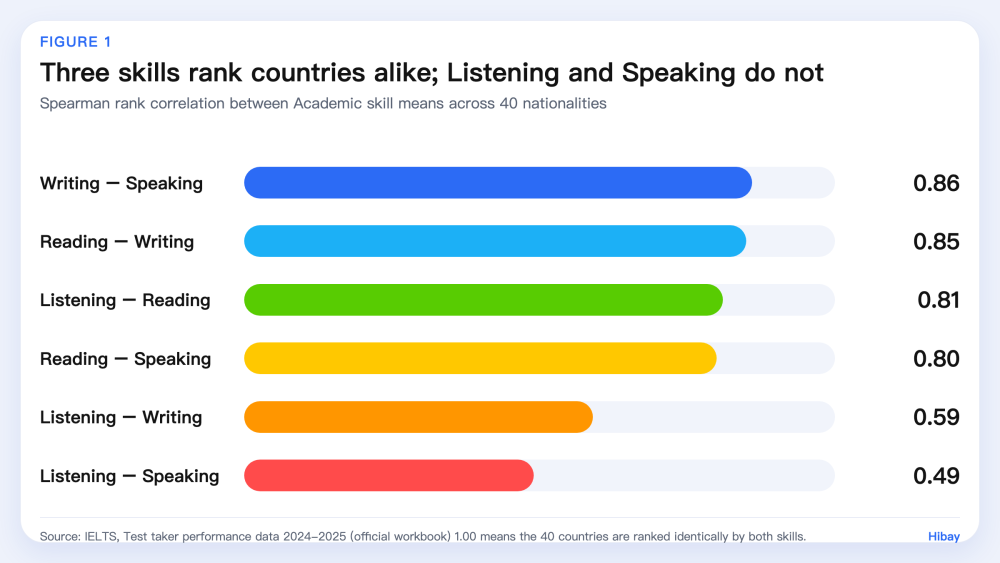
Figure 1. Spearman rank correlation between pairs of skill means across the 40 Academic nationality groups, n = 40 groups. Source: IELTS test taker performance data 2024-2025.
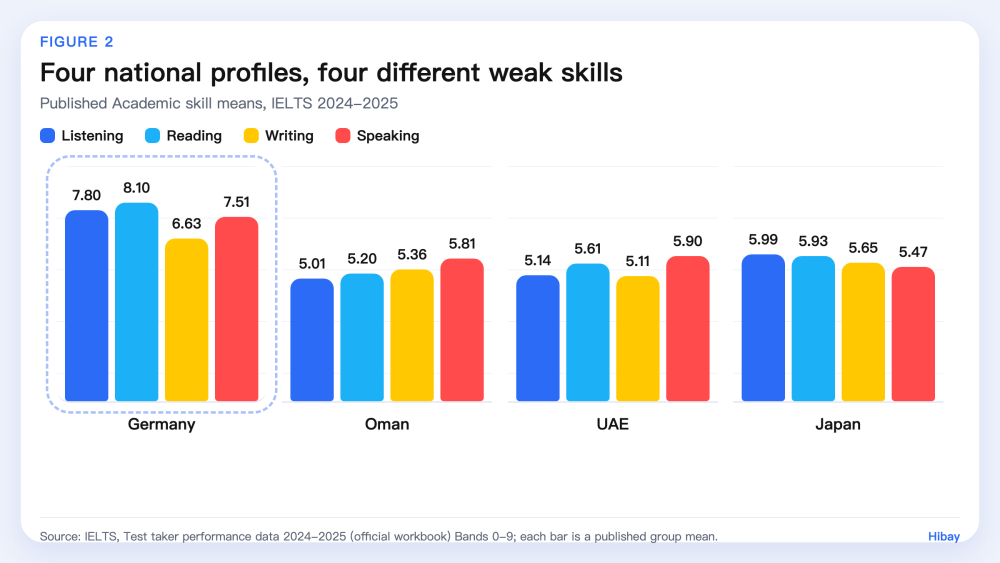
Figure 2. Published Academic skill means for Germany, Oman, the United Arab Emirates and Japan, 2024-2025, n = 40 nationality groups in the source table. Source: IELTS test taker performance data 2024-2025.
Limitations
A rank correlation across 40 published groups is a statement about those groups, not about learners. The groups differ in size and the table does not say how many candidates sit behind each row, so a small nationality and a large one count equally. Correlations also say nothing about causes: a shared education system, a shared first language or a shared testing history could all push two skills into the same order, and this data cannot separate them. The nine-band scale compresses differences at the top, where many groups share the same rounded mean, and ties are handled by average ranking, which slightly flattens the coefficients. Finally, the published means cover overall bands per skill only; they do not show how many candidates reached a given skill band, so the ordering describes averages rather than distributions.
What this means for learners
The practical point is that a country's average says more about Reading and Writing than about Speaking. A learner who reads that their country ranks well in English should check which skill that ranking refers to, because a strong Reading position is compatible with an ordinary Speaking position — Japan is the clearest published example in this table.
For preparation, the pair that moves least together is the pair most worth testing separately. If Reading and Writing already sit at a similar level, the useful question is where Speaking sits relative to Listening, and a practice plan can be built around that gap rather than around the overall band.
Frequently Asked Questions
What does a 0.85 rank correlation mean here?
It means the 40 nationality groups are ordered almost the same way by Reading means and by Writing means: countries near the top in one are usually near the top in the other. A value of 0.49 for Listening and Speaking means the two orderings agree much less.
Does this show that listening practice improves speaking?
No. The measure is a correlation between group averages, and it cannot establish direction or cause. It only shows how similarly the two skills order the same set of countries.
Why is Japan's Speaking mean so far below its Reading mean?
The table reports means, not reasons. Japan's published Academic means are 5.93 in Reading, 5.99 in Listening, 5.65 in Writing and 5.47 in Speaking, and the source data does not explain the gap.
How to cite
Hibay Product Team. (2026, November 5). IELTS: Reading and Writing Ranks Move Together at 0.85. Hibay. https://www.hibay.ai/en/news/ielts-skill-rank-agreement-2024-2025
References
- IELTS. Understand and explain IELTS scores. https://ielts.org/organisations/ielts-scoring-in-detail. Accessed 2026-11-05.
- IELTS. Test taker performance data 2024-2025 (XLSX workbook, sheet "AC mean by nationality" and "GT mean by nationality"). https://ielts.org/cdn/ielts-downloadable-assets/ielts-research/ielts-research-data/ielts-test-taker-performance-data-2024-2025.xlsx. Accessed 2026-11-05.