
IELTS 7.0 Equals CELPIP 9, Except in Writing
In a 1,089-candidate study that gave both tests, IELTS 7.0 overall matched CELPIP 9 overall, but the Writing section needed CELPIP 10 at the same band, two levels above Reading's equivalent.


On this page
The first published concordance between CELPIP General and IELTS General Training rests on 1,089 candidates who took both tests within 90 days. At the overall level the mapping is orderly: IELTS 7.0 corresponds to a minimum CELPIP score of 9, IELTS 6.5 to 8 and IELTS 8.0 to 11. Section by section it is not: at IELTS 7.0 the equivalent CELPIP minimum is 8 in Reading and Speaking, 9 in Listening and 10 in Writing. The study was commissioned by the IELTS partners and Prometric and analysed by ACER, and the tables report only minimum CELPIP scores, based on a single 90-day pairing per candidate.
Key findings
- The study matched 1,089 candidates who took both tests inside a 90-day window, and 98.4 percent of them were testing for immigration.
- Overall, IELTS 7.0 maps to a minimum CELPIP score of 9, IELTS 6.5 to 8, IELTS 6.0 to 7 and IELTS 8.0 to 11.
- At IELTS 7.0 the section equivalents diverge: 8 in Reading, 8 in Speaking, 9 in Listening and 10 in Writing.
- The divergence grows with band: at IELTS 7.5 the Writing equivalent is 12 while Reading is 9.
- Standard errors are smallest mid-scale, at 0.05 for the overall 7.0 conversion, and largest at the extremes, at 0.51 for Writing at IELTS 4.0.
Background
CELPIP General and IELTS General Training are both accepted for Canadian immigration purposes, and institutions that accept either need to know what one score means in the other's terms [1]. Concordance studies answer that by testing the same people twice rather than by comparing published statistics.
The design choice matters. CELPIP reports 12 levels on its scale, IELTS reports 9 bands in half steps, and the two tests elicit language differently: CELPIP is computer-delivered and fully machine-scored, IELTS General Training includes a face-to-face speaking interview and a handwriting-or-typing writing paper. A concordance table, the authors write, is an estimate for guidance, not a conversion formula.
Data and method
The source is the IELTS Partnership Research Paper 2025/2, a concordance study of CELPIP General and IELTS General Training by Ikeda, Chen and Clark, published by the IELTS partners and analysed by ACER [1]. Candidates were recruited through Prometric and had to complete both tests within a 90-day window; 1,089 did, 587 of them IELTS first and 502 CELPIP first. Equipercentile linking was run separately for each of the four sections and for the overall score, and each row of the tables reports a minimum CELPIP score with the share of candidates behind it expressed as n. The sample drawn on here is the full 1,089; the per-level sample sizes in the tables range from 1 candidate at IELTS 9.0 overall to 358 at IELTS 6.5 in Writing, and each conversion carries a standard error. All data are aggregated at score level, and no individual result is reported. The study year is 2025, and the survey component drew 843 responses.
Results
Overall, the mapping runs one CELPIP level per half IELTS band through the middle of the range. IELTS 5.5 maps to 6, IELTS 6.0 to 7, IELTS 6.5 to 8, IELTS 7.0 to 9, IELTS 7.5 to 10 and IELTS 8.0 to 11, with standard errors of 0.10, 0.08, 0.07, 0.05, 0.07 and 0.09 respectively. The tightest conversion in the study is the overall 7.0 to 9, with 266 candidates behind it and a standard error of 0.05.
The sections behave differently. At IELTS 7.0, Reading maps to a minimum CELPIP score of 8 on 157 candidates, Listening to 9 on 137, Speaking to 8 on 227 and Writing to 10 on 189. At 6.5 the gap is smaller but still present: Reading 8, Listening 8, Speaking 8, Writing 9. Below 6.0 the four sections converge, with Reading, Listening, Speaking and Writing all mapping to 7 at IELTS 6.0.
At the top of the range the divergence is widest. At IELTS 7.5, Writing maps to 12, Listening to 10, Reading to 9 and Speaking to 9. So a candidate with a 7.5 in every section would, on the minimum-score reading of this table, need the top CELPIP levels in Writing and a mid-upper level in Reading.
The tails are thin and the study says so. The overall 9.0 conversion rests on 1 candidate and carries no standard error; Writing at 8.5 rests on 2 candidates with a standard error of 0.50, and Writing at 4.0 on 5 candidates with 0.51. At IELTS 4.5 and 5.0 the overall table produces the same CELPIP minimum of 5, a compression the authors attribute to the restricted range of scores in the sample.
The candidate profile behind the tables is narrow. Of the 1,089, 1,072, or 98.4 percent, reported taking the test for an immigration application; 574 were male and 515 female; ages ran from 20 to 72 with a mean of 33.6; 61 countries of citizenship and 59 first languages were represented. Familiarity differed sharply between the tests: 78.4 to 79.2 percent felt familiar with each IELTS section against 51 to 61.9 percent for CELPIP, and 63.8 percent prepared four weeks or less for IELTS against 71.1 percent for CELPIP.
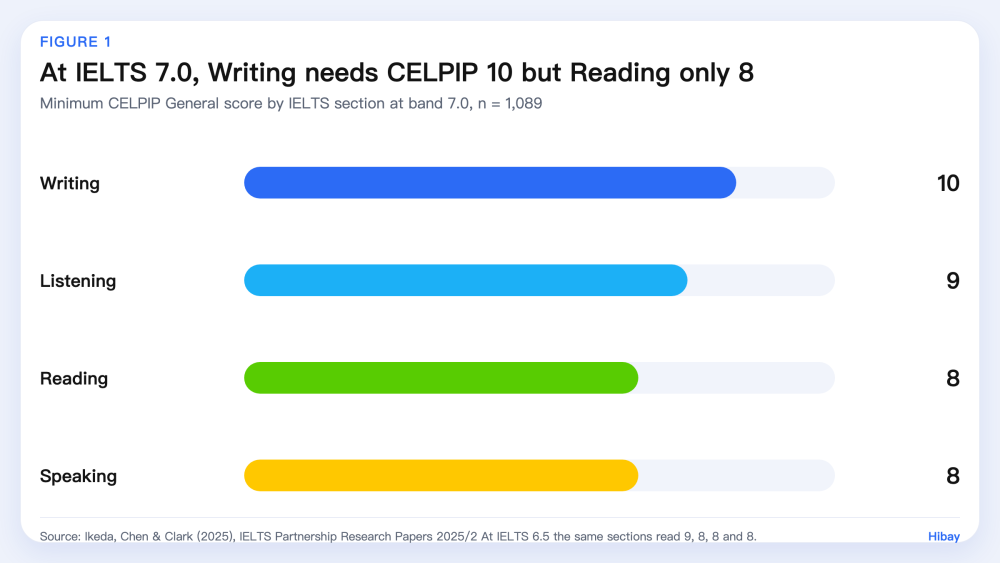
Figure 1. Minimum CELPIP General score corresponding to IELTS 7.0 in each section, n = 1,089 dual test takers. Source: Ikeda, Chen & Clark, IELTS Partnership Research Papers 2025/2.
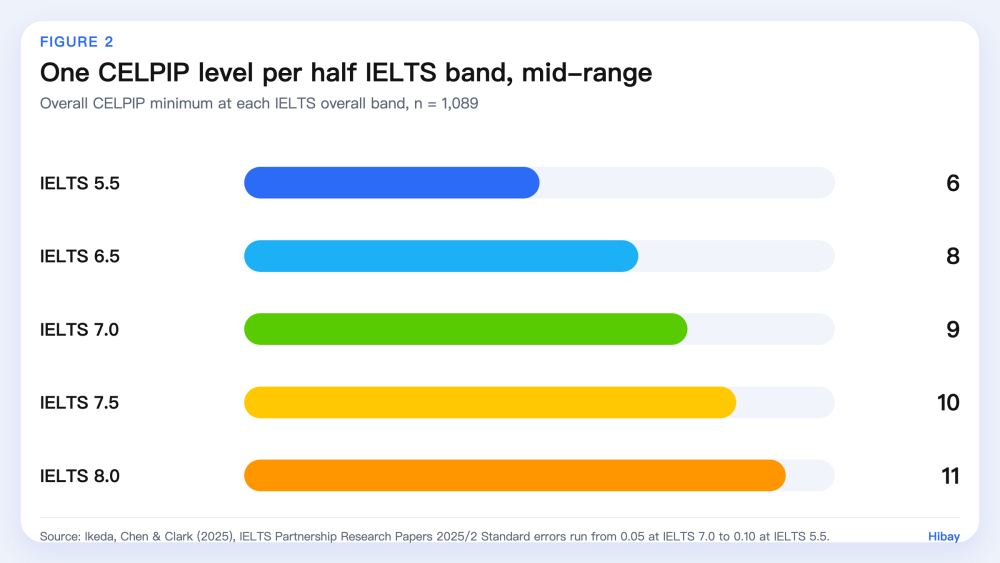
Figure 2. Overall concordance across the middle of the range, with standard errors from 0.05 to 0.10. Source: Ikeda, Chen & Clark, IELTS Partnership Research Papers 2025/2.
Limitations
Four limits apply. The sample is small at the extremes and the study publishes standard errors precisely because of that: the Writing 8.5 conversion rests on 2 candidates, and the overall 9.0 row on 1, so those rows should not be used for decisions. The observed range was restricted: the authors note that including candidates below IELTS 3.5 was not practical, and that IELTS Speaking and overall scores covered a narrower range than the other measures. The population is immigration-focused, 98.4 percent of the sample, so the tables describe people applying to move to Canada rather than academic test takers. And the two tests measure related but not identical constructs, so a concordance is an estimate of comparable standing, not evidence that the two scores mean the same thing.
What this means for learners
The section column is the operational part of this table. A candidate who needs IELTS 7.0 in Writing for a Canadian application is, on these data, being asked for something that sits at CELPIP 10 in Writing but only CELPIP 8 in Reading. The two tests do not place the same relative demand on the same skill, which means a weak section should drive the choice of test rather than the overall band.
The second consequence is about preparation, not conversion. Because 71.1 percent of candidates prepared four weeks or less for CELPIP and 63.8 percent for IELTS, and because familiarity with CELPIP was markedly lower, part of the section-level divergence may reflect test familiarity rather than ability. Candidates switching tests should budget for the format as well as the language.
Third, use the mid-scale rows and treat the tails as indicative. The overall 7.0 to 9 conversion has 266 candidates and a 0.05 standard error; Writing at 8.5 has 2 candidates and 0.50. Those are not equally usable numbers, and requirements built on the second one are built on very little.
Frequently Asked Questions
What is IELTS 7.0 in CELPIP?
At the overall level, IELTS 7.0 corresponds to a minimum CELPIP score of 9, based on 266 candidates in the 2025 IELTS-CELPIP concordance study.
Does IELTS 7.0 equal CELPIP 9 in every section?
No. At IELTS 7.0 the minimum CELPIP equivalent is 8 in Reading and Speaking, 9 in Listening and 10 in Writing.
How large was the study?
1,089 candidates took both CELPIP General and IELTS General Training within a 90-day window, 98.4 percent of them for immigration purposes.
How to cite
Hibay Product Team. (2026, November 9). IELTS 7.0 Equals CELPIP 9, Except in Writing. Hibay. https://www.hibay.ai/en/news/ielts-celpip-general-concordance-2025
References
- Ikeda, N., Chen, M., & Clark, T. (2025). A concordance study of CELPIP General and IELTS General Training. IELTS Partnership Research Papers 2025/2. https://ielts.org/cdn/ielts-research-reports/celpip-and-ielts-concordance-report-ikeda-et-al-2025.pdf. Accessed 2026-11-09.