
EF EPI 2025: 234 Points, 123 Places, 13 Ties
The EF English Proficiency Index 2025 ranks 123 countries and regions from 624 to 390, a span of 234 points, but the average step between neighbouring ranks is 1.92 points and 13 pairs of countries share a score.

On this page
The EF English Proficiency Index 2025 ranks 123 countries and regions on a 100-800 scale. The top score is the Netherlands at 624 and the bottom is Cambodia at 390, a range of 234 points, and the median country sits at 506. Yet the ranking is far denser than that range suggests: across 122 steps between neighbouring ranks the average move is 1.92 points, 95 steps are 2 points or less, and 13 pairs of countries are tied on identical scores. The index is built from 2.2 million EF SET results collected in 2024, based on a self-selected test population rather than a sampled one, and the median country sits inside the moderate band rather than near the top of the 100-800 scale.
Key findings
- The EF EPI 2025 ranks 123 countries and regions from the Netherlands at 624 to Cambodia at 390, a span of 234 points.
- The median of the 123 scores is 506, and the mean is 505.1, so half the ranking sits within 100 points of the middle.
- Across 122 steps between neighbours the average gap is 1.92 points, 95 steps are 2 points or less, and 71 are 1 point or less.
- Thirteen pairs of countries share a score, covering 26 of the 123 places, and the 123 places therefore resolve into 110 distinct ranks.
- The top 10 scores span 18 points and the top 15 span 24, while the largest single step in the ranking is 11 points.
Background
The EF EPI scores countries on a 100-800 scale and groups the scores into five bands: very high from 600, high from 550 to 599, moderate from 500 to 549, low from 450 to 499, and very low below 450 [1]. The 2025 edition is built on 2.2 million EF SET results from 2024 and covers 123 countries and regions [2].
Almost all coverage of the index quotes the top of the table and the bottom. That framing implies a ladder of 123 evenly spaced rungs, and the published table is not that: it is a dense cluster of scores in which a one-point change can move a country several places, and where 13 ties are resolved by alphabetical order rather than by measurement.
Data and method
The source is the EF EPI 2025 report's ranking of countries and regions, which lists each place with its rank and its overall score [2]. The window is the 2024 test year, the edition published in 2025, and the sample is the full published ranking of 123 places; n refers to places, not test takers, and the per-country test-taker counts are not published. Ranks and scores are taken as printed. The step statistics are computed from the sorted scores: 122 steps for 123 places, step size as the difference between consecutive scores, ties counted as identical published scores, and the median and mean computed over the 123 published scores. All values are aggregated at country level, and no individual test record is used.
Results
The ends of the ranking are far apart. The Netherlands at 624, Croatia at 617 and Austria at 616 sit 234 points above Cambodia at 390, with Libya at 395 and Côte d'Ivoire at 393 just above it. That spread is what makes the index readable as a description of national English proficiency: a 234-point range on a 700-point scale separates the strongest and weakest systems.
The middle is where the ranking stops behaving like a ladder. The median of the 123 scores is 506 and the mean 505.1, both in the moderate band, and the steps around them are small. Ninety-five of the 122 adjacent steps are 2 points or less, and 71 are 1 point or less, which means that for most of the table a single point of score decides several places. The largest step in the whole ranking is 11 points, between Switzerland at 564 and Honduras at 553.
Ties are the visible symptom. Thirteen pairs share a score: 602 at rank 13 for South Africa and Zimbabwe, 540 at rank 36 for Ghana and Spain, 531 for Moldova and Paraguay, 521 for Bolivia and Russia, 515 for Armenia and Cuba, 492 for Iran and Morocco, 465 for Malawi and Mozambique, 456 for Syria and Turkmenistan, 446 for Afghanistan and Japan, 444 for Haiti and Myanmar, 417 for Kazakhstan and Rwanda, 406 for Benin and Iraq, and 402 for Thailand and Yemen. Those 26 places occupy 13 ranks, so the 123 places resolve into 110 distinct ranks.
At the top the scale is compressed rather than stretched. The top 10 scores run from 624 to 606, 18 points, and the top 15 from 624 to 600, 24 points, against 234 points for the full table. Seventeen of the 24 points that separate rank 1 from rank 15 are consumed in the first six places, where the Netherlands, Croatia, Austria, Germany, Norway and Portugal sit within 12 points of each other.
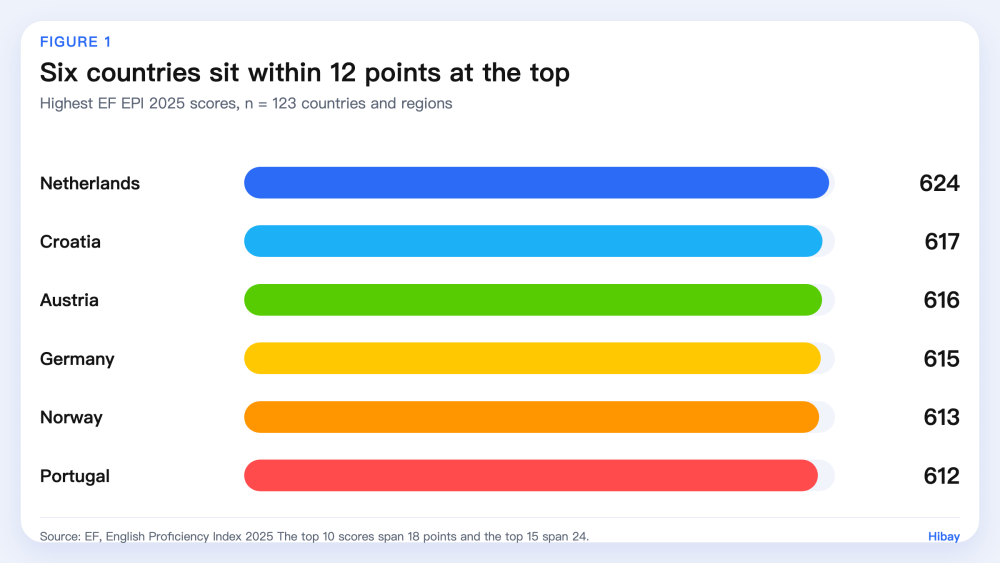
Figure 1. The six highest-scoring places in the EF EPI 2025, which span 12 points, n = 123 places ranked. Source: EF, English Proficiency Index 2025.
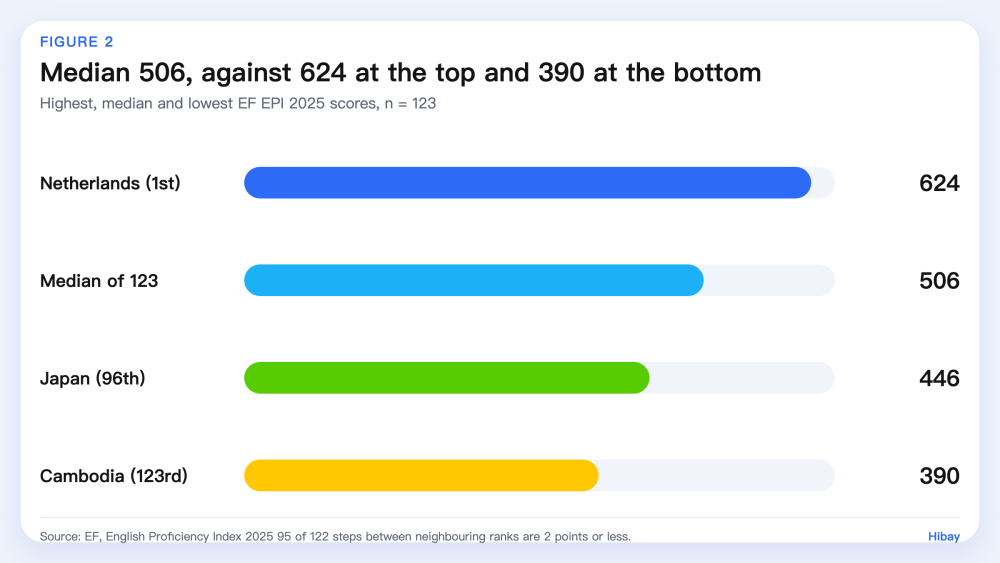
Figure 2. Highest score, median and lowest score in the EF EPI 2025 ranking, n = 123 countries and regions. Source: EF, English Proficiency Index 2025.
Limitations
Four limits apply. The ranking is built from a self-selected population: EF SET is free and open, so the people behind each country score chose to take an online test, and the report treats representativeness as a limitation of the index. Test-taker counts per country are not published, so a country score cannot be weighted by how many people produced it. Rank order below the top is fragile by construction: with 95 of 122 steps at 2 points or less, a small change in a country's score can move it several places, and a tie is broken by convention rather than by measurement. Finally, the 123 places do not include every country and region, and the report excludes those with too few test takers to report a stable score.
What this means for learners
A rank is a position, not a distance. Ghana at 540 and Spain at 540 are ranked 36th together, and a learner reading "36th in the world" as a statement about the quality of English teaching in either country is reading a tie in a dense table, not a measurement of either system.
The more useful number from this ranking is the step size. Because the average move between neighbours is 1.92 points and the median country sits at 506, a country's band is a better guide than its rank: the band is defined by a threshold the report publishes, while the rank depends on how many other countries happen to sit within a point or two. A learner comparing two countries should compare their bands, and should treat a gap of a few points as no gap at all.
The last consequence is about the top of the table. The 24 points between rank 1 and rank 15 are smaller than the 234-point span, which means the leading countries are close together and their order is the least stable part of the ranking in proportional terms. For a learner choosing where to study or work, the top 15 are better read as one group than as fifteen positions.
Frequently Asked Questions
How many countries are in the EF EPI 2025?
The ranking covers 123 countries and regions, scored on a 100-800 scale from the Netherlands at 624 to Cambodia at 390.
Why do some countries share a rank in the EF EPI?
Because 13 pairs of countries have identical published scores, including South Africa and Zimbabwe at 602 and Ghana and Spain at 540, so the 123 places resolve into 110 distinct ranks.
What is the median score in the EF EPI 2025?
The median of the 123 published scores is 506, and the mean is 505.1, both inside the moderate proficiency band.
How to cite
Hibay Product Team. (2026, November 9). EF EPI 2025: 234 Points, 123 Places, 13 Ties. Hibay. https://www.hibay.ai/en/news/ef-epi-2025-rank-density
References
- EF. EF EPI proficiency bands and score scale. https://www.ef.com/wwen/epi/. Accessed 2026-11-09.
- EF. EF English Proficiency Index 2025 (report PDF). https://ef.com/assetscdn/WIBIwq6RdJvcD9bc8RMd/cefcom-epi-site/reports/2025/ef-epi-2025-english.pdf. Accessed 2026-11-09.