
Joining a Group Conversation in English: Getting In, Staying In, Getting Out
Group talk moves faster than a pair: people overlap, latch on and answer in half-sentences. This guide answers how to make friends in English from inside a group, with six entry lines, the reaction each one gets, and two rehearsal scenes.


On this page
Joining three people who are already talking is a different skill from holding a one-to-one conversation. How do I join a group of people who are already talking in English? This guide answers that with openings that work, lines that hold a turn, and a polite way out.
Why a group is harder than a pair
Turn-taking research describes talk as an organised sequence: one person speaks at a time, and the space between turns is kept short (Sacks, Schegloff and Jefferson, per Wikipedia's turn-taking article, accessed 2 November 2026). An ended turn is often reassigned by self-selection: whoever speaks first claims it.
In a group three people compete for the same slot, and a silence is not addressed to the newcomer.
- Overlap: people start before the previous speaker has finished, usually as cooperation.
- Latching: the next speaker starts on the last syllable, with no pause.
- Back-channelling:
yeahormm-hmfrom a listener signals attention, not a claim on the turn (Yngve's term; see Wikipedia on backchannels, accessed 2 November 2026).
Finding the gap: what to listen for before you speak
Stop listening for silence and start listening for handover points.
- A finished turn: the pitch falls and a real stop follows.
- An answered question: a small space opens before the group moves on.
- A topic change:
Anyway, how was the trip?invites a question from anyone. - After laughter: the topic is closed and the group's guard is down.
Take the listening position as well: stand close enough to be seen, face the speaker, and give small back-channels. Your first sentence then lands as one of the group.
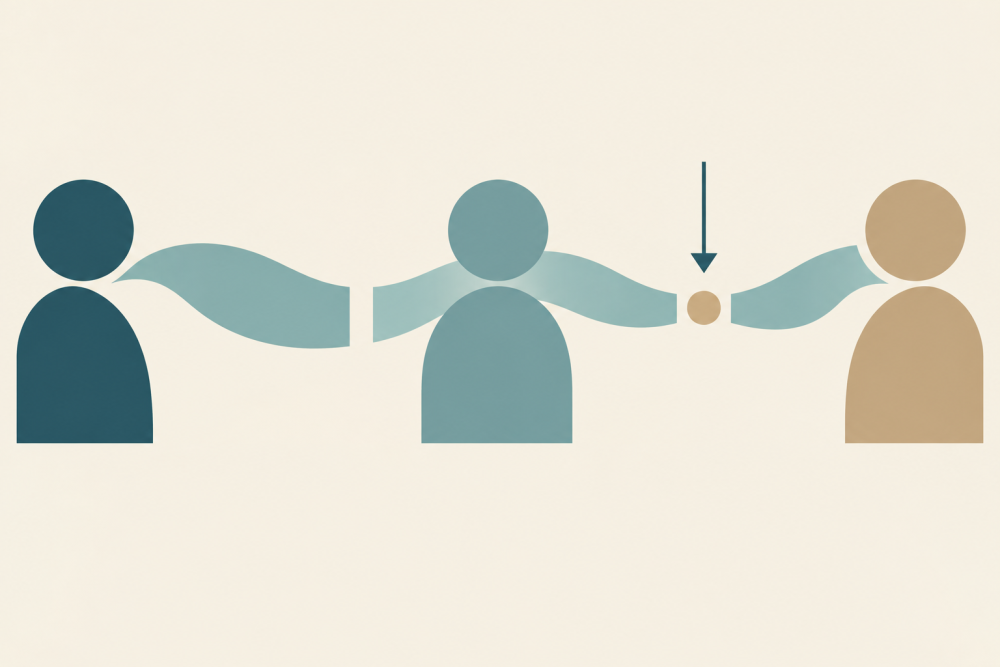
Six entry lines and the reaction each one gets
| Opening you say | The reply you usually get | Your next line |
|---|---|---|
Sorry, I couldn't help overhearing — is this the Saturday run? | Yeah, three of us go weekly. | How long is the route? |
Mind if I join? | Sure, go ahead. | Thanks. I'm new here. |
That sounds like the noodle place near my flat. | Oh, you've been? | Twice. I'd queue again. |
Wait — is that the one near the river? | No, the other one. | Ah, the one by the station. |
Hi, I'm Anna. I don't know anyone here yet. | Hi Anna, I'm Tom. This is Priya. | Hi Priya. Have you been before? |
Can I ask how you two know each other? | We used to work together. | Same building? |
Do you come here often? | Mm, sometimes. | I found it last month. |
Sorry, what are you talking about? | Nothing, just work stuff. | Fair enough — I'll get back to it. |
The pattern is in the middle column: the openings that work attach to something the group has already said, or ask for almost nothing.
Holding your place once you are in
Getting in is the smaller half.
- Say something before you ask something: a question hands the floor back.
- Signpost that you have more:
So, the thing is... - Never stop mid-sentence to hunt for a word; say
How do I put this..., because a silent pause looks like a finished turn. - If you are cut off, take the turn back once:
Sorry, I was just going to say...
Asking a question back to keep the turn
If every turn of yours is a question, you become the interviewer and the group closes around you.
- Ask one person, not the group:
Priya, was that the same place you mentioned last year? - Attach it to their detail:
You said it was a Tuesday place — is it quieter then?is answerable;So what do you all do?is not. - Keep back-channels going:
Right.Mm-hm.They keep you inside without taking the turn.
Leaving without offence
One reason, one warm line, no request.
- Give a reason with a time in it:
I'm going to head off — early start tomorrow. - Do not leave mid-turn or slip away; wait for a turn to end, then move.
- Leave a hook:
I'm at the Thursday run most weeks — if you're ever there, say hi. - If one person is still talking, close that exchange instead:
Anyway, I'll let you get back to the others.
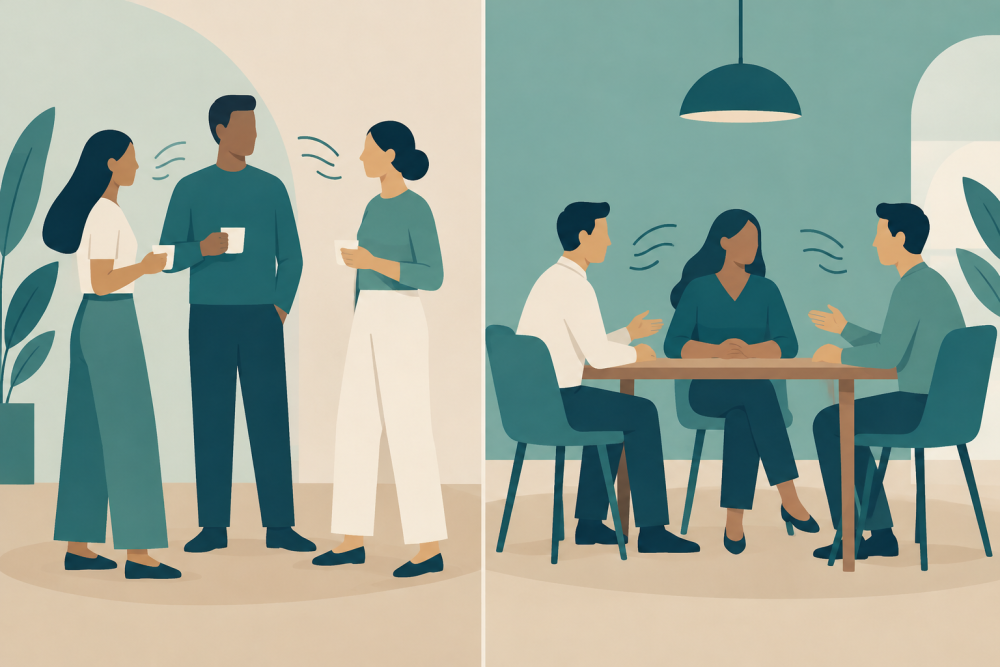
Two rehearsal scenes: the meetup and the work lunch
Rehearse both aloud with one reader per role, and change a reply on the second run.
Scene one, the meetup. Role cards: Tom organises the run; Priya joined a year ago and answers briefly; you are new.
- Tom:
We had fourteen at the last one. - Priya:
Nobody wants to run in the rain, so we all turn up when it's dry. - You:
Sorry, I couldn't help overhearing — is this the Saturday run? - Tom:
It is. Are you thinking of coming? - You:
I am. I've been running alone for months. - Priya:
That's why I started. The first one is the worst. - You:
Good to know. What time do you set off?
Scene two, the work lunch. Role cards: Marco raises the release; Dana joined three months ago and agrees; you were invited by a colleague who just left.
- Marco:
The whole release slipped by a week because one service wasn't ready. - Dana:
Again. That's the third time this quarter. - You:
Sorry, is this the release that was meant to go out on Friday? - Marco:
The same one. Do you work on that side of it? - You:
Only on the reporting part, which is why I noticed. - Dana:
That makes three of us, then. - You:
If it helps, I can send you the dates. Anyway, I'll let you two get back to lunch.
How to make friends in English from a group conversation instead of a pair
Groups are where the question of how to make friends in english actually starts: a group gives you repeated, low-stakes contact with the same people. You do not have to be interesting; you have to be present, twice, and slightly memorable.
- Come back — the same meetup, the same lunch rotation. Recognition runs on repetition, not charm.
- Give yourself one marker: the noodle place you recommend, the Thursday run.
- Take the small opening:
Are you coming next week?is the group offering you a one-to-one.
Frequently asked questions
How do I join a conversation when three people are already talking?
Listen for a turn that has just ended, then add a sentence about their topic rather than a question.
If the group is talking fast, join at a slower moment — after an answered question, after laughter, or after a subject change. Use an opening that costs nothing, such as Mind if I join?, then add one sentence of your own.
How do I leave a group conversation politely in English?
Give one short reason for going, one warm line about the conversation, and no request.
The reason should belong to your day: I'm going to head off — early start tomorrow. If you want to see them again, leave a hook: I'm at the Thursday run most weeks — if you're ever there, say hi.