
How to Make Friends in English: Start a Conversation and Stay in Touch
Learn how to make friends in English with clear openings, related follow-ups, respectful invitations, and original phrases you can rehearse.


On this page
You may know how to introduce yourself and still feel unsure about what comes next. A friendly first exchange needs more than a list of questions: you need to react to the other person's answer, share something about yourself, and notice whether they want to keep talking.
If you are wondering how to make friends in English, start with a small conversation in a situation you already share. This guide gives you phrases to rehearse and ways to move from an introduction to a possible next meeting. The examples are original practice material, not a promise that a particular phrase will create a friendship.
Start with Something You Both Share
Use the setting to make your opening easy to answer. At a class, you could say Have you taken a class here before? At a community event, try What brought you to this event? A question about the shared situation gives the other person a clear place to start without asking for private information.
Listen to the answer before choosing your next line. If someone mentions that a friend recommended the class, you can ask about that experience. If they seem busy or give a short answer without continuing, leave room to end the exchange. A friendly opening is an invitation to talk, not a request they have to accept.
You do not have to seek out only native speakers. English can be the language you share with another learner, a classmate, a neighbor, or a colleague. Focus on a setting or interest you have in common rather than guessing someone's background from their appearance or accent.
Add a Detail of Your Own
After a question, contribute something the other person can respond to. If they say this is their first class, you might reply, It's my first time too. I'm still figuring out where everything is. You have acknowledged their answer and offered a small detail about yourself.
Keep that detail connected to the conversation. Someone who mentions hiking does not need your whole travel history. A response such as I usually walk in the park near my apartment. I'd like to try a longer trail. gives them a possible topic without turning the exchange into a speech.
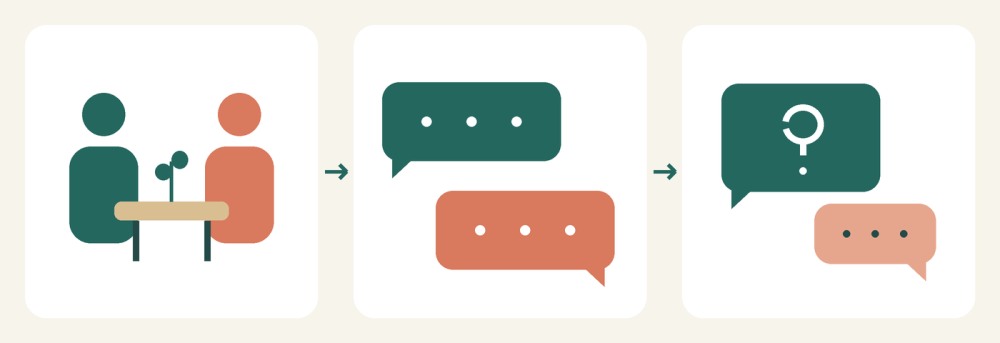
Think of the pattern as notice, share, and follow up. It is a practice aid, not a rule for every turn. Some conversations need a question; others continue because one person adds a related observation. Let the other person take a turn before deciding what to say next.
Follow Up on the Answer You Actually Hear
Use a detail from the other person's answer to choose your follow-up. If they mention a weekend cooking class, you could ask, What did you enjoy making? That stays with their experience. Moving immediately to an unrelated prepared question can make the exchange feel like an interview.
You can also respond without another question: I've never tried making that. It sounds interesting. A comment gives the other person room to add more, change the subject, or ask you something. Avoid reading a pause as an instruction to ask several questions in a row.
Early conversations do not need personal questions about income, relationships, immigration, or other private matters. When you are unsure, stay with the activity, a shared interest, or something the person has already chosen to mention. Their comfort matters more than using every phrase you practiced.
Repair a Missed Word and Keep Your Meaning Clear
Ask about the part you missed instead of pretending to understand. Try Sorry, what was the name of that place? or Could you say the last part again? A specific request tells the other person what would help. You can then check your understanding: So you went there last weekend?
If you cannot find a word, describe the idea with language you know. For example, It's a place where people borrow books. can communicate the meaning even if you temporarily forget the word library. You can learn the missing word afterward; the immediate task is to make your message understandable.
For a brief pause, Let me think for a second. is enough. You do not need to apologize for every sentence. If the other person still seems confused, try a shorter version of your meaning rather than repeating the same long sentence more loudly.
Suggest a Small Next Step and Leave Room for a No
When the exchange feels mutual, suggest something connected to what you discussed. After a class, you could say, Would you like to get a coffee after the next class? A specific, small invitation gives the person something clear to consider.
Make a refusal easy to accept. If they are unavailable or do not seem interested, you can say, No problem. It was nice talking with you. You do not need a reason from them, and a pleasant first conversation does not oblige either person to exchange contact details or meet again.
When an invitation is accepted, agree on a simple next step using a contact method you both choose. In a later message, remind them of the shared context: Hi, it's Alex from the art class. Are you still interested in coffee after Saturday's session? Use your own name and real plans when you adapt the example.
Rehearse a Short Scene Before Trying It with a Person
Choose one setting, one opening, and one possible follow-up. Say them aloud, then change the answer so you have to respond differently. This gives you a concrete task to practice without trying to memorize a complete conversation.
HiBay describes its app as an AI English speaking coach for everyday conversations. If you use an available practice mode for this topic, rehearse a short social exchange and check whether your meaning is clear. An AI response is practice material; it cannot tell you whether a real person wants a friendship or will react in the same way.
After a real conversation, note one moment that was difficult and rehearse that moment. You might work on asking for clarification or making a clear invitation. Use that specific observation to choose your next practice task instead of judging the whole exchange by how much English you spoke.
Frequently Asked Questions
How can I practice speaking English so I can make friends with native speakers?
Rehearse an opening, a related response, and a polite ending for a situation you expect to encounter. Then try a small exchange with someone who is open to talking. You can practice with native speakers or other English learners; shared interests and mutual willingness matter alongside language practice.
How can I keep an English conversation going without asking too many questions?
Respond to a detail in the answer and share something relevant about yourself. You can follow with one question when it fits, or make a comment and let the other person continue. You do not need to fill every pause, and it is fine to end the exchange when the other person seems ready to leave.
How can I ask someone to meet again without putting pressure on them?
Suggest a small activity connected to your conversation and make it easy to decline. If they accept, agree on a simple next step. If they decline or do not respond, respect that choice rather than asking repeatedly. A friendly conversation can be worthwhile even when it does not lead to another meeting.
Try One Small Exchange
For your next class, event, or shared activity, prepare one opening and one detail you could share about yourself. Leave the rest of the exchange open so you can listen and respond to what the other person actually says.
If you want to rehearse first, use an appropriate HiBay practice activity to work on that specific moment. Then take the same clear, respectful approach into a real conversation, where both people get to choose whether to continue.