
Measuring Fluency: Words per Minute, Pauses and Self-Corrections Over Six Weeks
Three counts from one two-minute recording a week, words per minute, pauses you can hear and self-corrections, plus a six-week tracker that changes one variable at a time, for learners who want to speak English fluently free of a teacher's weekly verdict.


On this page
You can speak English fluently free of charge for a year and still have no idea whether you are improving, because "it felt easier today" mixes at least three separate things that move at different speeds. This guide takes one two-minute recording a week and pulls three numbers out of it: words per minute, the long pauses you can hear, and every time you repair your own sentence. Those numbers are not a score. They are how you tell which of the three actually changed.
The method is built from the same measures that speech researchers and speaking examiners use, cut down to something you can do by hand in about ten minutes a week, with no teacher, no software licence and no listener present. What you give up in precision you get back in repetition: six recordings across six weeks will tell you more about your own speaking than one test score ever will.
Fluency Has Three Measurable Parts, Not One Feeling
Published work on second language fluency separates the concept into layers: the efficiency of the processes behind speech (cognitive fluency), the measurable properties of the speech itself (utterance fluency), and what a listener perceives (perceived fluency) (Assessment of second language fluency, accessed 28 October 2026). At home you can only count the middle layer. The other two explain why a number is never the whole answer.
Inside that countable layer, research since the early 2000s has repeatedly found three factors rather than one general quantity: speed, breakdown and repair (same review, accessed 28 October 2026). Speed is how fast the words arrive, breakdown is where speech stops, and repair is what you do when you notice something went wrong. A feeling covers all three at once, which is why a good week and a bad week can both produce the sentence "that was better".
| Factor | What it covers | One count you can take by hand |
|---|---|---|
| Speed | how fast speech arrives | words per minute |
| Breakdown | where speech stops | number of long pauses in two minutes |
| Repair | what you do after a slip | self-corrections and restarts |
Three Counts From One Two-Minute Recording
Record the same shape of task every week: two minutes, one take, spoken into your phone rather than written down first. Then take three counts from the transcript and the playback.
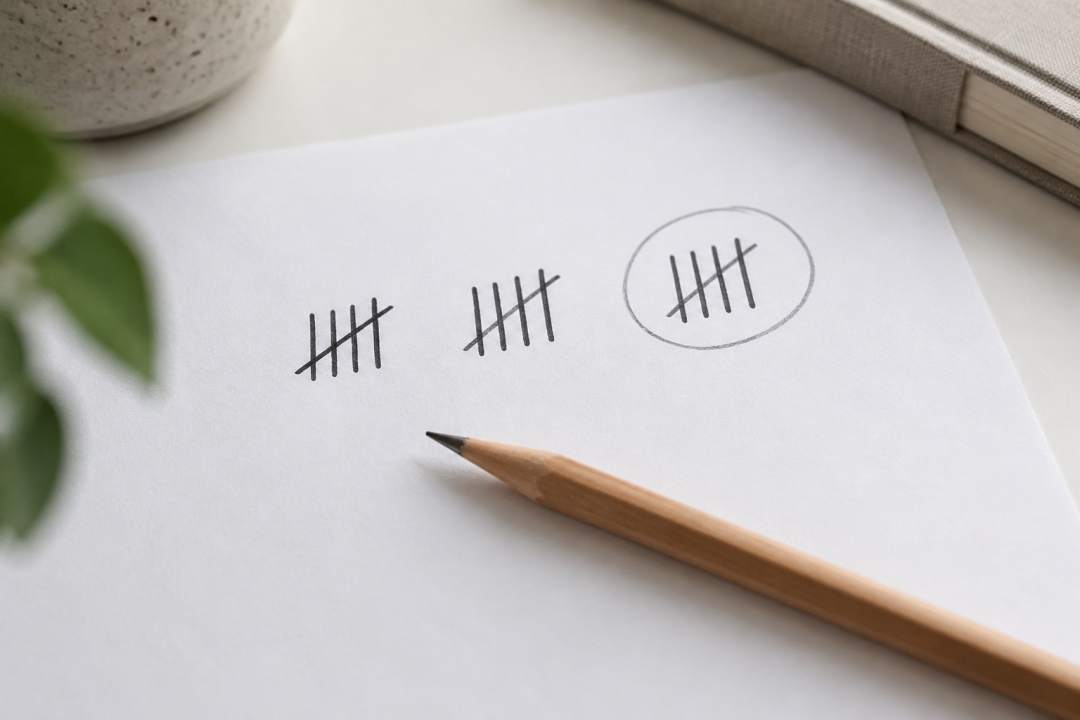
- Words per minute. Count the words in the transcript and divide by two, because the recording is exactly two minutes. Fixing the length means you never do arithmetic on duration, and the weeks stay comparable.
- Long pauses. Count the stops you can actually hear. Research measures silent pauses with software and a threshold: one study that tested thresholds from 100 milliseconds upwards concluded that a cut-off near 250 to 300 milliseconds gives the strongest link between the number of pauses and a measure of proficiency, and that setting the threshold higher than 300 milliseconds weakens the measure (Choosing a threshold for silent pauses to measure second language fluency, accessed 28 October 2026). A quarter of a second is at the edge of what a person can hear and count on playback, so a hand count is a coarser instrument. The rater study behind one major speaking test used a one-second pause threshold (Assessment of second language fluency, accessed 28 October 2026). One second is therefore a defensible hand count, provided you keep the same one second for all six weeks.
- Self-corrections. Count each time you replace a word or restart a phrase, and write down the word you abandoned. So
I went to the — I mean I walked to the stationis one repair, and the note tells you which word was missing.
| Count | What it tells you | How to take it by hand | What makes it unreliable |
|---|---|---|---|
| Words per minute | speed | words in a fixed two-minute take | a faster take full of long stops |
| Long pauses | breakdown | stops of about a second, counted on playback | counting only the ones you remember |
| Self-corrections | repair | every replaced word or restarted phrase | treating every repair as a failure |
Write all three down even in a week that felt bad. A single number moving on its own is still information: a week where self-corrections doubled while speed stayed flat usually means you started monitoring your own grammar, which is work rather than decline.
The Six-Week Tracker, With One Variable Per Week
The tracker's job is to make each week's recording comparable with the last, so that any change you see has one plausible cause. Keep the length, the task type, the planning time and the room fixed, and change exactly one practice variable per week.
| Week | What stays fixed | The one variable you change | What you record |
|---|---|---|---|
| 1 | two minutes, 30 seconds planning, familiar topic type, same room | nothing, this is the baseline | three counts |
| 2 | as in week 1 | planning time doubled to 60 seconds | three counts |
| 3 | as in week 1 | an unfamiliar topic of the same type | three counts |
| 4 | as in week 1 | short sentences only, no long clauses | three counts |
| 5 | as in week 1 | back to baseline conditions | three counts |
| 6 | as in week 1 | repeat the one change that helped most | three counts |
Week 5 matters more than it looks, because it shows whether a gain survived the return to normal conditions or was an artefact of that week's experiment. A two-year study of learners who spent a year abroad found that speed fluency developed quickly and was usually maintained, while breakdown fluency took a long time to improve and was more sensitive to attrition (Assessment of second language fluency, accessed 28 October 2026, summarising Huensch and Tracy-Ventura, 2017). Expect the same asymmetry over six weeks: your words per minute may move first while your pauses barely move at all.
Reading the Numbers: What a Faster Count Can Hide
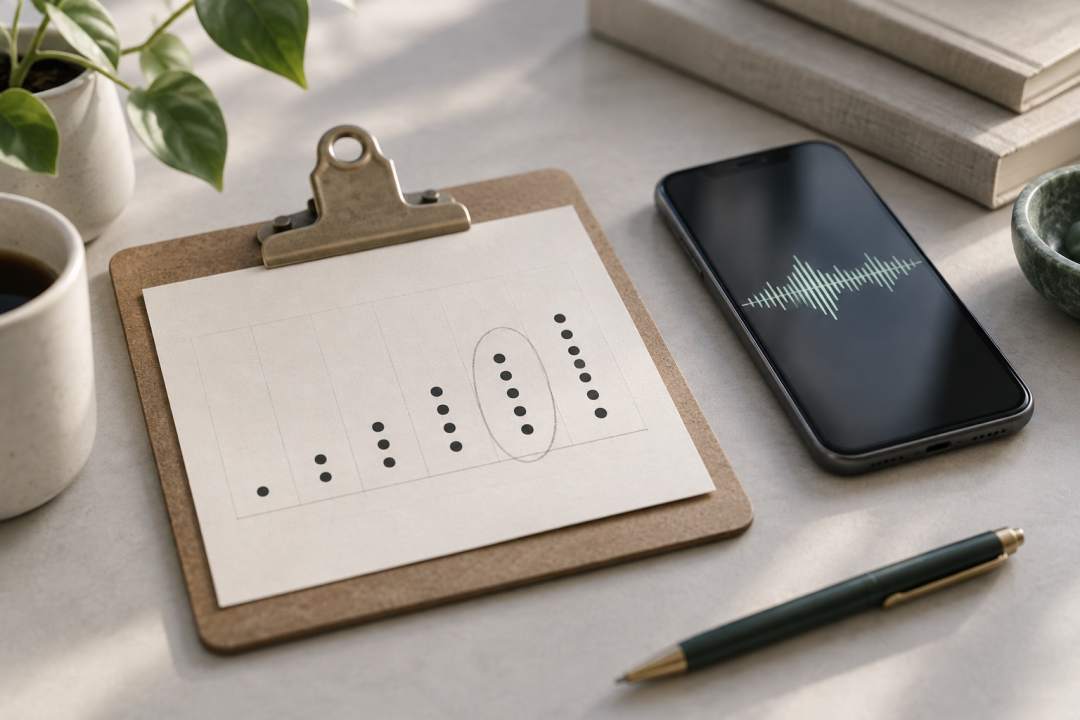
A rising words-per-minute figure has two possible sources: you are articulating faster, or you are stopping less. Those are different improvements, and the pause count is what separates them. If words per minute rises while the pause count is unchanged, your articulation got quicker. If the pause count fell, your planning got quicker. The second is usually the one that changes how you sound to another person.
Pause duration is the weaker of the two pause measures. In the threshold study above, the number of silent pauses related to a measure of proficiency, while the mean duration of the pauses did not, at any threshold tested. Counting how many times you stop is more informative than measuring how long each stop lasted.
Where you stop matters as much as how often. A study of learners at three levels found that the frequency of pauses at final clause boundaries separated low from mid level performance, pauses inside clauses separated mid from high level performance, and articulation rate separated high level from near-native performance (Assessment of second language fluency, accessed 28 October 2026). In practice: a stop between two ideas is planning, a stop in the middle of an idea is usually word-finding, and the two call for different work.
The repair count is the least diagnostic of the three for a listener. In that same study, the repair measures did not relate to listeners' fluency ratings and did not distinguish between the proficiency groups. That does not make the count useless, because it records what you noticed, and noticing is where control begins.
Here is a worked example with invented numbers, included to show the arithmetic and the reading, not a real learner's record:
| Week | Words per minute | Long pauses | Self-corrections | How to read it |
|---|---|---|---|---|
| 1, baseline | 104 | 11 | 7 | slow and choppy, stops spread through the middle of ideas |
| 3, unfamiliar topic | 92 | 15 | 9 | the topic moved the numbers, not the ability |
| 5, baseline again | 118 | 8 | 5 | a real change: fewer stops, not just faster talking |
| 6, longer planning | 121 | 6 | 4 | planning time is the variable worth keeping |
Change One Variable Per Week, Not Five
Read the counts before deciding what to practise, because the three patterns need different work. If your stops sit between ideas and the speed is low, the missing piece is planning: say the message to yourself in three sentences before you record, and keep the same task type but change the content so you are not rehearsing a script. If your stops sit inside ideas, the missing piece is retrieval: say the same message three ways in a row, using what happened, why it mattered and what I did next as your three boxes, and notice which box empties. If your repairs cluster on one structure, that is a grammar target rather than a fluency target, and no amount of speaking faster will fix it.
Change one of those at a time. Two changes in one week give you two explanations and no answer, which is exactly the trap that makes daily practice feel unmeasurable in the first place.
What a Speaking App Reports, and Where Its Score Stops Being Evidence
Automatic scoring can compute speed, pause counts and repair counts faster and more finely than you can, and test providers increasingly use automated fluency measures to predict proficiency (Assessment of second language fluency, accessed 28 October 2026). HiBay's App Store listing describes conversation practice with AI partners and real-time checks on pronunciation, grammar and vocabulary as you speak (HiBay on the App Store, listing for version 1.61.0, accessed 28 October 2026). That description is a statement about the product, not evidence about your progress, and the two should be kept apart.
The reason is the descriptor language that real speaking tests use. At IELTS band 9, any hesitation is used only to prepare the content of the next utterance and never to find words or grammar; at band 8, hesitation may occasionally be used to find words or grammar but most of it is content related; at band 7, some hesitation, repetition or self-correction may occur, often mid-sentence, and indicate problems with accessing appropriate language (IELTS Speaking band descriptors, accessed 28 October 2026). The same one-second stop can therefore be a planning stop or a word-finding stop, and no single number separates them. A score measures what the scorer can compute. Your three counts plus one human listener cover what it cannot.
Frequently Asked Questions
What words per minute should I aim for in English?
There is no universally correct figure, and published numbers are hard to compare because the tasks, the recording lengths and the pause thresholds differ from study to study (Assessment of second language fluency, accessed 28 October 2026). Your own week-1 count, taken under the conditions you can repeat, is the only baseline that is genuinely comparable to your week-6 count. Aim for fewer long pauses before you aim for a particular speed.
How can I improve my English speaking by myself if I have no one to practice with?
Split the problem in two. Measuring is solo work, and the tracker above does it. Practising retrieval is also solo work: the three-box retelling in the section on changing one variable needs no partner. What does need another person is the listener layer, and it needs far less of their time than learners assume, because two minutes of audio once a fortnight is enough for someone to tell you which words they did not catch.