
How to Speak English Fluently and Confidently: A Practice Routine
Fluency is retrieval speed, not vocabulary size. A practice routine that trains speaking under pressure instead of collecting more words.


On this page

Search for how to speak English fluently and you mostly get two things: "fluent in thirty days" promises, and long lists of words to memorize. Neither explains the gap most learners actually feel — reading a page comfortably, then freezing the moment someone asks a question.
The reason is that fluency is not how much English you know. It is how fast you can pull out what you already know while someone is waiting for an answer. That is a different skill from studying, and it improves with a different kind of practice. Here is a routine built for it.
Step 1: Stop Measuring Fluency as Accuracy
Fluency and accuracy are two separate skills, and most learners improve neither because they train them at the same time. If you stop mid-sentence to fix every small error, you never build the momentum that makes speech feel automatic — and the listener follows your hesitation more than your grammar.
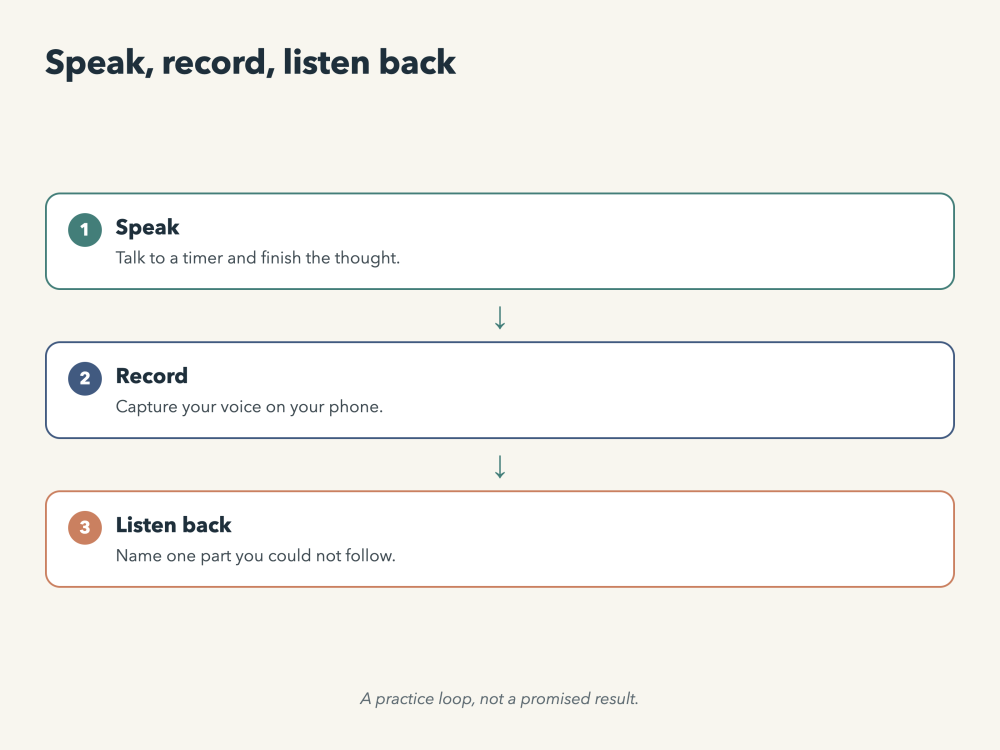
Split the two. In a fluency session, keep going and finish the thought, even with a mistake in it. Save the corrections for a review pass afterward, where you can look at them calmly instead of in the middle of a sentence.
Step 2: Speak Before You Feel Ready
Confidence does not arrive before you speak; it arrives after, and only in small amounts. Waiting to feel ready is the trap, because readiness comes from a history of speaking badly enough and surviving, not from another week of preparation.
Lower the bar until it is almost impossible to fail. The goal of one session is not to be correct — it is to finish a few thoughts out loud. You can be accurate later; you cannot be fluent without first being willing to sound unfinished.
Step 3: Practice Against a Clock, Not a Mirror
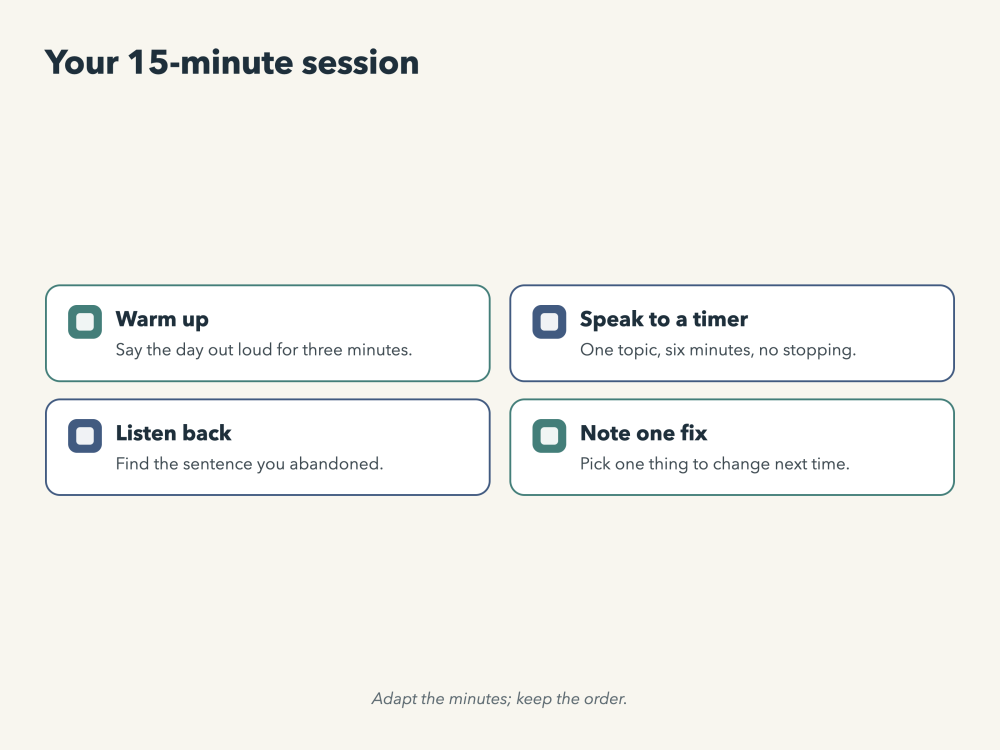
A lot of learners rehearse a sentence silently until it is polished, then say it once. That trains planning, not speaking. What trains fluency is producing speech while the clock is running and the next sentence is not ready yet.
Set a timer and answer a question in thirty seconds without stopping. If you run dry, keep the shape of the answer going with a filler phrase rather than silence. The discomfort of pushing through that gap is exactly the muscle you are building, so do not rescue yourself by switching back to your own language.
Step 4: Reuse One Sentence in Three Situations
New vocabulary rarely becomes fluent on first contact. What becomes automatic is the phrase you have had to use in several different contexts, because each new context makes it slightly less like a translation and slightly more like a reflex.
So when you learn a useful phrase, do not file it away. Take it into three situations in the same week — one about work, one about daily life, one about something you are interested in. By the third, you stop assembling it and start reaching for it.
Hibay's AI Chat, for example, runs scenario-based conversations across work, travel and everyday life, and checks your pronunciation, grammar and vocabulary in real time, with a short report after each session. Its Shadowing section takes the other route, giving sentence-level model audio and sound-level feedback on intonation and linking. The scores are practice feedback, not a certification, which is the honest way to read any automated score.
Step 5: Get Corrected on What You Repeat, Not on What You Avoid
Correction is only useful where it meets something you already do often. Fixing a rare construction you would not have used again is wasted effort; fixing the same three mistakes you make every session is not.
Keep a short list — three items, no more — of the patterns that keep coming back: a tense you avoid, a word you overuse, a sound that trips you. Practice those inside real answers, not as isolated drills, so the fix has somewhere to live when you are speaking fast.
Step 6: How Long Until It Feels Natural?
Longer than the ads suggest, and shorter than you fear. Pauses and abandoned sentences usually loosen within a few weeks of daily speaking; accuracy and range take months. Fifteen focused minutes a day, most days, will move you faster than one long session at the weekend, because fluency is a retrieval habit rather than a knowledge base.
If you are still translating in your head, that is normal at this stage, and it fades as the phrases you reuse pile up — not because you learned a rule about it.
Pick one question you could answer about your own week, and answer it out loud three times today, for thirty seconds each, without stopping. Then do the same question tomorrow with a different answer. If you are starting from zero, the gentler routine in English Speaking Practice for Beginners is a better entry point, and How to Improve English Speaking by Yourself covers the solo side of the same habit. If you want the timer, the scenarios and the corrections in one place, run a short scenario in Hibay's AI Chat and check the report afterward.
Frequently Asked Questions
How long does it take to speak English fluently?
It depends on your starting point, but with fifteen focused minutes of real speaking most days, hesitation and abandoned sentences usually soften within three to four weeks. Accuracy and vocabulary range take several months, and nobody goes straight from silent reading to easy conversation.
Can I become fluent without a practice partner?
Yes, for the mechanical part. Speaking out loud to a timer, to recordings of your own voice, or to an AI partner trains retrieval and pronunciation without anyone else present. What a partner adds is unpredictability — someone going off-script — so once you can hold a thought, borrow a real person for that part.
Is it better to study grammar or practice speaking?
Both, but not at the same time. Grammar study gives you forms to use; speaking practice makes them available under pressure. If you can only do one each day, spend it speaking and correct the recurring mistakes afterward, because grammar you never say out loud stays in the part of your memory that only works when you have time to think.
How do I stop translating in my head?
You do not stop by deciding to; you stop by reusing the same phrases until they arrive already in English. Practicing the same handful of sentence patterns across several situations, until they stop feeling assembled, is what shortens the gap between thinking and speaking.
What should I do when I freeze in the middle of a sentence?
Say something true about where you are — "I've lost the word I want" — and then describe the idea a different way, rather than stopping entirely. Buy the second you need, then continue. Freezing and going silent costs you more on fluency than a clumsy sentence ever will.