
How to Improve English Speaking by Yourself at Home
A practical solo speaking routine: record yourself, review feedback, repeat a correction and compare recordings. Includes a suggested 30-minute plan.


On this page
You can spend an evening watching English videos and still finish without saying a sentence. When you practice alone, it can also be hard to notice the same mistake appearing again.
Try building your routine around three questions: did I speak in full sentences, did I review what I said, and did I say a corrected version again? Below is a suggested 30-minute routine, four ways to review your speech and a four-week practice rotation. The timings are a starting point, not a promise of progress within a fixed period.
Why can solo practice feel unproductive?
Reading, listening and speaking can all belong in a study plan. For a speaking session, make sure some of the time is spent speaking and reviewing your own output.
| What you do alone | What to watch for | What to try |
|---|---|---|
| Read articles and watch videos | The session may end without any spoken practice | Say a short summary aloud after a section |
| Talk to yourself with no record | There is nothing to listen back to | Record a short answer and review it |
| Repeat memorized phrases | You may rely on one familiar sentence | Change the situation and express the same idea differently |
| Study grammar rules | You may understand a rule but not try it in speech | Use one pattern in your own sentences |
| Save all practice for Sunday | A long session may be hard to fit into your week | Try shorter sessions on days that work for you |
Table 1. Ways to make solo practice more active.
How can you get feedback without a practice partner?
These four approaches provide different kinds of information. None can tell you everything about how a real listener will understand you.
- Record and compare. Answer the same question on day 1 and day 30. Listen for unfinished sentences, long pauses and whether your message is clear. Familiarity with the question can affect the comparison.
- Check a transcript. Speak into a voice-to-text tool and compare the transcript with the recording. A mismatch is a reason to listen again, not proof of a pronunciation error: noise and recognition software can also cause mistakes.
- Try shadowing. Listen to a short clip with a transcript, then repeat it just behind the speaker or after each phrase. Focus on one feature, such as word stress or rhythm, rather than copying everything at once.
- Review tool feedback. If you use an AI tutor or pronunciation app, check whether it accepts spoken input and explains its suggestions. Treat generated corrections as suggestions to review, not an assessment you must accept.
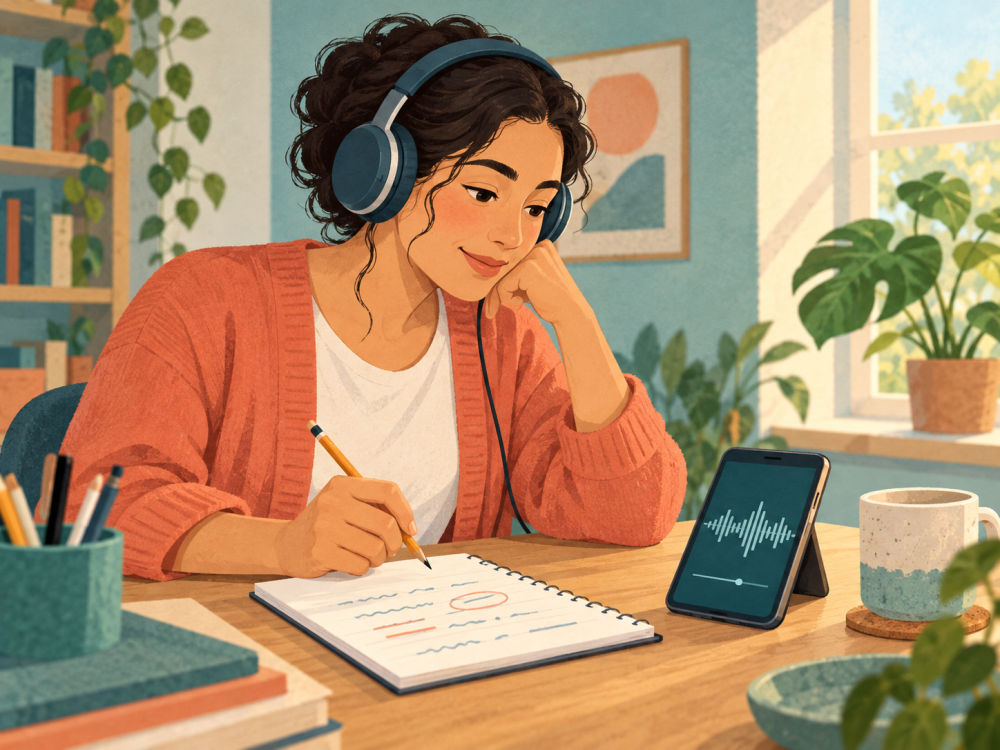
What could a 30-minute session look like?
The five steps below are one possible schedule. Change the topic and the length to suit your level. If you have ten minutes, try six minutes of speaking and four minutes of reviewing one correction.
| Minutes | Step | What you do | Self-check |
|---|---|---|---|
| 0–5 | Warm up | Repeat part of a 60-second clip with a transcript | Have you tried one feature of the speaker's delivery? |
| 5–17 | Speak | Rehearse a situation from your week; try 8 short turns or a 2-minute monologue | Have you answered something you did not script? |
| 17–24 | Review | Listen back, choose two points and say revised sentences twice | Can you explain what you changed? |
| 24–28 | Retell | Summarize what you said without reading your notes | Can you finish the main idea? |
| 28–30 | Log | Save three expressions and one point to revisit | Does the note identify a sound, word or pattern? |
Table 2. A suggested 30-minute solo routine.
What could you practice each week?
Use the rotation as a source of situations. Four weeks provides a convenient review period; the amount and pace of improvement will vary.
| Week | Situations | Focus | End-of-week check |
|---|---|---|---|
| 1 | Café, shop, asking for directions | Complete short sentences | Record a one-minute self-introduction |
| 2 | Appointments, phone calls, delivery problems | Word endings and clear key words | Describe a past problem in one minute |
| 3 | Work updates, small talk, explaining your job | Word stress | Answer "What do you do?" in three sentences |
| 4 | Complaints, returns, disagreeing politely | Clear connections between ideas | Repeat the day-1 question and compare |
Table 3. A four-week practice rotation.
For a work situation, use the examples in English phrases for meetings.
How can you check whether practice is helping?
Keep a few recordings made under similar conditions. Use the same short question for one comparison and a new question for another, so you also check what you can say without rehearsal.
- Long pauses: choose a consistent marker, such as pauses over two seconds, and count them in a one-minute answer. A lower count can be useful, but also listen for clear meaning.
- Unfinished sentences: note where you stopped before completing an idea.
- Repeated attempts: listen to words or phrases you had to restart. Check the recording before relying on a transcript.
- New expressions: notice whether you used an expression you had practiced in a different situation.
What does solo practice leave out?
A recording cannot reproduce every interruption, joke or unexpected follow-up from another person. It may also be hard to judge how formal or direct your wording sounds to someone else.
When you can, add a conversation with a colleague, a language partner or a tutor. Use solo practice to prepare a situation you want to try with them, then ask about one specific point.
FAQ
How can I practice if I have no one to speak English with?
Record a short answer, review the recording or available feedback, and say one revised sentence aloud. You can use a transcript as an aid, but check it against the audio.
What is a useful way to practice speaking at home?
Try a short loop: warm up, speak about a real situation, review one or two points, then retell the main idea. Adapt the suggested schedule instead of treating every timing as a requirement.
How long does it take to see progress?
There is no fixed timetable. Keep comparable recordings and check a few specific features over several weeks rather than assuming a plan guarantees fluency by a certain date.
Is home practice better than a class?
They provide different opportunities. Home practice gives you time to repeat an answer; a class or conversation gives you feedback and questions from another person. Choose a combination that fits your needs and access.
Can I practice at home without paying for an app?
If you already have a recording device, you can record and review yourself without a subscription. You can also repeat audio you are allowed to use. Check access conditions before relying on any service's free offering.
Should I study grammar while practicing speaking alone?
You can choose one relevant pattern, check an explanation and use it in your own spoken sentences. Review whether the sentences express what you mean, rather than only rereading the rule.
How can I rely less on translating every sentence in my head?
Rehearse a complete situation and a few reusable openings. Try a short answer, a reason and a detail. If you need to look up a phrase, return to the situation and use it in a sentence you understand.
Try one practice loop today
Record a one-minute answer to "What do you do?" and save it. Try the suggested routine, then choose a later date to compare your recordings. Keep one clear note about what you want to practice next.