
How Long Does It Take to Improve Spoken English? A 12-Week Plan by Starting Level
Published hour counts measure instruction, not your speaking minutes. Turn a three-month deadline into weekly speaking minutes, one error target and a twelve-week plan: the practical answer to the best way to learn English speaking.


On this page
You practise every day: the habit is in place, the recordings are on your phone, and you still cannot tell whether any of it works. When a three-month deadline arrives, the honest answer is a shrug.
The usable question is not how long fluency takes but how many weeks until a change you can hear. The best way to learn English speaking is not a product you buy; it is a rate you can measure.
Decide what "improving" means before you time it
Four things improve at four speeds.
- Accuracy: the same sentence comes out right twice in a row.
- Fluency: fewer silent gaps, not faster talking.
- Range: a second way to say it when the first word does not come.
- Pronunciation: the listener catches the word at the first attempt.
Choose one before you choose a deadline. Last week I could not explain my day at work without stopping twice. This week I said it once, without stopping. That is checkable; "my English is getting better" is not.
What published hour counts actually measure
The Foreign Service Institute, part of the United States Department of State, publishes average timelines for reaching S-3/R-3 professional proficiency: 600-750 class hours over 24-30 weeks for its easiest languages, 900 for German, 2200 for the hardest. Cambridge English publishes guided learning hours instead, cumulative from beginner: 350-400 hours to B1, 500-600 to B2, 700-800 to C1.
| Published figure | What the clock counts | What it leaves out |
|---|---|---|
| 600-750 class hours (FSI) | Timetabled classroom instruction | All of your solo practice |
| 350-400 guided hours (Cambridge, zero to B1) | Lessons plus set homework | Talking with nobody guiding it |
Both count instruction, not speech. The FSI calls its timelines averages that vary with natural ability, earlier languages and time in class; Cambridge calls its table a guideline and defines guided hours as classroom or programme learning. Neither counts your speaking minutes: a year inside those totals can still hold barely forty consecutive minutes of speech.
The two multipliers that decide your date
The first is speaking minutes per week: timed minutes with your mouth open in English. Reading, listening and subtitled series score zero, because a busy week otherwise looks like practice. Thirty-five minutes a week over twelve weeks is seven hours of talking; ninety is eighteen.
The second is whether the same error is corrected twice. The first correction is information; the second is evidence that the fix is not automatic yet, which is a scheduling problem rather than a character flaw. A meta-analysis of 33 studies of corrective feedback found a medium overall effect that held over time: feedback works; what fails is the same correction in the third week with no drill behind it.
Convert the deadline into weekly speaking minutes plus one error target; this is a working rule, not a published measurement.
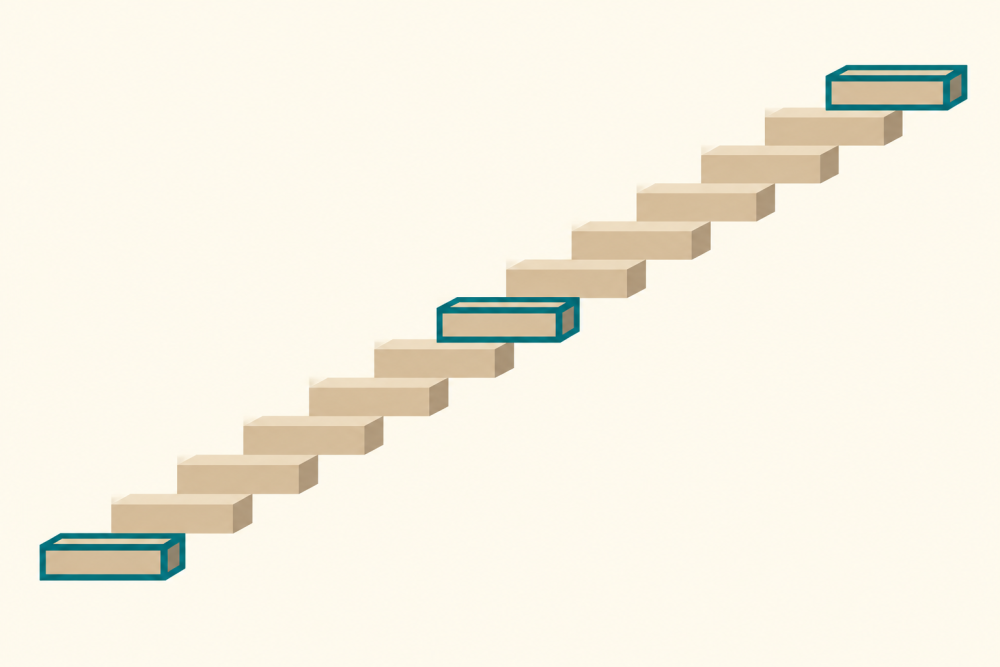
Weeks 1 to 4: minutes first
One job: raise weekly speaking minutes until the habit survives a bad day; if you already hold conversations, use two-minute turns instead of three sentences.
- Ten minutes a day, five days a week, out loud and recorded.
- Three patterns from your own week:
I spent the morning checking the numbers.,We had to push the deadline to Friday. - Rerun each with one change, tense or person or negative:
I have not finished it yet. - One self-correction rule: never restart the sentence; say the fix once and continue.
...he go, he goes to the office every day.
When nothing comes, repeat yesterday's three sentences; hunting for a topic is not speaking time.
Weeks 5 to 8: add range
- Two-minute monologues daily, one topic from your own day.
- Connectors until they arrive unasked:
First of all,on the other hand. - Paraphrase instead of the missing word:
It is the machine you dry your hair with — a hairdryer. - One re-recording: the same two minutes again, fixing the target on purpose.
Weeks 9 to 12: pressure practice
- Ten questions from areas you avoid, answered in twenty seconds each.
- Interruptions: answer, then hand the turn back.
How about you? Do you think that will change? - Hold-the-turn lines:
Sorry, could I finish my point?andThat is a good question. Let me think for a second. - One timed mock conversation a week: three minutes on a random topic, no restarting.
The target is three minutes, interrupted, without silence over five seconds.
The weekly self-check: one metric and one error target
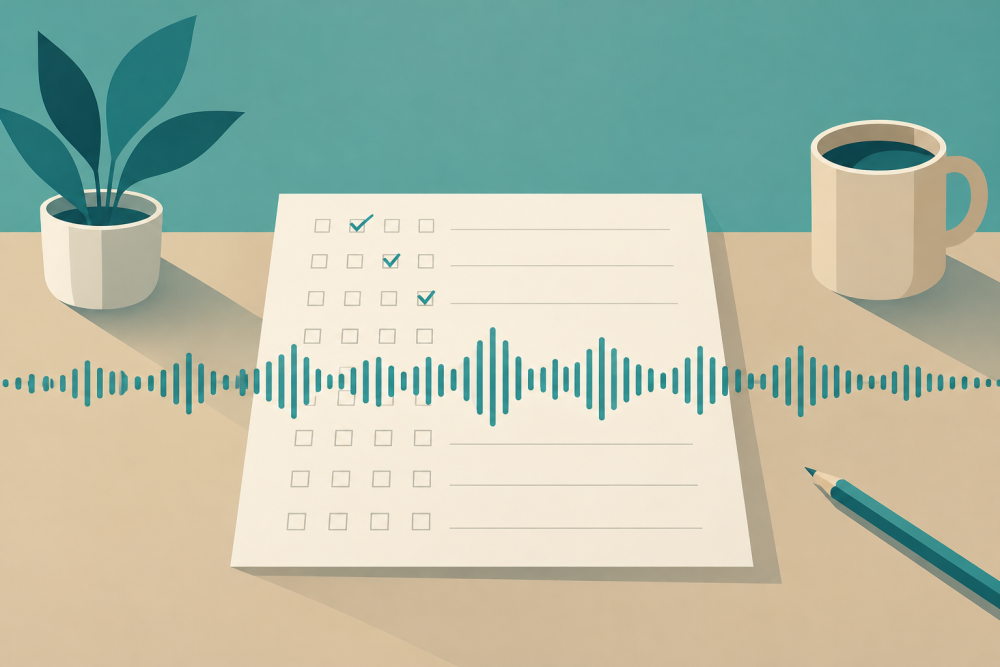
Once a week, record sixty seconds on a fixed topic and note two numbers and one sentence: speaking minutes, your metric, the error you chase.
| Week | Minutes | Metric | Error target | Fixed? |
|---|---|---|---|---|
| 3 | 52 | Pauses over three seconds: 6 | third-person -s | not yet |
| 8 | 96 | Pauses over three seconds: 2 | past tense endings | yes, twice clean |
Read the two together. Minutes up with a flat metric means the practice is comfortable: change the task before you add time. Metric up with minutes falling means you are refining something narrow: add an untouched topic. A target turns from "not yet" to "yes" after two clean recordings.
When to change the method instead of adding hours
More minutes is the standard answer to slow progress and sometimes the wrong one.
- The metric has not moved for three weeks while minutes rose.
- The same error is corrected a third time: the drill is missing, not the effort.
- One number improves as the other collapses: accuracy up, fluency down.
- Recordings get shorter, or the weekly check gets skipped.
Fixes: swap monologues for unfamiliar questions; force the error pattern with three sentences; alternate accuracy and fluency days.
Frequently asked questions
How can I improve my English speaking by myself if I have no one to practice with?
The recording is the partner; take the questions from your own day: Who did you speak to, what did you want, and what went wrong? Listen once for pauses, once for the error target, once for anything you could only say in your first language, then mark where you repaired yourself and say those sentences again slowly, then at speed. Alone, the error target can only come from your own recordings, so the weekly check is not optional.
what is the best way to learn english fast
The best way to learn English speaking is to protect three things: weekly speaking minutes, a second correction of the same error, and one number written down weekly. With three months, pick the four situations you need — introductions, work, plans, problems — and loop them rather than covering the language thinly. Then drop the two habits that eat minutes: reading about speaking, and preparing to speak. I should prepare first feels like work while the clock runs.