
Which Age Group Has the Best English? EF EPI 2025, 123 Countries
In the EF EPI 2025 data, 26-30 is the top age group in 51 of 103 country profiles, while the youngest adults sit 87 points below their 2015 level.

នៅលើទំព័រនេះ
The EF English Proficiency Index 2025 asks which adults handle English best, and for each country it profiles it names one top age group. It draws on 2.2 million EF SET test takers in 2024 across 123 countries and regions. Counting those labels, adults aged 26-30 hold the top spot in 51 of 103 profiles, the youngest band in 5 and the oldest in 3, while the 18-20 cohort sits 87 points below its 2015 level. The 103 profiles cover only the countries EF publishes in detail, and the sample is self-selected.
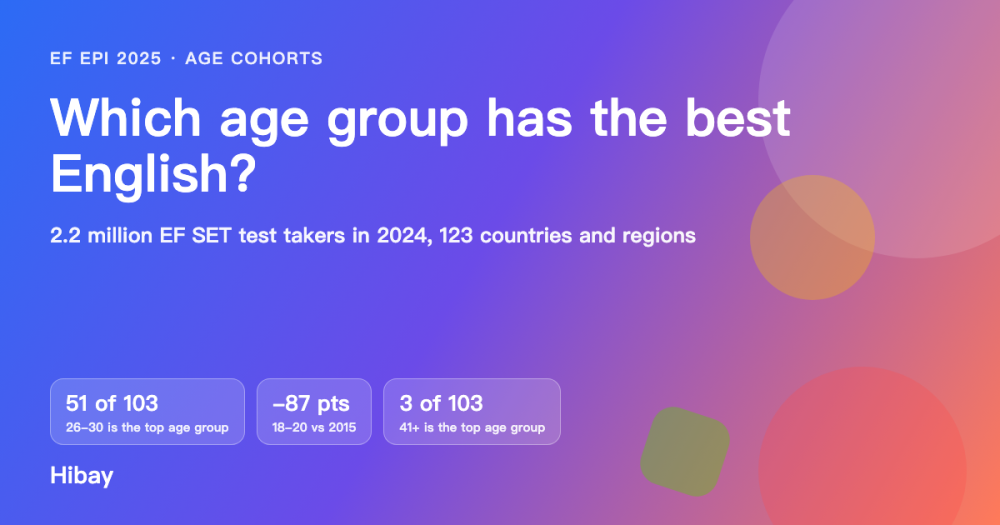
Cover. The middle of the age range leads in the EF EPI 2025 country profiles; the youngest cohort has fallen furthest since 2015. Source: EF Education First, EF EPI 2025, based on 2.2 million EF SET test takers in 2024.
Key findings
- Adults aged 26-30 were the top-scoring age group in 51 of the 103 EF EPI 2025 country and region profiles that name one, or 50% of them.
- The youngest band, 18-20, was the top group in only 5 of those 103 profiles (5%), and its worldwide average is 87 points below its 2015 level.
- The oldest band, 41+, was the top group in 3 profiles, all in Asia (India 528, Pakistan 509, Uzbekistan 472), and EF reports that over-40 scores slipped again to their level of a decade earlier.
- In Latin America, where EF says the youngest cohort trails working adults by almost 100 points in several countries, none of the 19 regional profiles names 18-20 as top; 26-30 is top in 12 of them (63%).
Background
Age is one of the least often published variables in national English rankings, which makes a count of EF's own labels useful. EF ranks 123 countries and regions by adult English skills, and the 2025 edition is the first to include speaking and writing assessments alongside reading and listening [1]. The publisher's launch statement frames the question directly: adults under 25 are not rebounding after the pandemic, and in many countries they now score below older age groups [2].
Data and method
Source and window. This article uses the EF EPI 2025 report, built on EF SET tests taken in 2024, and the publisher's launch statement [1][2]. National scores are three-year rolling averages.
Sample and inclusion. The edition covers 2.2 million test takers and ranks 123 countries and regions: 37 in Europe, 25 in Asia, 20 in Latin America, 28 in Africa and 13 in the Middle East. EF includes countries with a minimum of 400 test takers and cities or regions with a minimum of 100.
Definitions. A top age group is EF's label for the band with the highest average score inside one country, printed as "Top age group: 26-30 (average score 640)"; the bracketed score is that band's national average, not population weighted. Its count has numerator = profiles naming that band and denominator = the 103 profiles naming any band, so base = 103 profiles, not countries or test takers. Age-trend changes are point differences between 2015 and 2025 from EF's charts. The score-shift count has numerator = countries moving 5 points or less and denominator = the 117 country rows in Appendix E.
This article's own counts. The Proficiency Detail pages publish 116 country and region profiles, of which 103 name a top age group and 13 name none. Each profile was assigned to the region where it appears on EF's regional ranking pages; region shares use each region's profiles with a top age group as the denominator (Europe 32, Asia 20, Latin America 19, Africa 20, Middle East 12). Only aggregated, published country-level results are used.
Design and rounding. All figures are descriptive and comparative; no causal claim is made. Figures are rounded to the nearest whole percent.
Results
The middle of the age range carries the index. 26-30 is the top age group in 51 of the 103 profiles that name one, 21-25 in 31, 31-40 in 12, 18-20 in 5 and 41+ in 3. The pattern holds in every region: 26-30 is the most named band in Europe (53% of 32 profiles), Asia (55% of 20), Latin America (63% of 19), Africa (35% of 20) and the Middle East (33% of 12). Scores behind the label vary widely, from 640 in Austria and 576 in Honduras to 454 for Haiti's 26-30 group.
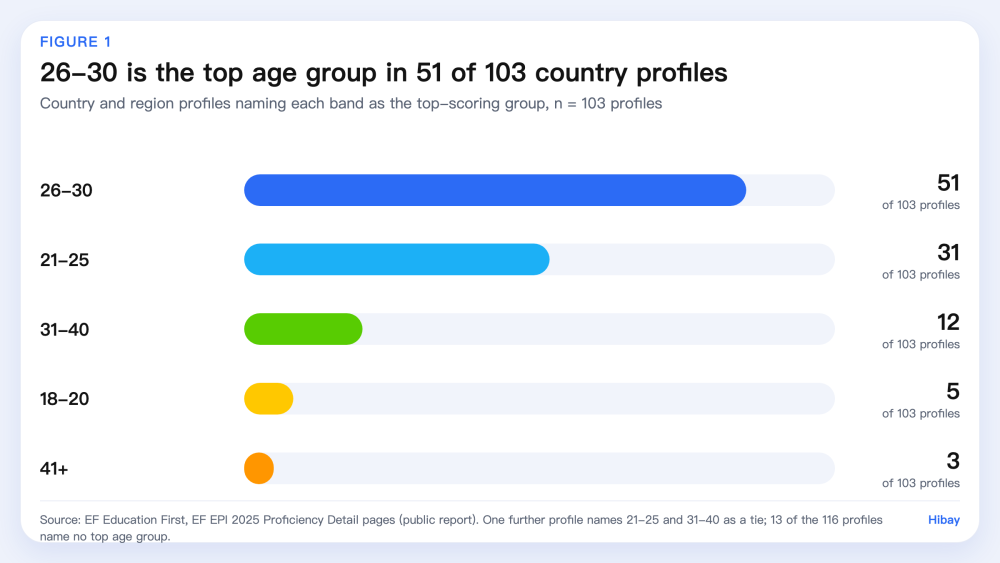
Figure 1. Country and region profiles by the age group EF names as the top-scoring band, n = 103 profiles. One further profile names 21-25 and 31-40 as a tie. Source: EF Education First, EF EPI 2025, Proficiency Detail pages.
The youngest cohort is the exception. 18-20 is the top group in only 5 profiles: Albania (540), Cote d'Ivoire (445), Rwanda (449), Sudan (431) and Yemen (416). Three of the five are African, and Africa is the only region where the youngest band leads a visible share of profiles, 15% against 3% in Europe and none in Asia or Latin America. The longer trend is steeper: on EF's global chart the 18-20 line ends 87 points below its 2015 level, while every other band sits within 11 points of where it started. EF adds that proficiency among the youngest adults remains lower than before the pandemic and that this year more countries saw further declines than improvements.
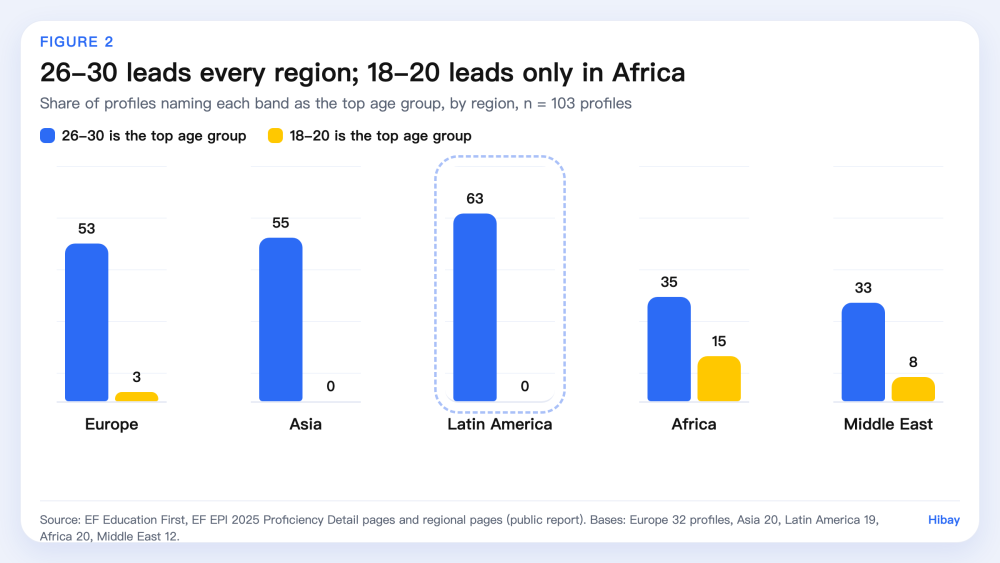
Figure 2. Share of country and region profiles naming 26-30 and 18-20 as the top age group, by region; bases are the profiles with a top age group in each region, n = 103 profiles. Source: EF Education First, EF EPI 2025, Proficiency Detail and regional pages.
Latin America shows the widest split between the youngest adults and everyone in work. EF describes the youngest cohort there as trailing working adults by almost 100 points in several countries, the widest age gap in the world, and the chart fits: 18-20 is 57 points below its 2015 level in Latin America, while 31-40 is up 51 points and 26-30 is up 49. Asia shows a similar pattern, with 18-20 down 54 points, and the Middle East is the only region where the youngest band improved, up 17 points.
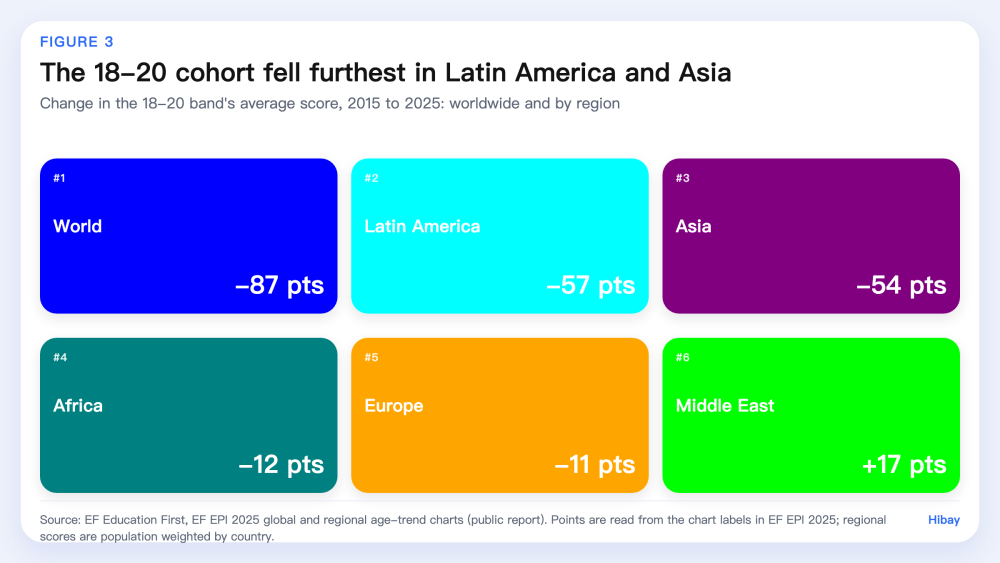
Figure 3. Change in the 18-20 band's average score between 2015 and 2025, worldwide and by region, in points; regional scores are population weighted by country. Source: EF Education First, EF EPI 2025, global and regional age-trend charts.
The oldest cohort is small and uneven in geography. 41+ is the top group in just 3 of the 103 profiles, all Asian: India (528), Pakistan (509) and Uzbekistan (472). EF reports that scores for adults over 40 slipped again worldwide, returning the cohort to where it was a decade ago, and its global chart shows the band 5 points above 2015, effectively flat. EF also calls age gaps in the Middle East narrower than average and names Kenya and South Africa among the most homogenous countries across age groups.
| Age group | Profiles naming it top (of 103) | Share | Global change, 2015-2025 (points) |
|---|---|---|---|
| 18-20 | 5 | 5% | -87 |
| 21-25 | 31 | 30% | -11 |
| 26-30 | 51 | 50% | +4 |
| 31-40 | 12 | 12% | +6 |
| 41+ | 3 | 3% | +5 |
Read the counts with the last column: the middle bands carry the labels, and only the youngest band moved far from its 2015 level. One further profile names 21-25 and 31-40 as a tie.
The 2025 edition also changed how scores are produced. Speaking and writing sections were added for the first time and ran only in the second half of 2024, and in most countries less than 20% of test takers took them. Comparing each country with and without productive skills, 83 of the 117 country rows moved by 5 points or less and only 4 by more than 10, from Uzbekistan 26 to Cyprus 15. EF notes a slightly larger effect for adults over 40, whose receptive-productive gap is wider.
Limitations
Four limits bound these numbers. The EF SET population is self-selected: the test is free and online, people without internet access are excluded, and EF warns this can pull scores either way, so the labels describe volunteers rather than national populations [1]. A top age group is a relative label inside one country, not an absolute standard, and the band sample behind it can be small even where the country clears 400 test takers; 13 of the 116 profiles name no top age group, so the counts rest on 103 profiles rather than all 123 countries and regions. The 2025 edition added speaking and writing, which puts a methodological break between these age comparisons and earlier editions, with a larger effect reported for the over-40 cohort. Finally, the 2015 to 2025 changes are printed as chart labels rather than as a table, and regional figures are population weighted while country band scores are not, so points from different panels are not additive. The design is observational: these are associations, not evidence about why any cohort scores where it does.
What this means for learners
A learner past 30 is in the band that tops most of the index, so a late start is a weak reason to postpone practice. A learner under 25 sits in the cohort that has lost the most ground since 2015, which makes steady speaking practice through university and early work more useful than waiting for a course to fix it. A national score says little about your own band: Austria's top band averaged 640, Haiti's 454. Hibay's speaking practice can fill the part of the week that formal study skips, though practice feedback is not an official score.
Frequently Asked Questions
Which age group has the best English? Adults aged 26-30 do: EF names that band as the top-scoring group in 51 of the 103 country profiles that name one (see Results).
Where do the youngest adults stand? The 18-20 band is the top group in 5 of the 103 profiles, and its worldwide average is 87 points below its 2015 level (see Results). Only the Middle East puts the band above its 2015 position, at 17 points.
Where do the oldest adults stand? Adults aged 41+ are the top group in 3 of the 103 profiles, all in Asia, and EF reports the cohort slipped again worldwide to roughly its level of a decade earlier (see Results and Limitations).
Can I compare these numbers with earlier EF EPI editions? Only with care: the 2025 edition added speaking and writing, which shifted national scores by 5 points or less in 83 of the 117 country rows (see Data and method).
How to cite
Hibay Product Team. (2026, October 30). Which Age Group Has the Best English? EF EPI 2025, 123 Countries. Hibay. https://www.hibay.ai/en/news/ef-epi-2025-age-cohorts
Figures are from the public sources listed below and may be cited with attribution.
References
- EF Education First. EF English Proficiency Index 2025: A Ranking of 123 Countries and Regions by English Skills. https://www.ef.com/assetscdn/WIBIwq6RdJvcD9bc8RMd/cefcom-epi-site/reports/2025/ef-epi-2025-english.pdf. Accessed 2026-10-30.
- EF Education First. EF English Proficiency Index 2025 launched: AI-powered insights reveal global language shifts in a fragmented world. https://www.ef.edu/about-us/press/articles/2025/ef-english-proficiency-index-2025-launched. Accessed 2026-10-30.