
TOEFL Listening Leads in Every Region; Speaking Does Not
Listening is the highest-scoring TOEFL section in all six ETS regions, but Speaking overtakes Reading in four of them and falls behind in Asia and the Pacific.

On this page
ETS publishes section means by country, which allows the four sections to be compared region by region. In the 2025 table, Listening is the highest-scoring section in all six regions, from 24.4 in Europe to 18.6 in Africa, while the relative position of Speaking flips: it sits 2.8 points above Reading in Africa and 1.0 point below Reading in the Pacific. The figures are unweighted averages of published national means over 153 countries and regions, and ETS cautions against ranking countries on them.
Key findings
- Listening is the highest-scoring section in all six ETS regions, from Europe at 24.4 and the Pacific at 24.0 down to Africa at 18.6.
- Speaking sits above Reading in four regions — Africa by 2.8 points, the Middle East by 1.9, the Americas by 1.1 and Europe by 0.2 — and below it in Asia by 0.8 and the Pacific by 1.0.
- Europe has both the highest section means and the narrowest internal spread, 22.3 in Writing to 24.4 in Listening.
- Asia is the only region where Writing matches Reading, at 20.9 against 20.8.
- Africa's section profile is the most distinctive: its Speaking mean of 19.6 is 2.8 above its Reading mean of 16.8, the widest such gap in the table.
Background
The TOEFL iBT reports four section scores out of 30 plus a total out of 120, and ETS publishes means for all five figures in its annual summary [1]. The country table is organised into six geographic sections, so the same section scores can be averaged within each region [2].
Section means are usually read as a description of where candidates are weak. Reading them by region changes the comparison: the question becomes whether the four sections rank the same way everywhere, or whether different regions produce different profiles. A learner preparing in one region is often shown data from another, so the answer matters for how section-level advice travels.
Data and method
The source is the country table of the ETS TOEFL iBT Test and Score Data Summary 2025, which gives Reading, Listening, Speaking, Writing and total means for each country and region with a reported mean, arranged under six regional headings [2]. The data cover examinees who tested between January and December 2025.
Rows were read from the table and kept with the heading they appear under, giving 153 countries and regions: 41 in Europe, 36 in Africa, 28 in Asia, 26 in the Americas, 18 in the Middle East and four in the Pacific. Each regional section mean is the unweighted average of the national means in that group, so the figures describe the published table rather than a candidate-weighted population. Differences are computed between those regional averages, all values are rounded to one decimal place, and no individual record is used. The sample is the set of published group rows in the source table, the key metric in each case is a published group mean or a share or difference computed from published means, and all values are aggregated at group level with no individual record used.
Results
Listening leads in every region, and by a consistent margin. Europe's 24.4 is 1.6 above its Speaking mean and 1.8 above its Writing mean; the Pacific's 24.0 is 2.0 above its Speaking figure; Africa's 18.6 is 1.8 above Reading and 0.1 above Writing. No region reports a section mean above its Listening mean.
Speaking and Reading swap places by region. In Africa, Speaking at 19.6 sits 2.8 points above Reading at 16.8, and in the Middle East the gap is 1.9, 20.8 against 18.9. The Americas show 1.1 and Europe 0.2. Asia reverses the order, with Speaking at 20.0 against Reading at 20.8, and the Pacific reverses it further, 22.0 against 23.0. Africa's gap is the widest of the six in either direction.
Writing is the least variable section across regions: it runs from 18.5 in Africa to 22.5 in the Pacific, a 4.0-point spread, against 5.8 points for Listening and 6.0 for Speaking. Europe's profile is the flattest, with all four sections inside 2.1 points of each other, and Asia's is the only one where Writing and Reading are level at 20.9 and 20.8.
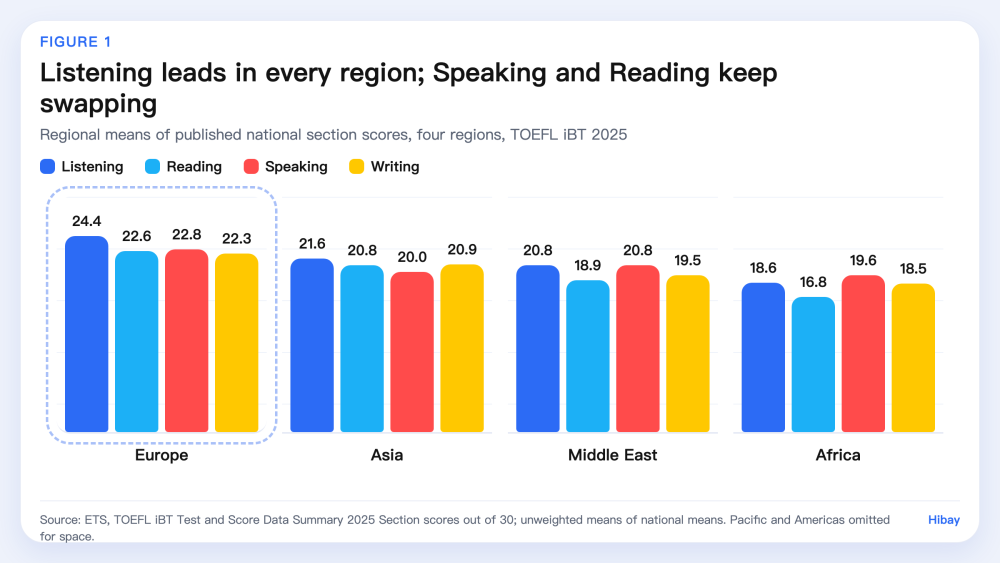
Figure 1. Unweighted mean of published national section means by ETS region, 2025, n = 153 countries and regions. Source: ETS, TOEFL iBT Test and Score Data Summary 2025.
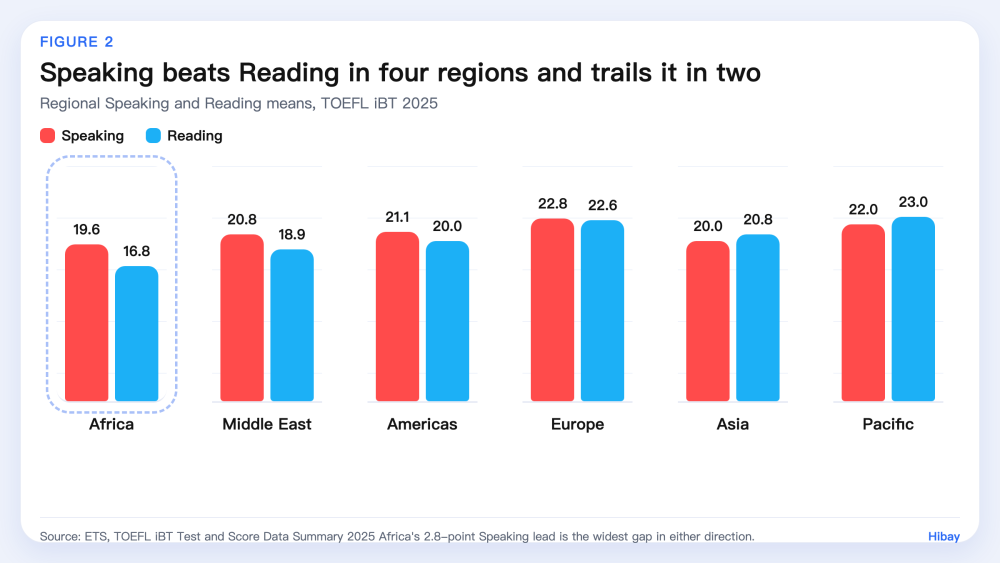
Figure 2. Difference between the regional Speaking and Reading mean, in score points, n = 153 countries and regions. Source: ETS, TOEFL iBT Test and Score Data Summary 2025.
Limitations
The regional section means are unweighted averages of national means, so a country with a few dozen examinees counts as much as one with tens of thousands, and the figures cannot be read as the profile of test takers in a region. The country groupings are the ones ETS uses, and several of them span very different education systems: the Americas section includes both Canada and Haiti, and the Pacific section has only four countries with a reported mean. Section scores are also reported to the nearest point, so small differences such as Europe's 0.2-point Speaking advantage over Reading sit within rounding. Finally, the summary does not report the number of examinees behind each row or their reasons for testing, and ETS states that the country table should not be used to rank countries.
What this means for learners
The stable finding is the Listening advantage: in every published region, candidates score higher in Listening than in any other section, which is the opposite of what a learner might assume from the common advice to practise listening most. The variable finding is where Speaking sits, and that is the one worth checking against local data rather than importing from another region.
For preparation, the regional profile suggests that a plan built on "everyone is weakest in speaking" does not describe Asia or the Pacific, where Reading sits above Speaking. A learner comparing their own section scores with a regional pattern should look at the profile of their own region rather than at a global average.
Frequently Asked Questions
Is Listening really the strongest TOEFL section everywhere?
In the 2025 ETS country table, averaged by region, Listening is the highest-scoring section in all six regions, from 24.4 in Europe to 18.6 in Africa.
Where is Speaking the weakest section?
Speaking is below Reading only in Asia, by 0.8 points, and in the Pacific, by 1.0. In Africa, the Middle East, the Americas and Europe, the regional Speaking mean is above the Reading mean.
Are these the scores of test takers in each region?
No. Each regional figure is the unweighted average of the national means that ETS publishes, so countries count equally regardless of how many candidates they contribute.
How to cite
Hibay Product Team. (2026, November 5). TOEFL Listening Leads in Every Region; Speaking Does Not. Hibay. https://www.hibay.ai/en/news/toefl-2025-regional-skill-profiles
References
- ETS. TOEFL iBT Test and Score Data Summary 2025. https://www.ets.org/pdfs/toefl/toefl-ibt-test-score-data-summary-2025.pdf. Accessed 2026-11-05.
- ETS. TOEFL iBT Test and Score Data Summary 2025, Table 16, total and section score means by native country. https://www.es.ets.org/pdfs/toefl/toefl-ibt-test-score-data-summary-2025.pdf. Accessed 2026-11-05.