
A 10-Point TOEFL Section Gap Is Rare: 2025 Country Profiles
Across 153 countries and regions, the gap between a country's highest and lowest TOEFL section is typically 3 points; only eight reach 5 or more, and Vietnam's 10 is the widest.

On this page
ETS publishes a section mean for every country and region it reports, which makes it possible to ask how balanced a national profile is. Across the 153 groups in the 2025 table, the gap between a country's highest and lowest section mean is most often 3 points on the 30-point scale, 59 groups sit at exactly 3 and 53 at 2, only eight reach 5 or more, and one group — Hong Kong — reports the same score, 23, in all four sections. Vietnam's 10-point gap is the widest. The figures are computed from published group means, and ETS cautions against ranking countries.
Key findings
- Across 153 countries and regions, the median gap between a country's highest and lowest TOEFL section mean is 3 points, and the mean gap is 2.67.
- 59 groups report a gap of exactly 3 points and 53 report 2; only 19 groups stay within 1 point.
- Eight groups report a gap of 5 points or more: Vietnam 10, Uzbekistan 7, Kazakhstan 7, Sierra Leone 6, Liberia 6, Tanzania 5, Bangladesh 5 and Andorra 5.
- Hong Kong is the only group with no gap at all, reporting 23 in Reading, Listening, Speaking and Writing.
- The widest gap is consistently on the speaking side: Vietnam's Speaking mean of 13 sits 10 points below its Reading mean of 23, and Kazakhstan's 14 sits 7 below its Reading mean of 21.
Background
The TOEFL iBT reports four section scores out of 30 and a total out of 120, and ETS publishes means for all five in its annual summary [1]. Because the sections are reported separately, a national total can hide a very uneven profile: two countries with the same total can differ in how far apart their strongest and weakest section sit.
That balance is what the section gap measures. It is not a measure of proficiency — a country with low scores everywhere can have a small gap — but it does describe how uneven a cohort's profile is, which is the question an institution asks when it sets a minimum section score rather than a minimum total.
Data and method
The source is the country table of the ETS TOEFL iBT Test and Score Data Summary 2025, which gives Reading, Listening, Speaking, Writing and total means for each country and region with a reported mean [2]. The data cover examinees who tested between January and December 2025, and groups with fewer than 30 examinees are suppressed by ETS.
For each of the 153 groups the four section means were read from the table, and the gap is the highest of the four minus the lowest, in points on the 30-point scale. The distribution of that gap is reported as counts and as a median, and the named extremes are quoted with their published section means so the calculation can be checked. No value is estimated; every figure comes from a printed cell, and the data are aggregated at country level with no individual record used. The sample is the set of published group rows in the source table, the key metric in each case is a published group mean or a share or difference computed from published means, and all values are aggregated at group level with no individual record used.
Results
The distribution is tightly clustered. A gap of 3 points is the single most common value, reported by 59 groups, and 2 points is next at 53, so 112 of the 153 groups sit at 2 or 3. Nineteen groups stay within 1 point and one, Hong Kong, reports no gap at all: Reading, Listening, Speaking and Writing all stand at 23, for a total of 91.
Long gaps are unusual. Only eight groups reach 5 points or more. Vietnam's 10 is the widest, from a Reading mean of 23 and a Listening mean of 21 down to a Speaking mean of 13, with Writing at 19. Uzbekistan and Kazakhstan follow at 7: Uzbekistan reports 22 in Reading, 22 in Listening, 15 in Speaking and 19 in Writing, and Kazakhstan 21, 21, 14 and 16. Sierra Leone and Liberia report 6, in both cases with Speaking above Reading rather than below it — Sierra Leone at 21 in Speaking against 15 in Reading.
The direction of the gap is not uniform. In Vietnam and Kazakhstan the weakest section is Speaking, while in Sierra Leone and Liberia it is Reading. That difference matters for how the gap should be read: a wide gap describes an uneven profile, not a specific weakness.
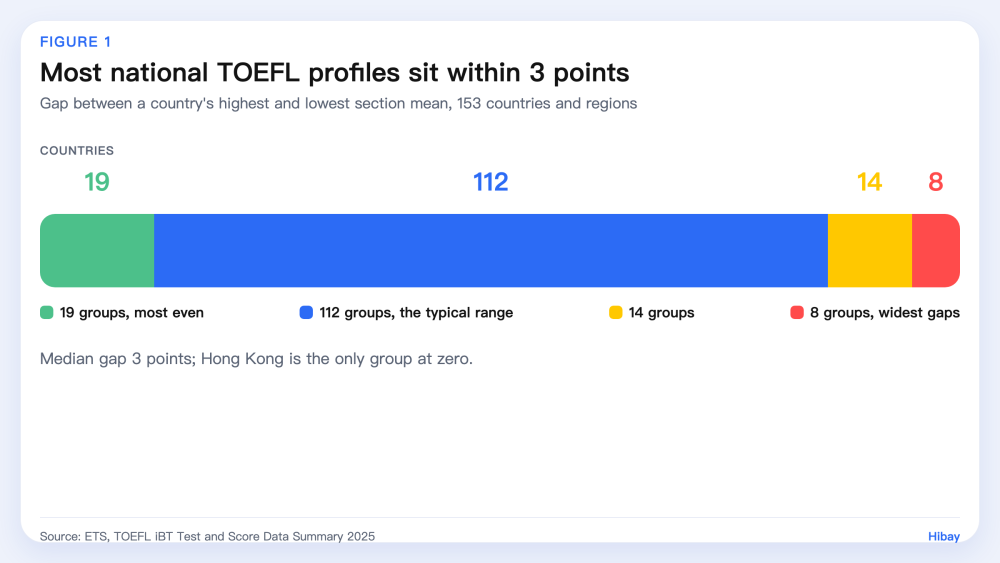
Figure 1. Number of countries and regions by the gap between their highest and lowest published TOEFL iBT section mean, 2025, n = 153 groups. Source: ETS, TOEFL iBT Test and Score Data Summary 2025.
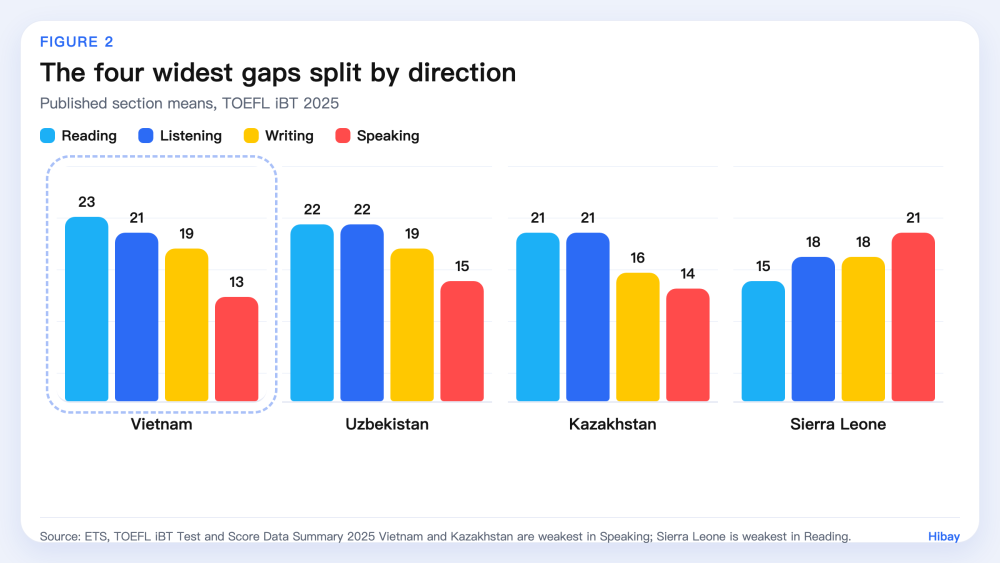
Figure 2. Published section means for the groups with the widest gap, ordered Reading, Listening, Writing, Speaking, n = 153 country groups in the source table. Source: ETS, TOEFL iBT Test and Score Data Summary 2025.
Limitations
The gap is a property of four published means and inherits all their limits. Section means are printed as whole numbers, so a gap of 1 or 2 points is close to rounding noise and should not be read as a precise difference. The means describe groups, not individuals, and a group's small gap can coexist with widely different individual profiles inside it. ETS suppresses groups below 30 examinees, so the countries with the smallest candidate numbers are absent, and those are the groups most likely to show unusual patterns. The total mean is also not the average of the four section means, because ETS rounds section scores before summing, so a country's gap and its total do not have to reconcile exactly. Finally, the table gives no candidate counts, purposes or test histories, and ETS states that country means should not be used to rank countries.
What this means for learners
A national profile is usually more balanced than a learner expects. If 112 of 153 groups sit within 2 or 3 points across four sections, a candidate reporting a 6-point spread between their own best and worst section is further from the typical national pattern than the numbers suggest — but that comparison is against a mean of means, not against other candidates.
The more useful reading is directional. Countries with wide gaps split into two kinds, those weak in Speaking and those weak in Reading, and the same total score can therefore describe two very different profiles. A learner setting a section target should look at their own section scores against the institution's requirement rather than against a national profile.
Frequently Asked Questions
What is the typical TOEFL section gap within a country?
In the 2025 ETS country table, the median gap between a country's highest and lowest section mean is 3 points on the 30-point scale, and the mean gap across 153 groups is 2.67.
Which country has the most even TOEFL profile?
Hong Kong reports 23 in Reading, Listening, Speaking and Writing, the only group in the 2025 table with no gap between its highest and lowest section mean.
Is a wide section gap bad?
The gap describes balance, not level. A country can have a wide gap with strong scores or with weak ones, and the direction of the gap — whether the weakest section is Speaking or Reading — differs between countries.
How to cite
Hibay Product Team. (2026, November 5). A 10-Point TOEFL Section Gap Is Rare: 2025 Country Profiles. Hibay. https://www.hibay.ai/en/news/toefl-2025-section-gap-within-countries
References
- ETS. TOEFL iBT Test and Score Data Summary 2025. https://www.ets.org/pdfs/toefl/toefl-ibt-test-score-data-summary-2025.pdf. Accessed 2026-11-05.
- ETS. TOEFL iBT Test and Score Data Summary 2025, Table 16, total and section score means by native country. https://www.es.ets.org/pdfs/toefl/toefl-ibt-test-score-data-summary-2025.pdf. Accessed 2026-11-05.