
One Language, 27 Points: TOEFL's Arabic-Speaking Countries
ETS reports an Arabic-speaking group mean of 77 on the TOEFL iBT, but the 18 Arabic-speaking countries it lists run from 62 to 89, a 27-point spread.

On this page
ETS publishes the 2025 TOEFL iBT two ways: a mean for each native-language group and a mean for each native country or region. Reading the two tables together shows how much a language label hides. The Arabic-speaking group averages 77 out of 120, while the 18 countries with Arabic among their languages of record run from 62 in the United Arab Emirates to 89 in Lebanon, a 27-point spread. The tables report group means, not candidate records, and ETS cautions against using them to rank countries.
Key findings
- The Arabic native-language group averages 77 out of 120 in the 2025 ETS table, while the 18 Arabic-speaking countries listed in the country table run from 62 to 89.
- The Spanish-speaking group averages 84, and the 20 Spanish-speaking countries listed run from Cuba at 73 to Spain at 91, an 18-point spread.
- The Portuguese-speaking group averages 88; Brazil reports 88 and Portugal 93, a 5-point spread across just two countries.
- The French-speaking group averages 86, while five French-speaking countries with published means run from Monaco at 85 to Switzerland at 100.
- A language group and a country group are different populations: one contains every examinee reporting that first language, the other every examinee reporting that country, whatever their first language.
Background
The TOEFL iBT summary contains two separate classification tables. the language table gives means by native language, with 107 language groups in the 2025 edition; the country table gives means by native country or region, with 153 groups [1]. Both tables report the same five figures — Reading, Listening, Speaking, Writing and total — for examinees who tested between January and December 2025.
Institutions often use one table or the other when setting score expectations. A language group is the closer match when the question is what a candidate with a given first language typically scores; a country group is the closer match when the question is what candidates from a given education system typically score. Neither is a subset of the other.
Data and method
The source is the ETS TOEFL iBT Test and Score Data Summary 2025, the language table and the country table [1]. the language table is read for the published means of the Arabic, Spanish, Portuguese and French language groups; the country table is read for the country and region means, and countries are attached to a language group here only where that language is an official or widely used language of the country in question.
The country lists are explicit rather than inferred from the ETS table: 18 countries with a published mean are treated as Arabic-speaking, 20 as Spanish-speaking, two as Portuguese-speaking and five as French-speaking. Only countries with a published mean appear, because ETS suppresses groups with fewer than 30 examinees. Means are quoted as published, ranges are the highest published mean minus the lowest, and no candidate-level record is used. The two tables are never subtracted from each other, because they describe different populations. The sample is the set of published group rows in the source table, the key metric in each case is a published group mean or a share or difference computed from published means, and all values are aggregated at group level with no individual record used.
Results
The Arabic comparison produces the widest range. The language group's mean is 77, and the 18 countries with published means run from the United Arab Emirates at 62 through Djibouti at 64 and Kuwait at 65 to Bahrain and Egypt at 87 and Lebanon at 89. That is a 27-point range inside a single language label, and the language-group figure sits near the middle of it rather than at either end.
Spanish shows the same pattern at a smaller scale: a group mean of 84, with 20 countries running from Cuba at 73 and Guatemala at 78 to Uruguay at 89, Costa Rica at 90 and Spain at 91, an 18-point range. Portuguese is the narrowest of the four comparisons, because only two countries report a mean: Brazil at 88, exactly the group figure, and Portugal at 93.
French illustrates the opposite problem. The language group averages 86, but the five countries with published means run from Monaco at 85 through France at 88 and Canada at 94 to Belgium at 96 and Switzerland at 100. Those higher country means come from countries where French is one of several official languages and where many examinees are not first-language French speakers, which is exactly why the two tables cannot be read as the same measurement.
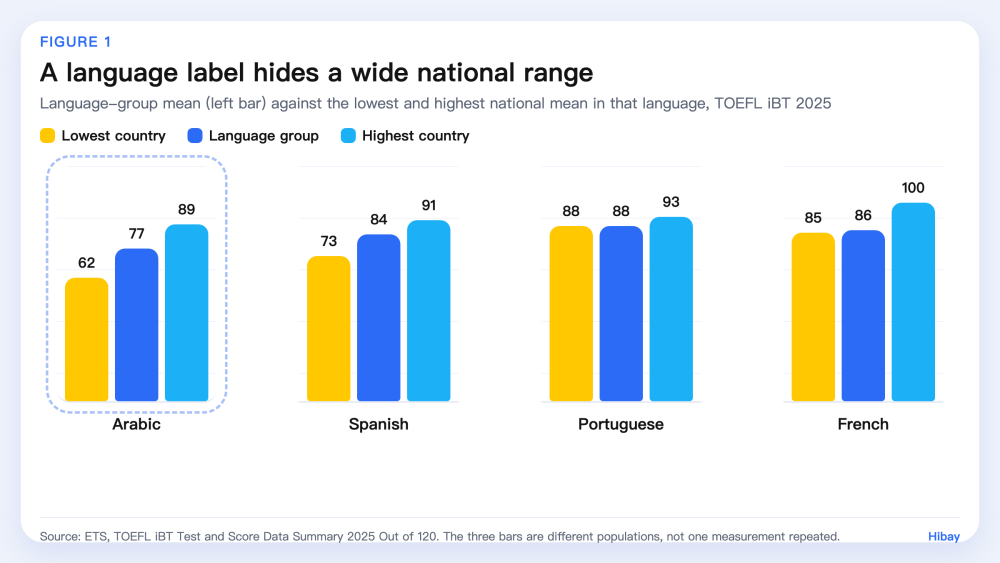
Figure 1. Published TOEFL iBT 2025 total means for four language groups and the range of their countries' national means, n = 107 language groups and 153 country groups in the source tables. Source: ETS, TOEFL iBT Test and Score Data Summary 2025.
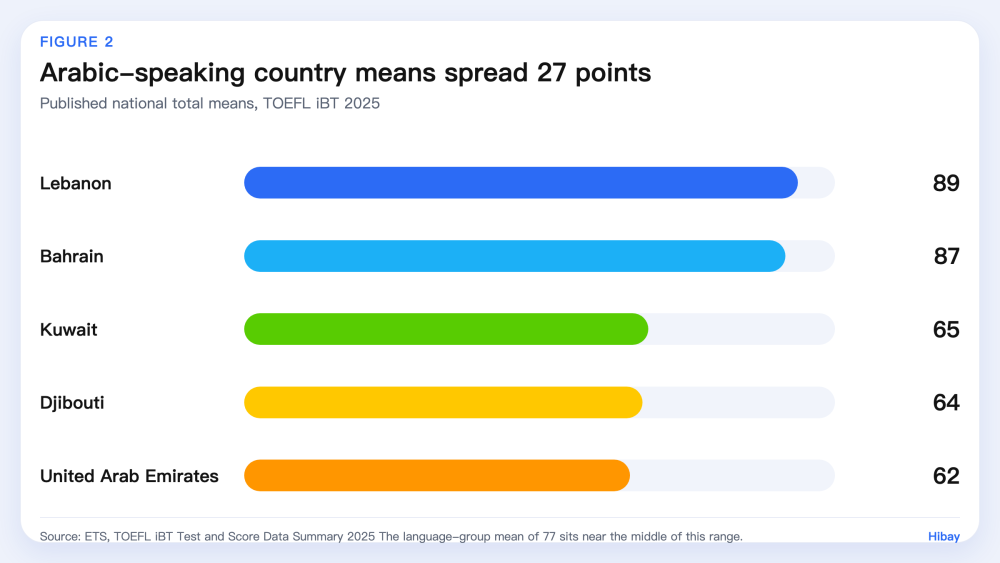
Figure 2. The lowest and highest published national TOEFL iBT means among the 18 Arabic-speaking countries with a reported mean. Source: ETS, TOEFL iBT Test and Score Data Summary 2025.
Limitations
The central limitation is that the two tables describe different people. A country mean includes every examinee who reported that country, including first-language speakers of other languages, and a language mean includes every examinee who reported that language, wherever they took the test. The country lists used here are also a judgement: which countries count as Arabic-speaking or French-speaking is not a field in the ETS table, and a different list would move the ranges. Small groups are suppressed below 30 examinees, so countries and languages with few candidates are absent, and the summary gives no candidate counts above that threshold. Finally, these are group means with no information on who took the test, why, or how often.
What this means for learners
A language label is not a score band. The Arabic group mean of 77 is consistent with country means as far apart as 62 and 89, so a candidate who reads that "Arabic speakers average 77" has learned very little about their own expected score or about the standard in the country where they studied.
For institutions setting requirements, the pair of tables suggests using the country table when the education system is the relevant comparison and the language table when the first language is, and never treating one as a stand-in for the other. Where the two disagree, the disagreement is the finding: it marks a population whose composition differs, not a measurement error.
Frequently Asked Questions
Why is the Arabic language group mean lower than most Arabic-speaking countries?
The group includes every examinee reporting Arabic as a first language, in every country, and the country table covers different sets of examinees. The tables describe different populations, so one is not expected to sit inside the other's range.
What is the range for Spanish-speaking countries?
20 Spanish-speaking countries with a published 2025 mean run from Cuba at 73 to Spain at 91, an 18-point range, against a language-group mean of 84.
Can I use a language group mean to estimate my own score?
No. The published means describe groups, not individuals, and the tables carry no information about a candidate's preparation, purpose or number of attempts.
How to cite
Hibay Product Team. (2026, November 5). One Language, 27 Points: TOEFL's Arabic-Speaking Countries. Hibay. https://www.hibay.ai/en/news/toefl-2025-language-group-vs-country-means
References
- ETS. TOEFL iBT Test and Score Data Summary 2025, Tables 15 and 16. https://www.ets.org/pdfs/toefl/toefl-ibt-test-score-data-summary-2025.pdf. Accessed 2026-11-05.