
French Is the Second Choice in 60 Countries: Duolingo 2025 Two-Language View
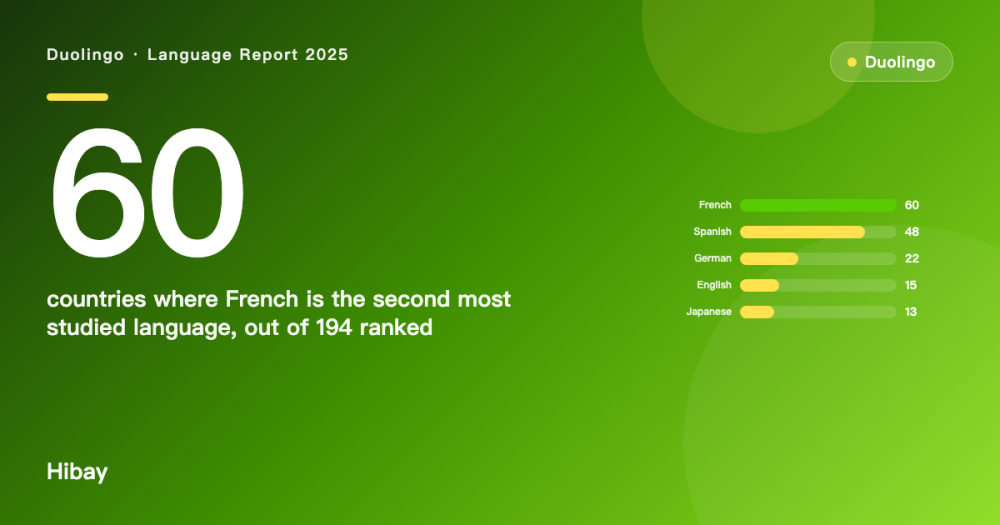
Duolingo's 2025 report ranks languages per country. The first-place table uses 4 languages and the second-place table uses 14, and French leads the runner-up list in 60 of 194 countries.

On this page
Most reporting on Duolingo's annual language report uses the map of what ranks first in each country. The report also publishes a second table, for the second most studied language, and that table is where the variety sits: 14 languages appear as a runner-up against 4 as a first choice. French is the second choice in 60 of the 194 countries ranked and Spanish in 48, together 108 countries. This report reads the two published tables against each other; both count countries rather than learners, and the report does not publish the learner volumes behind a rank.
Key findings
- French is the second most studied language in 60 of the 194 countries ranked and Spanish in 48, together 108 countries, or 55.7% of the base.
- Diversification shows up in the runner-up position: the second-place table contains 14 languages against 4 in the first-place table, where English leads in 154 countries, Spanish in 26, French in 12 and German in 2.
- English is the second choice in 15 countries even though it is the first choice in 154, and 25 countries place English outside their top two entirely.
- Second-choice languages outside the global top ten are visible only in this table: Russian in 4 countries, and Arabic, Hindi, Irish and Turkish in 1 each, 8 countries in total.
Background
A "most studied language" ranking is a map of first choices, and a country's first choice is usually its school system's or its neighbour's. The second choice is closer to a free decision: it is what learners add when the obvious option is already taken, and it responds to labour markets, migration patterns and media in ways the top slot does not.
Duolingo's report covers more than 280 courses teaching more than 40 languages, plus math, music and chess. Its country tables rank languages by the number of learners in each country, aggregated by country and by language. Because the tables are published as counts of countries per rank rather than as learner counts, they answer a geographic question and not a demographic one: how many countries have French as their runner-up, not how many people study it.
The two tables also use different vocabularies. Four languages win a country outright. Fourteen reach second place. The gap between those two numbers is the space in which learners diversify.
Data and method
Source and window. The figures come from the 2025 Duolingo Language Report, published in November 2025, and from the two country tables it prints, one for the most popular language in each country and one for the second most popular [1]. The reporting window is 1 October 2024 to 30 September 2025.
Sample. Rankings cover 194 countries. Duolingo excludes learners under 13 from all analyses, excludes countries with fewer than 5,000 Duolingo learners from the rankings, and aggregated data by country or by language so that no individual learner is identified. The unit of analysis is a country-rank pair: which language holds first place, and which holds second, in each of the 194 countries.
Definitions. A rank is the position of a language among the languages studied by Duolingo learners resident in a country, measured by learner number within that country and not per capita. "First choice" means rank 1 in a country; "second choice" means rank 2. All counts in this report are counts of countries, and the shares are those counts divided by 194; averages are not used because the published tables report counts of countries per rank, not learner totals.
Arithmetic. Three figures here are computed from the published counts and are registered in the accompanying data file: 60 plus 48 gives 108 countries, 108 divided by 194 gives 55.7%, and 60 divided by 194 gives 30.9%. The combined count of 8 for the second-choice languages outside the global top ten is 4 plus 1 plus 1 plus 1 plus 1.
Results
The first-place table is concentrated. English leads in 154 countries, Spanish in 26, French in 12 and German in 2, which accounts for the whole base of 194 with no fifth language reaching first place. That is the map most readers have seen: one language dominates, one is a strong regional second, and two others hold small territories.
The second-place table is a different distribution altogether. French leads the runner-up list with 60 countries and Spanish follows with 48, so the two together hold 108 of 194, or 55.7%. German is the second choice in 22 countries, English in 15, Japanese in 13 and Portuguese in 13. Chinese takes 9, Russian 4, and Italian and Korean 3 each. Arabic, Hindi, Irish and Turkish appear in 1 country each. None of those last five reaches the global top ten, so their presence is only visible in this table.
English's double position is the clearest illustration of how the two tables differ. A language that is first in 154 countries is still second in 15, and 25 countries keep it out of the top two altogether: in those places another language is both the first and the second choice. The report notes that English ranks highly even where English proficiency is high or where it has official status, naming the United States, Sweden and Tanzania.
The report's third layer is subject choice rather than language choice. Duolingo now offers math, music and chess alongside languages, and it reports that learners studying Latin are the most likely to add one: more than 19% of Latin learners also study chess, 14% also study math and 13% also study music. The report launched 148 new courses during the period for speakers of more than 20 languages, which is the mechanism behind several of the shifts in the tables.
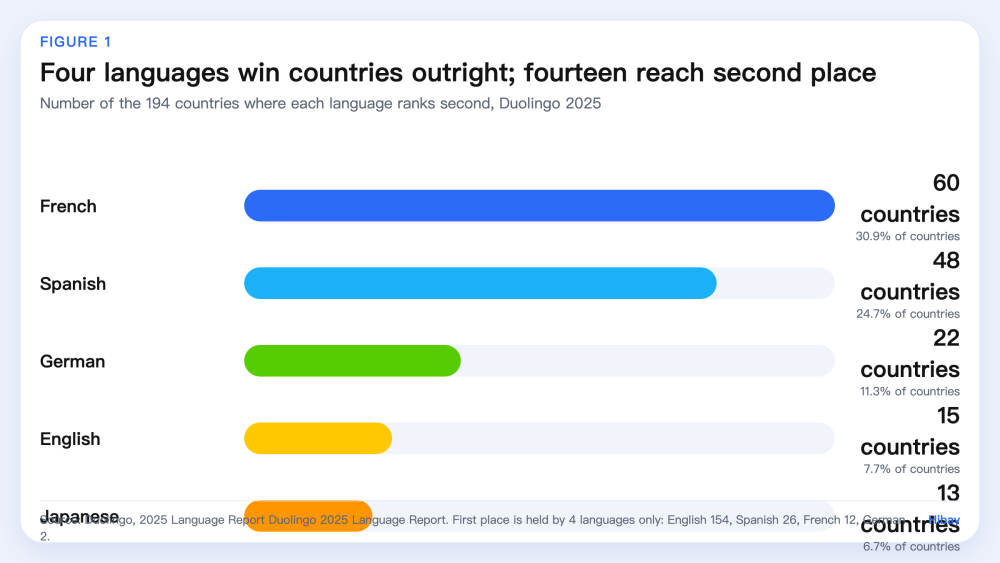
Figure 1. Countries where each language is the second most studied, out of 194 ranked countries, Duolingo 2025 Language Report. Source: Duolingo, 2025 Language Report.
Limitations
Four limits apply. First, country counts are not learner counts. A language that leads one small country and trails in a large one looks stronger in this table than it is in the learner base, and the report does not publish per-country learner volumes, so no weighting is possible. Second, the 5,000-learner floor removes small markets entirely, which is precisely where a rare second choice would be most visible. Third, the under-13 exclusion and the self-selected nature of app learners mean the rankings describe Duolingo's users rather than language learners in general. Fourth, the multi-subject percentages are reported for Latin learners only, so no comparison across language courses can be made, and a single group is not evidence of a general pattern.
What this means for learners
The second choice is where a curriculum decision actually happens. Once a first language target is fixed by school, work or a visa requirement, the choice that remains is what to add, and the runner-up table shows what learners in comparable countries are adding. French and Spanish dominate that slot not because they are the only options but because they are the default second option in most of the world.
For a learner, the more useful signal is the tail: Japanese and Portuguese hold 13 countries each as a runner-up, and Russian, Arabic, Hindi, Irish and Turkish appear only once. A language that is nobody's default is still somebody's second choice in a handful of places, and those places are usually where the language has a live economic or family connection. Practice on a specific skill, with feedback, is the part of this a learner controls; practice feedback is not an official score and Hibay does not issue one.
Frequently Asked Questions
Which language is the second most studied in the most countries? French, in 60 of the 194 countries ranked, ahead of Spanish at 48. German is third on that list at 22 countries, and English is fourth at 15.
Why would English be a second choice anywhere? In 15 countries another language ranks first, usually a regional or official language with a larger local learner base, while English takes the runner-up slot. In 25 countries English does not reach the top two at all.
Does the report say how many learners each rank represents? No. The country tables are published as counts of countries per language and rank, and the report does not disclose per-country learner volumes. That is why the shares here are shares of countries, not of learners.
What else do Duolingo learners study? Math, music and chess, alongside languages. The report gives one comparison: more than 19% of Latin learners also study chess, 14% also study math and 13% also study music.
How to cite
Hibay Product Team. (2026, November 4). French Is the Second Choice in 60 Countries: Duolingo 2025 Two-Language View. Hibay. https://www.hibay.ai/en/news/duolingo-2025-second-language-choice
Figures are from the public source listed below and may be cited with attribution.
References
- Duolingo. 2025 Duolingo Language Report, including the most popular and second most popular language tables and the data note. https://blog.duolingo.com/2025-duolingo-language-report/. Accessed 2026-11-04.