
Duolingo 2025: Japan Leads for Learners Studying Three Languages
Duolingo's 2025 report ranks Japan first both for learners studying three or more languages and for average time spent learning, with English still the top language in 154 countries.

On this page
Duolingo's 2025 report ranks Japan first both for learners studying three or more languages and for average time spent learning, with English still the top language in 154 countries.
Duolingo's 2025 Language Report ranks countries on two measures that are not about how many people study a language but about how they do it: the share of learners studying three or more languages, and average time spent learning. Japan takes first place on both lists. Australia, Finland, Germany and the United Kingdom follow on the multi-language measure, while Hungary, Belarus, Russia and Germany follow Japan on time spent. English remains the most studied language in 154 countries, and in 25 countries it is not among the two most popular. Duolingo publishes rank orders rather than counts, so the figures here cover ordering only, not scale.
Key findings
- Japan ranks first among countries where learners study three or more languages, ahead of Australia, Finland, Germany and the United Kingdom, in a report covering more than 280 courses.
- Japan also ranks first for average time spent learning, ahead of Hungary, Belarus, Russia and Germany, on a list that runs across more than 40 languages.
- On the course side, Spanish attracts the most serious learners by average time, followed by English, Italian, Welsh and Norwegian, among the more than 280 courses in the report.
- English is still the most studied language in 154 countries, a 14% increase over the 2024 report, and in 25 countries it is not among the two most popular languages.
- Japanese became the fourth most popular language to study globally and Korean sixth, after Duolingo opened direct courses for speakers of more than 20 languages.
Background
Duolingo's annual language report is one of the few public windows into what self-directed learners choose to study, and the 2025 edition covers more than 280 courses teaching more than 40 languages, plus math, music and chess [1]. The report's own framing is that global interest in learning is at an all-time high, driven partly by course expansion: 148 new courses launched in 2025, which is what made Japanese and Korean directly available to speakers of more than 20 languages. That expansion matters for reading the rankings, because a language can climb the chart simply by becoming reachable by more people.
Data and method
All figures come from the 2025 Duolingo Language Report published on Duolingo's blog [1]. The report is built from Duolingo's own learner data for its 2025 reporting period and covers more than 280 courses and more than 40 languages. The two country lists in the key findings rank countries by two different measures: the share of that country's Duolingo learners studying three or more languages, and average time spent learning per learner. Duolingo publishes the order of the countries on each list but not the underlying shares or average minutes, so this report can state who ranks first and who follows, and cannot state how far apart they are.
Three definitions matter. A rank here means a position in Duolingo's published order, not a measured share, and a country that does not appear may simply be outside the list rather than low. The count of 154 countries is Duolingo's own count of countries where English is the most studied language, and the 25 countries are those where English is not among the two most popular languages. The 14% figure is the change in that country count against the 2024 report, not a change in learners. Results are aggregated at country and course level, no individual learner record is published, and Duolingo does not disclose absolute learner numbers per country or per language.
Results
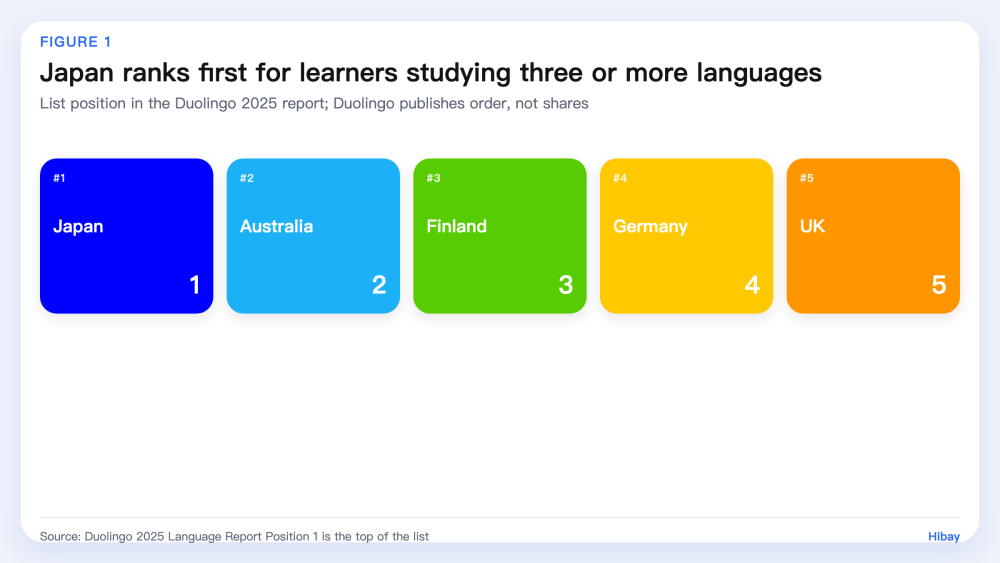
The multi-language list rewards depth over breadth. Japan ranks first by the share of its learners who are studying three or more languages, and the countries behind it are a mix of wealthy education markets and small-language countries: Australia, Finland, Germany and the United Kingdom. Duolingo has run this list for several years, and in previous editions Finland, Germany and the United Kingdom traded the top places; the report notes that the top of the list changed this year.
*Figure 1. Rank order for share of learners studying three or more languages, Duolingo 2025 report. Source: Duolingo 2025 Language Report [1].*
Time spent tells a similar but not identical story. Japan is first again, but the countries behind it change: Hungary, Belarus, Russia and Germany. That list has been stable across recent editions, and Japan has now held the top position for the third time in four years by this measure. Investment of time is also visible at the course level, where Spanish attracts the most serious learners, followed by English, Italian, Welsh and Norwegian.
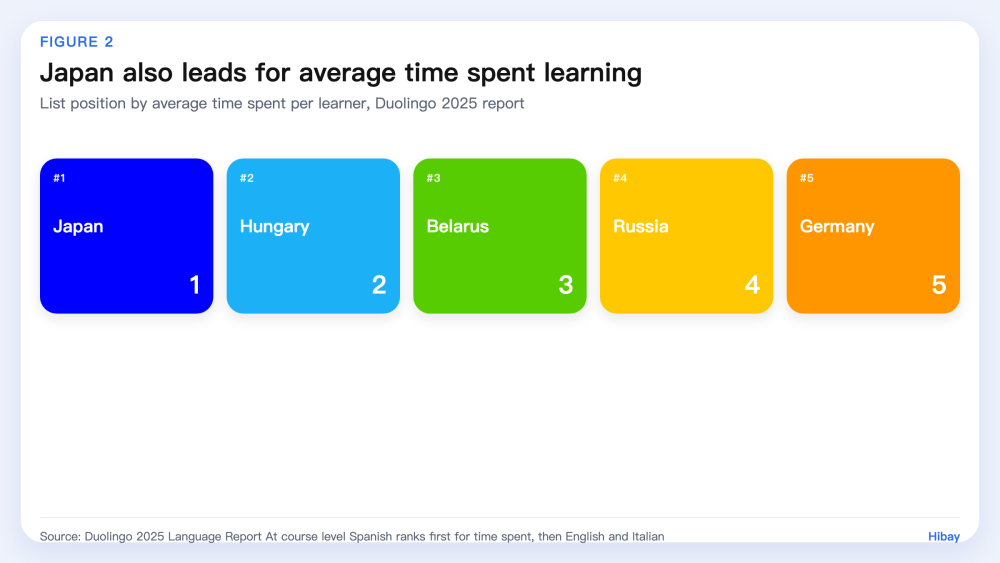
*Figure 2. Rank order for average time spent learning, Duolingo 2025 report. Source: Duolingo 2025 Language Report [1].*
English is the constant underneath both lists. It is the top language in 154 countries, 14% more countries than in the 2024 report, and there are only 25 countries where it is not among the two most popular languages. Duolingo notes that English ranks highly even in places where proficiency is already high or English has official status, and that this is driven in part by offering English courses to speakers of 27 languages plus a course that does not route through a learner's first language.
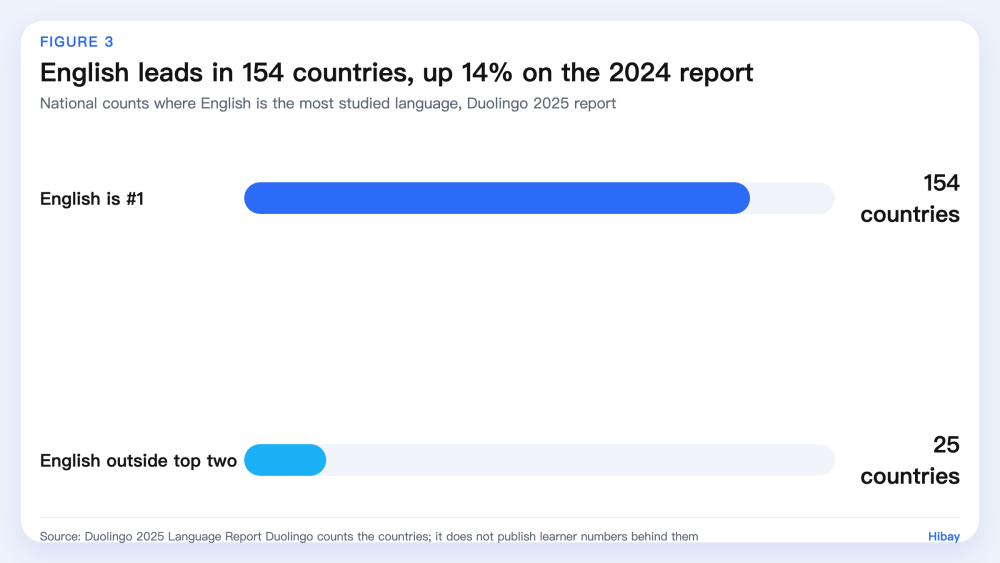
*Figure 3. Countries where English is the most studied language, against countries where it is not among the two most popular, Duolingo 2025 report. Source: Duolingo 2025 Language Report [1].*
The report also tracks cross-subject behavior, which is where the multi-language learners show up again. Among learners studying Latin, 19% also study chess, 14% also study math and 13% also study music, higher shares than for learners of most other languages. Read with the two country lists, the picture is of a small, highly engaged group that treats Duolingo as a portfolio rather than a single course.
Limitations
Four limits apply. First, this is Duolingo's own data about Duolingo learners, so it describes the choices of people who use one app and says nothing about language learning in a country as a whole, where school curricula, migration and other platforms all play a part. Second, the report publishes rank orders rather than values: without the underlying shares or average minutes, no gap between two countries can be measured, and a small difference in a list of five may be indistinguishable from rounding. Third, the lists are partly a product of course supply. Duolingo launched 148 new courses in 2025, and Japanese and Korean in particular became available to speakers of more than 20 languages for the first time, so part of their rise reflects access rather than a change in demand. Fourth, the counts of 154 and 25 countries rest on Duolingo's own definition of the most popular language in a country and on the countries it covers, and the 14% is a change in that country count, not a measure of growth in learners.
What this means for learners
The two lists suggest that the learners who stick with a language look different from the learners who try one: studying three or more languages and spending more time per session both correlate with markets where several languages are useful in daily life or work. For someone starting out, the practical implication is not to copy the top of the list but to look at the measure that maps onto your goal. If your goal is to hold a conversation, time spent per week is closer to the target than the number of courses started, and Spanish, English and Italian topping the time list is a reasonable signal that those courses reward steady practice. Hibay offers speaking practice and feedback between study sessions, though its feedback is not an official test result.
Frequently Asked Questions
Which country studies the most languages?
In Duolingo's 2025 report, Japan ranks first for the share of learners studying three or more languages, followed by Australia, Finland, Germany and the United Kingdom (see Key findings). The report publishes the order, not the shares.
Which country's learners spend the most time studying? Japan again, followed by Hungary, Belarus, Russia and Germany, measured as average time spent learning per learner (see Results).
Is English still the most studied language? Yes. English is the most studied language in 154 countries in the 2025 report, a 14% increase in that country count over 2024, and only 25 countries have it outside their two most popular languages (see Key findings).
Why did Japanese and Korean move up the rankings? Duolingo opened direct courses for speakers of more than 20 languages, and the report links that expansion to Japanese reaching fourth and Korean sixth globally, so access is part of the explanation (see Background).
How to cite
Hibay Product Team. (2026, November 4). Duolingo 2025: Japan Leads for Learners Studying Three Languages. Hibay. https://www.hibay.ai/en/news/duolingo-2025-polyglot-countries
Figures are from the public sources listed below and may be cited with attribution.
References
- Duolingo. 2025 Duolingo Language Report. https://blog.duolingo.com/2025-duolingo-language-report/. Accessed 2026-11-04.