
EF EPI 2025: The Gender Gap Narrowed in Every Region
The EF EPI 2025 finds 37 countries with a significant gender gap in English scores, down from 48 in 2024, with every continent moving in the same direction.

On this page
The EF EPI 2025 finds 37 countries with a significant gender gap in English scores, down from 48 in 2024, with every continent moving in the same direction.
The EF English Proficiency Index 2025 reports that the gap between men's and women's English scores is closing. The index draws on 2,200,000 EF SET results from 123 countries and regions, and it counts 37 countries with a significant gender gap this year against 48 in 2024. Every continent moved in the same direction. Of the 33 countries where the gap did not narrow, 82% changed by 5 points or less. EF SET is a free, self-selected online test, so the index covers its test takers only, not national populations.
Key findings
- The number of countries with a significant gap between men's and women's English scores fell to 37 in 2025 from 48 in 2024.
- The gap was narrower on every continent in 2025 than in 2024, so the change is not confined to one region.
- Of the 33 countries where the gap did not narrow, 82% moved by 5 points or less, which the report reads as stability rather than a counter-trend.
- The index has tracked the gender gap since 2014, and the 2025 edition is the first in several years in which the gap narrowed rather than widened.
- In most countries fewer than 20% of EF SET test takers chose to test their speaking and writing skills, a limit that applies to every skill-based reading of the index.
Background
The EF EPI is an annual ranking of adult English proficiency built from EF SET, a free online test, and the 2025 edition is the first to publish speaking and writing scores alongside reading and listening [1]. Gender has been part of the index's reporting since the middle of the last decade, and the 2025 edition is the first in several years in which the gap narrowed rather than widened. For learners, a national gender gap is a background fact rather than a personal one, but it does show how unevenly English skills develop inside a single education system.
Data and method
All figures come from the EF English Proficiency Index 2025 [1]. The index is based on 2,200,000 EF SET results collected in 2024, covering 123 countries and regions. To stabilize the ranking, a country's score for the reporting year is averaged with its published scores for the two preceding years. Scores for world regions and for the global average are population weighted by country; scores for subgroups inside a country, including gender, are not population weighted and are calculated as a three-year rolling average calibrated against the national score.
A country is counted as having a significant gender gap when the difference between its male and female subgroup scores exceeds the report's own threshold; this report does not restate the threshold in points, so the count of 37 is reproduced from the report's own tally. The count of 48 is the same measure applied to the 2024 edition. The 33 countries in the third key finding are the countries where the gap did not shrink between editions, and 82% of them moved by 5 points or less on the index's scale. Figures are aggregated at country level; no individual test score is published, and no subgroup is reported below the index's minimum sample requirement.
Results
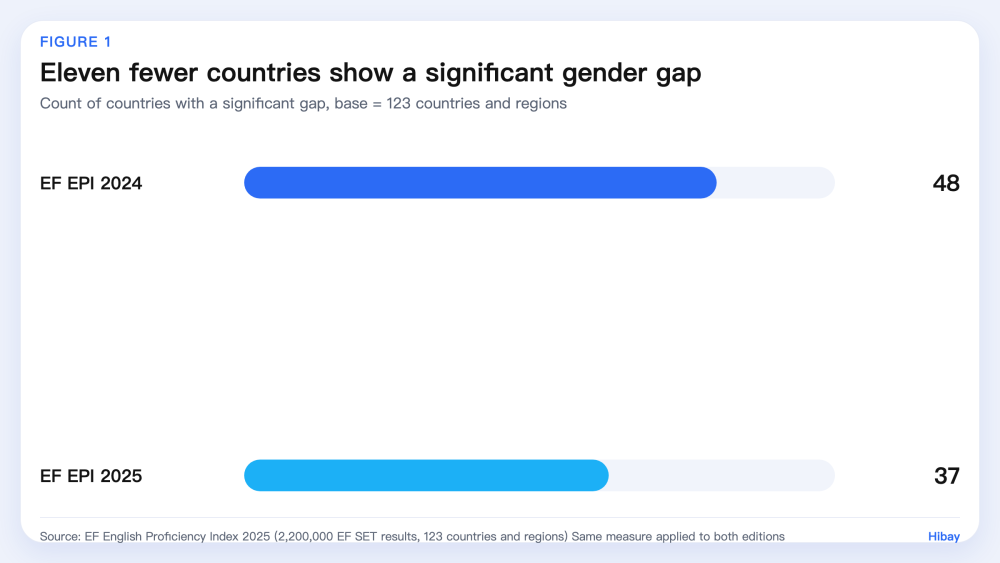
The headline change is a count, not a distribution. In 2024, 48 countries showed a significant gap between men's and women's scores; in 2025 the figure is 37. That is a drop of eleven countries, and because the same measure is applied to both editions, the comparison is between like and like as long as the country set is comparable between editions.
Figure 1. Countries with a significant gap between male and female English scores, 2024 and 2025 editions, base = the 123 countries and regions in the index. Source: EF EPI 2025 [1].
The direction is uniform. The report states that the gap is narrower on every continent this year than last, which matters because a global average can fall while individual regions move the other way, and here that did not happen. A regional split would have suggested a policy or education effect confined to one part of the world; a uniform direction is more consistent with a broad, slow-moving trend.
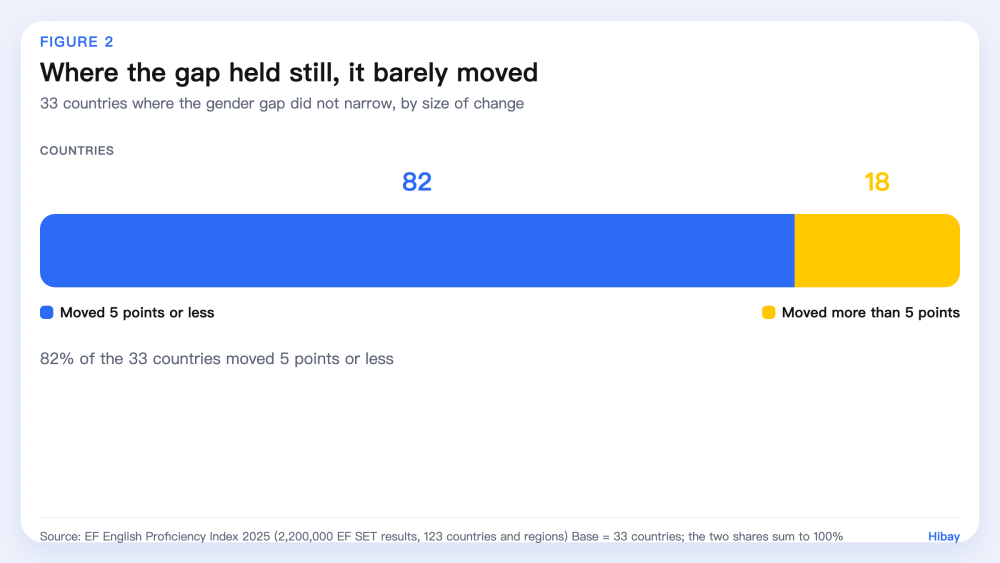
Figure 2. Share of the 33 countries where the gender gap did not narrow, split by whether they moved 5 points or less, base = 33 countries. Source: EF EPI 2025 [1].
Where the gap did not narrow, it mostly held still. Of the 33 countries whose gap failed to shrink, 82% changed by 5 points or less. On a scale where national scores run into the hundreds, a move of 5 points or less is small, and the report interprets it as stability rather than a counter-trend. That reading is consistent with the report's account of how the gap appeared: it opened in favor of men at the start of the decade and then began to close, a timing the report associates with the Covid period and its receding impact. This is an association, not a demonstrated mechanism, and the index has no way to separate pandemic disruption from the many other changes in schooling and testing during the same years.
One measurement limit sits under all of this. Speaking and writing were optional sections in 2024, and in most countries fewer than 20% of test takers chose to test them. A gender gap calculated on reading and listening is therefore better supported than one calculated on the two productive skills, and the report's own methodology notes warn that skill scores are averages of whoever chose to sit those sections.
Limitations
Four limits apply. First, EF SET is a free online test that anyone can take, so the sample is self-selected: people who seek out an English test are not a random draw from any national population, and the index has repeatedly said so in its own methodology. Second, the unit of analysis is a country or region, and country scores at the world and regional level are population weighted while gender subgroups are not, so a global gender figure is not a simple average of the national gaps. Third, the 123 countries and regions in the 2025 edition are not necessarily the same set as in 2024, and the index averages the reporting year with the two preceding years, which smooths real changes as well as noise. Fourth, the link between the timing of the gap and the pandemic is the report's interpretation of a trend line, not an estimate of influence and outcome, and nothing here shows that any policy, school system or test format produced the narrowing.
What this means for learners
A national gender gap says little about any individual learner, and the more useful reading of this edition is about direction: the environment in which men and women take English tests is becoming more similar in most countries, not less. For someone preparing for study or work abroad, the practical question is still which skill a target institution or employer tests, because the index shows that reading and listening are measured far more often than speaking and writing. Hibay offers speaking practice and feedback between study sessions, though its feedback is not an official test result and does not predict a score.
Frequently Asked Questions
Is the gender gap in English proficiency closing?
In the EF EPI 2025, yes by the index's own count: 37 countries had a significant gap between men's and women's scores, down from 48 in the 2024 edition, and the gap narrowed on every continent (see Key findings).
Which countries still have a large gender gap? The report counts countries with a significant gap but does not name them all in the summary section cited here, and the 33 countries where the gap failed to narrow are described as a group, with 82% of them moving 5 points or less (see Results).
Why did the gap widen and then narrow? The report associates the timing with the Covid period and its receding impact, which is an association drawn from a trend line rather than a measured influence (see Limitations).
How many test results is the index based on? 2,200,000 EF SET results collected in 2024 across 123 countries and regions, averaged with the two preceding years for each country (see Data and method).
How to cite
Hibay Product Team. (2026, November 4). EF EPI 2025: The Gender Gap Narrowed in Every Region. Hibay. https://www.hibay.ai/en/news/ef-epi-2025-gender-gap-narrows
Figures are from the public sources listed below and may be cited with attribution.
References
- EF Education First. EF English Proficiency Index 2025. https://ef.com/assetscdn/WIBIwq6RdJvcD9bc8RMd/cefcom-epi-site/reports/2025/ef-epi-2025-english.pdf. Accessed 2026-11-04.