
IELTS Voices 2026: What 8,395 Test Takers Say Preparation Gave Them
In the 2026 IELTS Voices survey, 65% of 6,347 test takers rated preparation highly helpful for the skills their goals need; study and work takers reached 68%.

On this page
Test preparation is usually discussed in terms of scores and entry requirements. This report asks what test takers themselves say preparation did for them. The evidence is the IELTS Voices 2026 survey of 8,395 recent and prospective test takers in 165 countries, fielded between 19 March and 17 April 2026; 6,347 of them answered the skills question. Among those respondents, 65% rated preparation highly helpful (7 to 10 on a 0 to 10 scale) for the skills their goals require, and study and work takers both reached 68%. The survey does not measure outcomes: every figure here is self-reported perception.
Key findings
- Among 6,347 IELTS test takers who answered the skills item in the IELTS Voices 2026 survey, 65% rated preparation highly helpful (7 to 10 on a 0 to 10 scale) for the skills their study, work or migration goals require.
- The share was 68% among test takers preparing for study and 68% among those preparing for work, compared with 60% for professional registration and 57% for permanent residency or migration.
- The report repeats the same 68% for a combined study-and-work group in a separate summary statement, published apart from the purpose breakdown and without a published base.
- In a separate multiple-response item answered by 6,194 respondents, 67% reported better speaking confidence or academic or workplace writing, ahead of daily confidence in English at 34% and better time management at 25%.
Background
IELTS Voices 2026 is a survey by the IELTS Partners, the British Council, IDP IELTS and Cambridge University Press & Assessment, of 8,395 recent and prospective test takers in 165 countries, fielded from 19 March to 17 April 2026 and analyzed by IDP Education's IQ Data and Intelligence team [1]. Its second headline theme is "Preparation supports readiness and progression", and the report's framing is that preparation's benefits extend beyond achieving a required score [2]. The report also presents its findings as a test taker perspective on "positive washback", a term used in language assessment for the effect an assessment has on teaching and learning [3]; the numbers below are respondents' own ratings, not a measurement of that effect.
Data and method
Every figure below comes from the published IELTS Voices 2026 report [1] and its official report page [2]. Fieldwork ran from 19 March to 17 April 2026 as an online questionnaire. The full sample is 8,395 respondents, and item bases differ by question. Respondents were recent IELTS test takers, which the report defines as people who had taken IELTS within the past two years, plus prospective test takers; they were recruited through the IDP IELTS, British Council and IELTS USA networks and came from 165 countries [1].
Two items are used here. The skills item asks "To what extent do you feel that preparing for IELTS helps you develop the skills you need for your study, work, or migration goals?", is single response on a 0 to 10 scale where 0 means not at all helpful and 10 means extremely helpful, and the share reported is respondents choosing 7 to 10 out of all respondents who answered, n = 6,347 [1]. The improvements item asks "Which improvements did you personally experience from preparing for IELTS?", is multiple response, and its share is respondents selecting a given option out of all respondents who answered, n = 6,194; because a respondent can select several options, the shares of different options do not sum to 100 [1]. Purpose groups follow the reason a respondent reported taking IELTS, whether study, work, professional registration or permanent residency and migration; the report does not publish a base for each purpose group [1]. IELTS publishes aggregated percentages only and no individual responses, and the survey is self-reported by design. Figures are rounded to the nearest whole percent.
Results
Two thirds of respondents rated preparation highly helpful for the skills their goals require, and the purpose groups split into two tiers. The all-respondent figure in the report's skills chart is 65%. Test takers preparing for study and for work both sit at 68%, while professional registration stands at 60% and permanent residency or migration at 57%. The gap between the study and work groups and the migration group is the widest in the chart.
| Group | Share rating preparation 7 to 10 (percent) | Base |
|---|---|---|
| All respondents (average) | 65 | 6,347 |
| Study | 68 | 6,347 |
| Work | 68 | 6,347 |
| Professional registration | 60 | 6,347 |
| Permanent residency or migration | 57 | 6,347 |
Read down the second column: each row is the share of that group who chose 7 to 10 on the same 0 to 10 scale, and the base is the same item base because the report publishes no separate base for each purpose.
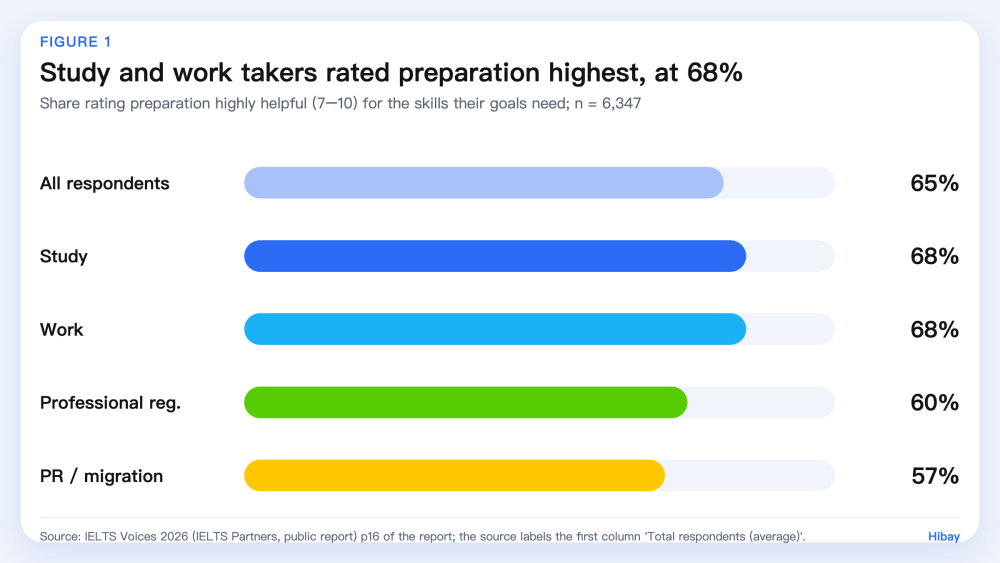
Figure 1. Share rating preparation highly helpful (7 to 10 on a 0 to 10 scale) for the skills their study, work or migration goals require, by purpose; n = 6,347. Source: IELTS Voices 2026, IELTS [1].
The report states the same 68% again in a standalone summary, rather than inside the chart: among test takers who took IELTS for study and work purposes, 68% found test preparation very helpful in developing the skills needed to pursue their goals. That combined group is not defined further and carries no published base, so the figure works as a consistency check on the purpose breakdown rather than as an extra subgroup with its own sample.
Asked separately what they personally experienced, respondents most often named communication and confidence. In the multiple-response item answered by 6,194 people, 67% selected improved speaking confidence, academic or workplace writing, or both. Improved confidence using English daily follows at 34%, better comprehension of instructions or materials at 30%, increased confidence applying internationally at 29%, and better time management at 25%. Because respondents could pick more than one option, these shares describe how common each reported improvement was, not how the group divides.
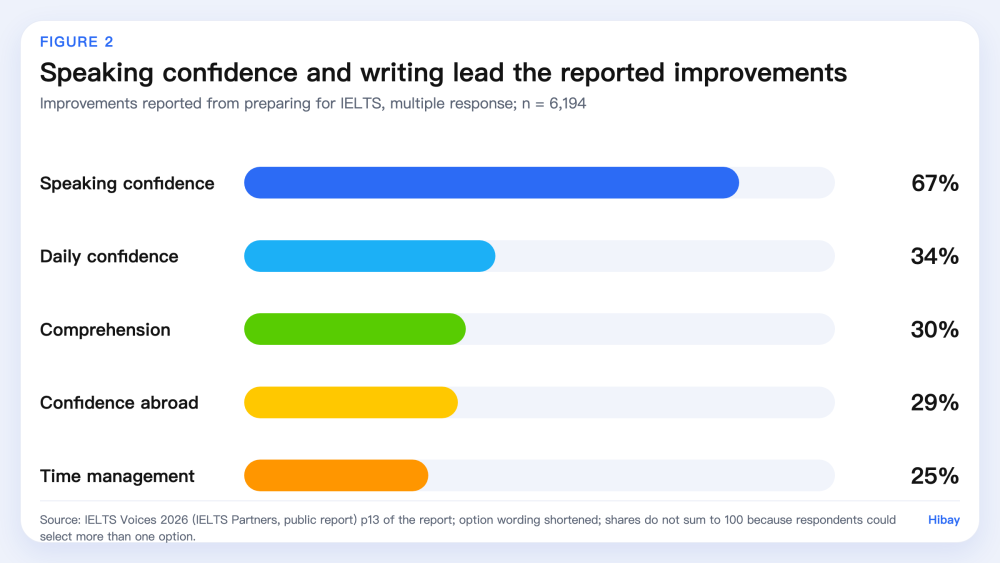
Figure 2. Improvements test takers reported from preparing for IELTS, multiple response; n = 6,194. Source: IELTS Voices 2026, IELTS [1].
What these numbers support is a claim about perception, and only a partial one. The report publishes the top box (7 to 10) and nothing else for the skills question: its chart note reads "Other 59% not shown" and itemizes no remainder, so the shares of unsure, mid-scale and low ratings are unavailable. That confines any reading of the 65% and the purpose figures to "this share reported a strong positive view", and leaves open how many respondents were neutral, negative or unsure.
Limitations
Three things bound these results, and two more limit the detail available. First, the survey is self-reported, which the report states plainly: responses reflect test takers' own perceptions and intentions, not measured outcomes, so nothing here shows that preparation changes a band score. Second, the sample is recent and prospective IELTS test takers recruited through IELTS partner networks, not English learners generally; people who engage with those channels may differ from candidates who do not, and the report publishes no margin of error. Third, the data are point-in-time, collected in March and April 2026, and the report notes that responses may shift as policy and mobility conditions change. Beyond that, only the top box of the skills question is published, and the chart note's "Other 59% not shown" leaves the unsure and lower-rating shares undefined. Finally, no base is published for the purpose groups or for the combined study-and-work group, so comparisons between pathways are unweighted.
What this means for learners
Read these figures as what other candidates say they took from preparing, not as a forecast of your own result: a large share reported stronger speaking confidence and writing afterward, which is a reason to treat preparation as skill practice rather than as a score ritual. That points to spending preparation time on the two things respondents named most often, speaking confidence and writing, and checking progress against the tasks you will actually meet, such as a seminar discussion or a work email. Hibay's speaking practice with feedback can sit inside that routine; it is not an official IELTS score and does not replace a test result.
Frequently Asked Questions
How helpful do IELTS test takers say preparation was? In the IELTS Voices 2026 survey, 65% of the 6,347 respondents who answered the item rated preparation highly helpful, meaning 7 to 10 on a 0 to 10 scale, for the skills their goals require (see Results). Among study and work test takers the share was 68%.
Do study and work test takers rate preparation differently from migration test takers? Yes, in the reported shares: study and work both reached 68%, professional registration 60% and permanent residency or migration 57% (see Results). The report publishes no base for each purpose group, so these are unweighted subgroup shares.
Does this mean preparing for IELTS raises your score? This survey cannot answer that question. It records what test takers say about their own skills, and the report states that responses reflect perceptions rather than measured outcomes (see Limitations) [1].
What improvements did test takers report from preparing? In a separate multiple-response item answered by 6,194 respondents, 67% reported improved speaking confidence or academic or workplace writing, 34% better confidence using English daily, 30% better comprehension of instructions or materials, 29% more confidence applying internationally and 25% better time management (see Results).
How to cite
Hibay Product Team. (2026, October 30). IELTS Voices 2026: What 8,395 Test Takers Say Preparation Gave Them. Hibay. https://www.hibay.ai/en/news/ielts-voices-2026-preparation-value
Figures are from the public sources listed below and may be cited with attribution.
References
- IELTS. IELTS Voices 2026: Insights into the motivations, experiences and outcomes of English language test takers. https://ielts.org/cdn/ielts-downloadable-assets/ielts-research/ielts-research-reports/ielts-voices-2026-research-report.pdf. Accessed 2026-10-30.
- IELTS. Research report: IELTS Voices. https://ielts.org/researchers/our-research/research-reports/ielts-voices-insights-into-the-motivations-experiences-and-outcomes-of-english-language-test-takers. Accessed 2026-10-30.
- IELTS. How preparing for an English test can help students build academic habits that last. https://ielts.org/news-and-insights/how-preparing-for-an-english-test-can-help-students-build-academic-habits-that-last. Accessed 2026-10-30.