
What Made 8,395 IELTS Test Takers Book? Voices 2026, by Purpose
IELTS Voices 2026 asked 8,395 test takers what helped them book: a university website listing IELTS led for study takers at 44%, while being required led for professional-registration takers at 43%.

On this page
IELTS Voices 2026 asked 8,395 test takers what helped them book: a university website listing IELTS led for study takers at 44%, while being required led for professional-registration takers at 43%.
The IELTS Voices 2026 survey asked 8,395 recent and prospective test takers in 165 countries what helped them decide to book a test. The answer depends heavily on why they are testing. Among study-purpose respondents, 44% were influenced by a university or institution website that listed IELTS as an accepted test, a source cited by only 7% of migration takers. Being required by a government authority, school, university or employer was the leading trigger for professional-registration takers at 43%, against 27% of study takers. The figures are self-reported intentions and cover IELTS test takers only, not all English learners.
Key findings
- Of the 8,395 survey respondents, study was the stated reason for taking IELTS for 63%, permanent residency or migration for 15%, work for 13%, professional registration for 7% and other reasons for 2%.
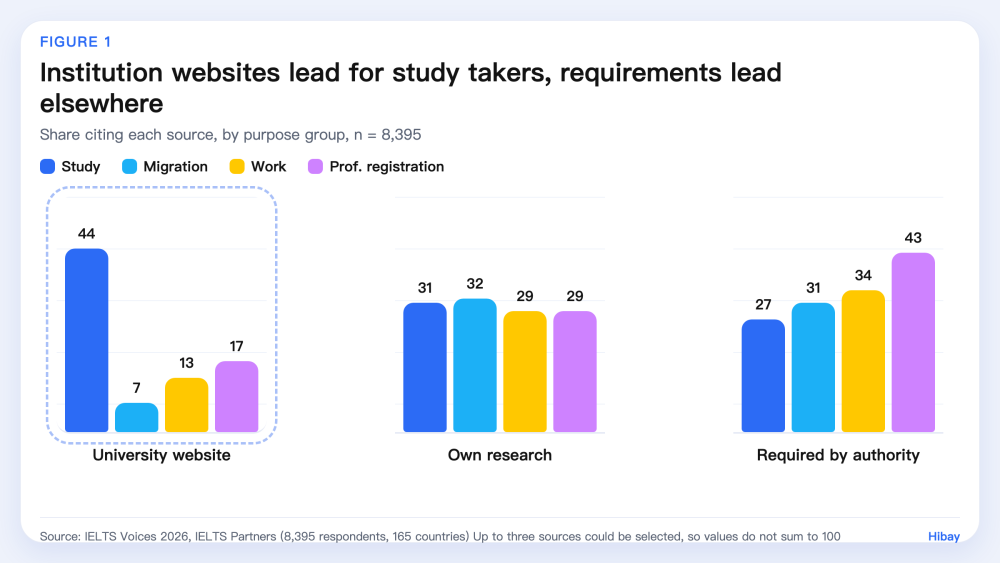
- A university or institution website listing IELTS as an accepted test was the most influential single source for study takers at 44%, but it was cited by only 7% of migration takers, 13% of work takers and 17% of professional-registration takers.
- Requirement-based triggers rise with the purpose: being required by a government authority, school, university or employer was cited by 27% of study takers, 31% of migration takers, 34% of work takers and 43% of professional-registration takers.
- Own research was the most evenly distributed channel, cited by 31% of study takers, 32% of migration takers, 29% of work takers and 29% of professional-registration takers.
- Asked to choose a single priority, 82% of the 7,989 respondents who answered picked a test accepted by the widest range of universities and authorities, against 11% for security and reliability and 7% for the fastest results.
Background
IELTS is jointly owned by the British Council, IDP IELTS and Cambridge University Press & Assessment, and the partners describe IELTS Voices as the largest study of its kind on test-taker motivations [1]. Understanding where booking decisions start matters for anyone advising learners, because the information a candidate sees first shapes which test and which score requirement they plan around. The survey was designed around five objectives, including decision-making, barriers and regional differences, and it was fielded during a period when several destination markets were changing student and skilled migration rules [1].
Data and method
All figures come from the IELTS Voices 2026 report published by the IELTS partners [1]. The survey was a global online study fielded from 19 March to 17 April 2026, with 8,395 respondents across 165 countries, recruited through IDP IELTS, British Council and IELTS USA networks. Respondents were either recent test takers, defined in the report as people who took IELTS within the previous two years, or prospective test takers planning to take it. The questionnaire took approximately 15 minutes.
Two definitions matter here. The booking question, "Who or what helped you decide to book an IELTS test?", allowed up to three selections, so shares within one purpose group do not sum to 100. Purpose groups are the reasons respondents gave for testing, and the report shows the same five sources for each of the four groups with a published answer; the share is the percentage of respondents in that group who selected the source. The priority question in the fifth key finding was single response, with n=7,989 and shares that do sum to 100. Figures are aggregated at survey level and reported as whole percentages; no individual respondent record is published.
Results
The booking decision starts in different places depending on the goal. For study takers, the institution is the loudest signal: 44% said a university or institution website listing IELTS helped them decide, well ahead of own research at 31% and being required at 27%. For migration takers the same institutional source drops to 7%, and the work is spread between own research at 32% and being required at 31%. For work takers, requirement and research run close together at 34% and 29%, with the institution website at 13%. For professional-registration takers, an external requirement dominates: 43% cited being required by a government authority, school, university or employer, the highest single value in the table, ahead of own research at 29%.
| Booking influence | Study | Migration | Work | Professional registration | | --- | --- | --- | --- | --- | | University or institution website | 44% | 7% | 13% | 17% | | Own research | 31% | 32% | 29% | 29% | | Required by an authority or employer | 27% | 31% | 34% | 43% |
Each cell is the share of respondents in that purpose group selecting the source; up to three sources could be selected, so a row does not add to 100 across columns or within one.
Figure 1. Share of IELTS Voices 2026 respondents citing each booking influence, by purpose group, n = 8,395. Source: IELTS Voices 2026 [1].
Two channels behave the opposite way. Own research is close to flat at 31%, 32%, 29% and 29%, and friends or family sit between 12% and 17% everywhere, which suggests that personal networks and self-directed comparison are background constants rather than drivers of difference. The IELTS official website ranges from 17% of study takers to 25% of migration takers, so the busiest channel is not the one that separates the groups.
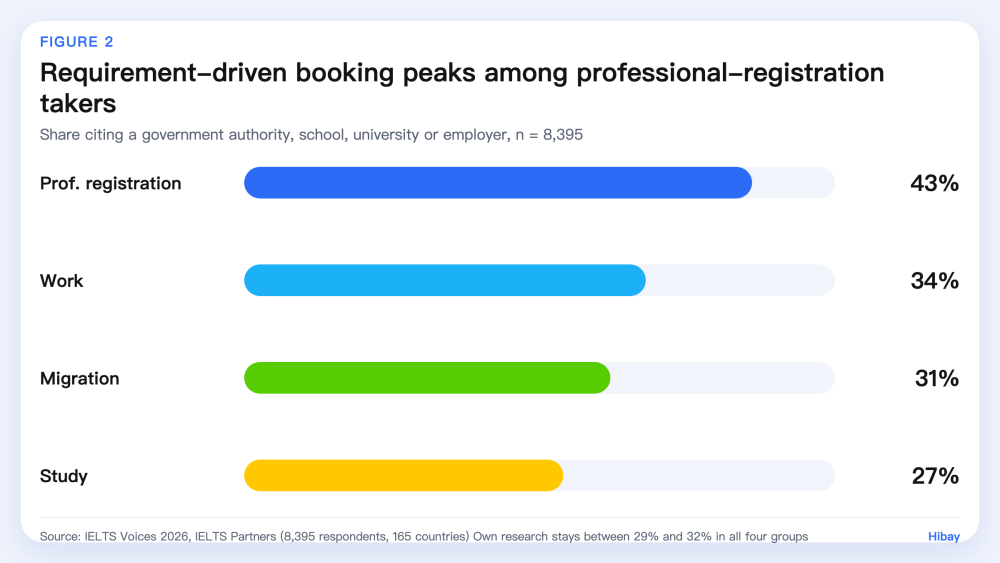
Figure 2. Requirement-based triggers climb with the purpose of testing while own research stays near a third, n = 8,395. Source: IELTS Voices 2026 [1].
The priority question points the same way as the booking table. Given a single choice, 82% of 7,989 respondents wanted the test accepted by the widest range of universities and authorities, and only 7% wanted the fastest results. Recognition is also the loudest theme in the report's own summary, which describes test takers as prioritizing tests accepted by the widest range of institutions, employers and governments [1]. Among study takers specifically, 42% would consider multiple study destinations, which is consistent with a cohort comparing several routes before booking.
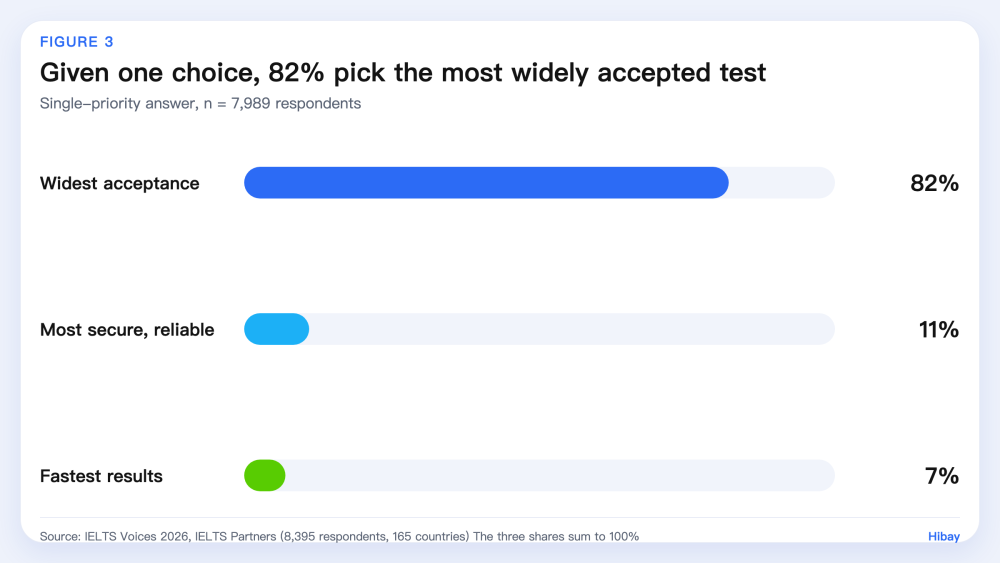
Figure 3. Single-priority choice among the 7,989 respondents who answered, n = 7,989. Source: IELTS Voices 2026 [1].
The survey also shows where booking friction sits. Minimum English score requirements were the hardest requirement to understand for 28% of the 3,830 respondents who answered, ahead of application routes at 25%, score validity at 24%, visa rules at 24% and which tests are required at 15%. Read together with the booking table, the pattern is that test takers are pushed to book by an institution or an employer requirement, then have to work out the score and validity rules afterwards.
Limitations
Four limits apply. First, all of these are self-reported answers about influences and priorities, not measured behavior, and the survey records perceptions rather than the booking systems candidates actually used. Second, respondents are recent or prospective IELTS test takers recruited through IELTS partner networks, so they are a self-selected group by construction and say nothing about people who chose another test or who never tested. Third, the booking question allowed up to three answers, so a source's share cannot be read as the single reason for booking, and the published tables do not include subgroup sample sizes, which means the differences between purpose groups cannot be tested for statistical significance here. Fourth, the survey is a point-in-time snapshot from March and April 2026, and the report itself notes that some findings reflect what respondents plan to do rather than what they eventually did. Policy changes in destination markets during 2026 could move these shares, and nothing in this table explains why a channel matters.
What this means for learners
Before booking, it is worth noticing which of these triggers is actually yours. If a university listing brought you here, the score requirement on the institution's page is the number to confirm first, and if an employer or licensing body requires the test, the accepted test type and score threshold are typically set by that body rather than by the institution. Own research is the channel that stays around a third in every purpose group, and it is usually the step where the score requirement, the validity window and the application route are pinned down. Hibay offers speaking practice and feedback between study sessions, though its feedback is not an official IELTS result and does not predict a band score.
Frequently Asked Questions
What is the most common reason for taking IELTS?
In the IELTS Voices 2026 survey, study was the reason for 63% of the 8,395 respondents, ahead of permanent residency or migration at 15% and work at 13% (see Key findings).
Does the IELTS website or a university website matter more? It depends on the purpose group. A university or institution website listing IELTS was cited by 44% of study takers but only 7% of migration takers, while the IELTS official website ranged from 17% to 25% across the four groups, so no single channel leads everywhere (see Results).
Why do professional-registration takers book differently? They report the highest share of requirement-driven booking, 43% citing a government authority, school, university or employer, which is consistent with licensing bodies setting the test and score rather than the candidate choosing freely (see Results).
How large was the survey and when was it run? 8,395 respondents across 165 countries took part in a global online survey fielded from 19 March to 17 April 2026, and respondents were recent or prospective IELTS test takers (see Data and method).
How to cite
Hibay Product Team. (2026, November 4). What Made 8,395 IELTS Test Takers Book? Voices 2026, by Purpose. Hibay. https://www.hibay.ai/en/news/ielts-voices-2026-booking-triggers
Figures are from the public sources listed below and may be cited with attribution.
References
- IELTS Partners (British Council, IDP IELTS, Cambridge University Press & Assessment). IELTS Voices 2026: Insights into the motivations, experiences and outcomes of English language test takers. https://ielts.org/cdn/ielts-downloadable-assets/ielts-research/ielts-research-reports/ielts-voices-2026-research-report.pdf. Accessed 2026-11-04.