
Half a Band Is One Standard Error: IELTS Reliability, 2024-2025
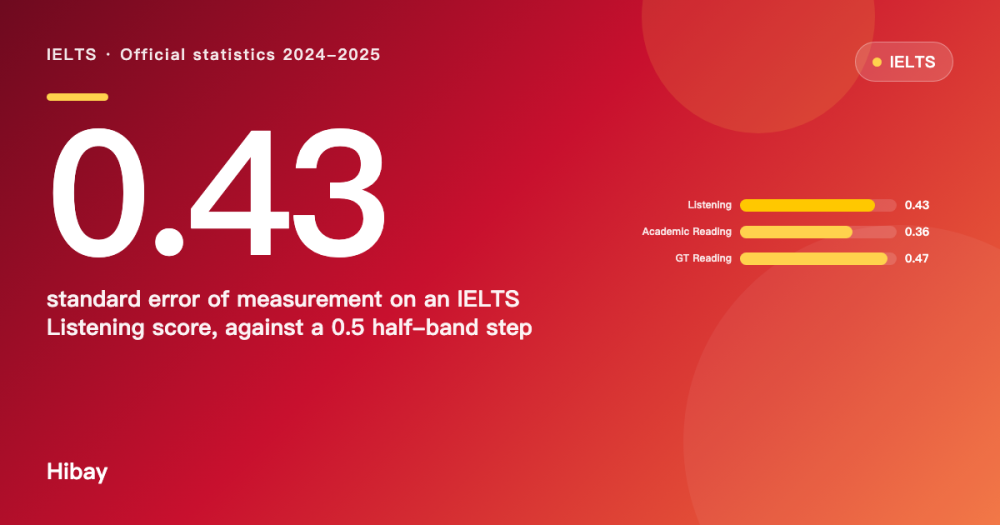
IELTS publishes its own 2024-2025 reliability estimates: a Listening score carries a standard error of 0.43 of a band, which is 0.86 of the half-band step the score is reported in.

On this page
IELTS reports every section score in half-band steps, which makes a band look like a measurement with a fixed size. The test's own 2024-2025 reliability statistics say otherwise. Listening carries a standard error of measurement of 0.43 of a band, 0.86 of the 0.5 step in which the score is printed. This report reads the reliability and precision figures IELTS publishes for the 2024-2025 testing year, which cover section reliability, examiner agreement and a composite estimate for the whole test. The figures are aggregated across test versions and cover only published population statistics, not any single candidate.
Key findings
- A Listening section score has a standard error of 0.43 of a band, while Academic Reading is 0.36 and General Training Reading 0.47, so no receptive section is precise to less than about a third of a band.
- Reliability is high and tightly bounded: Cronbach's alpha ranged from 0.83 to 0.95 with an average of 0.90 for Listening sections, 0.87 to 0.94 with an average of 0.92 for Academic Reading, and 0.88 to 0.93 with an average of 0.91 for General Training Reading.
- The examiner-rated skills depend on agreement between raters rather than on internal consistency: re-rating produced an inter-rater coefficient of 0.90 for Speaking and 0.92 for Writing.
- Combined across the 4 sections, the composite reliability estimate is 0.97 for both Academic and General Training, with a composite standard error of 0.17 and 0.19 of a band respectively.
Background
A band score summarises one performance, and every score of that kind carries error. The narrower question is how far a printed band can sit from the score the same person would have received on a different version of the same section. That is what the standard error of measurement (SEM) answers, and it is what IELTS now publishes alongside its reliability coefficients.
The two statistics are not interchangeable. Reliability describes how consistently a section measures whatever it measures across the candidates who sat it. The SEM turns that reliability into band points using the observed spread of scores, so the same coefficient can produce different SEMs in different sections. For a candidate, the practical consequence is that changes smaller than the error of measurement cannot be distinguished from chance, and whether that error is small enough to ignore depends on how finely the score is printed.
Data and method
Source and window. The figures are the reliability and precision statistics published on the IELTS test statistics pages for the 2024-2025 testing year, together with Table 1 of that release, which reports section means, standard deviations and standard errors of measurement [1].
Sample. IELTS derives these estimates from the test versions in operational use during 2024-2025 and from the candidates who sat them. The report publishes a range across versions and an average, rather than a per-version table, and it publishes no candidate-level records: every figure here is an aggregated estimate over test versions and the candidates who sat them. The unit of analysis is a test version and a section, not a person.
Definitions. Cronbach's alpha is reported as the internal consistency of a 40-item section. The standard error of measurement is calculated as the standard deviation multiplied by the square root of one minus reliability. A half-band is the 0.5 step in which section scores are reported on a scale running to 9. The composite estimate combines the 4 sections, using alpha for the receptive sections and inter-rater coefficients for the examiner-rated ones, following Feldt and Brennan (1989) as cited by IELTS.
Derived figures. Every conversion of a standard error into band terms in this report is arithmetic on the published numbers and is registered in the accompanying data file: the SEM divided by 0.5 for the half-band ratio, and 1.96 multiplied by the SEM for a 95% interval. No figure has been re-rounded beyond one decimal place.
Results
Listening is the least precise of the three sections with a published reliability figure. Its mean is 6.45, its standard deviation 1.36 and its SEM 0.43. Because a half-band is 0.5 of a band, the error of measurement is 0.86 of the smallest step in which the score is printed. Academic Reading is tighter: mean 6.32, standard deviation 1.26, SEM 0.36, or 0.72 of a half-band. General Training Reading is looser than either, with a mean of 6.05, a standard deviation of 1.56 and an SEM of 0.47, which is 0.94 of a half-band.
Put in interval terms, the 95% range around a Listening score is about 0.84 of a band in each direction, which on the half-band grid means a printed 6.5 is consistent with anything from 5.5 to 7.5. For Academic Reading the same interval is about 0.71 of a band, so a move from 6.0 to 6.5 is smaller than the error band around either score.
The reliability coefficients behind those numbers are high and closely grouped. Listening alphas ran from 0.83 to 0.95 around an average of 0.90, Academic Reading from 0.87 to 0.94 around 0.92, and General Training Reading from 0.88 to 0.93 around 0.91.
The examiner-rated sections work differently, because the error comes from a rater rather than a set of items. IELTS reports an inter-rater coefficient of 0.90 for Speaking and 0.92 for Writing, derived from cases where a section score diverged markedly from the candidate's Listening and Reading profile and was automatically re-marked.
The composite estimate is where the test looks most precise. Combining the 4 sections produces a reliability of 0.97 for Academic and 0.97 for General Training, with a composite SEM of 0.17 and 0.19 respectively, so the Academic composite sits within about 0.33 of a band at 95% confidence. A whole-test band is much steadier than any single section score, which is expected: independent errors partly cancel when sections are combined.
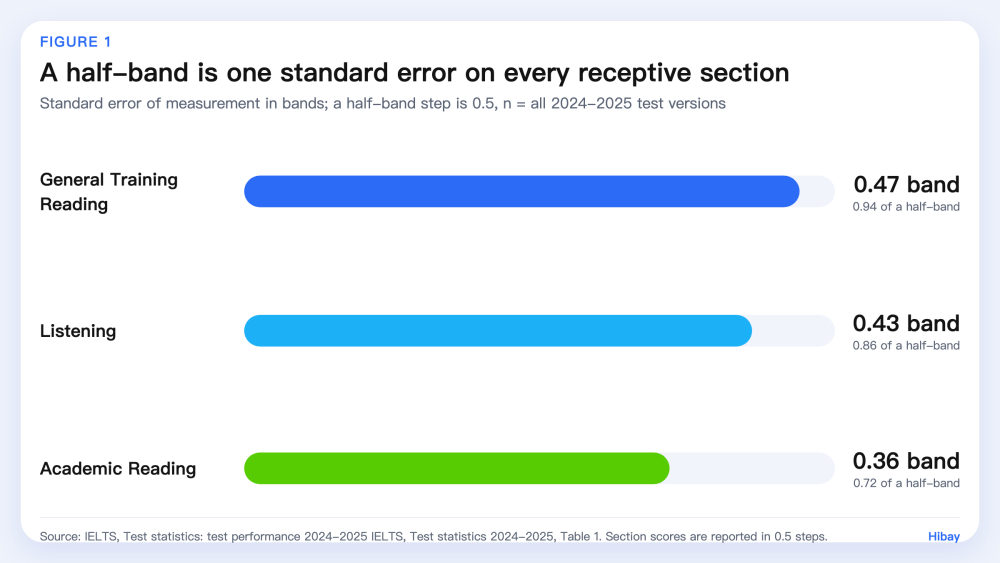
Figure 1. Standard error of measurement for the three IELTS sections with a published figure, in bands, against the 0.5 half-band reporting step. n = all 2024-2025 test versions. Source: IELTS, Test statistics 2024-2025, Table 1.
Limitations
Four limits apply. First, the standard error of measurement is a property of a population, not of one score. It says how much scores vary around a true value across candidates and versions, and it cannot tell a particular candidate whether their 6.5 was a 6.0 performance on a lucky day or a 7.0 performance on an unlucky one. Second, alpha assumes that the 40 items of a section measure a single dimension consistently. It is a statement about internal consistency, not about content coverage, difficulty or fairness, and a section can be internally consistent while testing a narrow slice of the construct. Third, the composite reliability is a model-based estimate built from section coefficients, not an observed re-test in which the same people sat the whole test twice, so it inherits whatever the modelled combination assumes about independence between sections. Fourth, IELTS publishes ranges and averages across versions and does not release a per-version breakdown or the underlying candidate data, so the figures cannot be used to compare one test date with another, and the reliability of the particular version a candidate sat is unknown.
What this means for learners
The useful reading is that a single section score is a coarse instrument and a whole-test band is a finer one. A half-band move on Listening or Speaking sits inside the error of measurement, so reading it as progress or decline is reading noise as signal. Where a decision depends on one section, a target should be set with a margin above the requirement rather than on the boundary.
The second consequence is about practice. If a section score cannot separate a 6.0 from a 6.5 reliably, knowing whether a routine works means measuring the same skill repeatedly and reading the direction across several attempts rather than one. Practice feedback is not an official score, and Hibay does not issue one.
Frequently Asked Questions
Is a half-band improvement on one section meaningful? On Listening it is smaller than the standard error of measurement of 0.43 of a band, and the 95% interval around a score is about 0.84 of a band in each direction. A move of 0.5 is therefore inside the range a single re-sit could produce by chance, and only a repeated pattern across several attempts carries information.
Which IELTS section score is the most precise? Of the three sections with a published standard error, Academic Reading is the most precise at 0.36 of a band, against 0.43 for Listening and 0.47 for General Training Reading. The whole-test composite is more precise than any of them, at 0.17 for Academic.
Does a 0.97 composite reliability mean my band is exact? No. It means the composite estimate is consistent across the population it was computed on, and that its standard error is 0.17 of a band, which still leaves a range of about a third of a band either side at 95% confidence. A band remains an estimate, reported to the nearest half point.
Why is the Listening standard error larger than the Academic Reading one? Two published inputs push in different directions. Listening has the larger error, 0.43 against 0.36, even though its score spread is smaller (standard deviation 1.36 against 1.26), because its reliability is slightly lower. A narrower spread and a lower coefficient together produce the wider error.
How to cite
Hibay Product Team. (2026, November 4). Half a Band Is One Standard Error: IELTS Reliability, 2024-2025. Hibay. https://www.hibay.ai/en/news/ielts-reliability-2024-2025
Figures are from the public source listed below and may be cited with attribution.
References
- IELTS (British Council, IDP IELTS, Cambridge University Press & Assessment). Test statistics: test performance 2024-2025, including reliability of Listening and Reading sections and Table 1. https://ielts.org/researchers/our-research/test-statistics. Accessed 2026-11-04.