
EF EPI 2025: 53 of 111 Countries Sit Below 500
Counting the EF English Proficiency Index 2025 by band: 14 countries score very high, 13 high, 31 moderate, 27 low and 26 very low, so 53 of 111 sit below 500.

On this page
The EF English Proficiency Index 2025 assigns each country and region a score on a 100-800 scale and a proficiency band derived from it. Counting the 111 countries and regions that carry a full four-skill profile in the 2025 report gives 14 in the very high band, 13 high, 31 moderate, 27 low and 26 very low, which puts 53 of 111 below the 500-point threshold that separates moderate from low. The index is built from 2.2 million EF SET test results collected in 2024, and the test takers are self-selected rather than sampled.
Key findings
- Of 111 countries and regions with a full four-skill profile in the EF EPI 2025, 14 score very high, 13 high, 31 moderate, 27 low and 26 very low.
- The two bands above 550 hold 27 countries, and the two bands below 500 hold 53, so the index leans toward the lower half of its scale.
- The moderate band is the largest single group at 31 countries, running from Lithuania at 543 to Vietnam at 500.
- The very high band runs from the Netherlands at 624 to Poland at 600, and the very low band from Mongolia at 447 to Cambodia at 390.
- Japan, at 446, sits in the very low band despite being one of the largest economies in the index.
Background
The EF English Proficiency Index scores countries on a 100-800 scale and groups them into five bands: very high from 600, high from 550 to 599, moderate from 500 to 549, low from 450 to 499, and very low below 450 [1]. The 2025 edition is built on 2.2 million EF SET results from 2024 across 123 countries and regions, and it includes speaking and writing scores for the first time [2].
Most reporting on the index quotes the top and bottom of the ranking. Counting the bands instead describes the shape of the distribution: how many countries sit above the threshold that employers and universities most often treat as a working level, and how many sit below it.
Data and method
The source is the EF EPI 2025 report, using the proficiency detail pages that give each country's overall score and its reading, writing, speaking and listening scores [2]. The sample here is the 111 countries and regions that carry all four skill scores plus an overall score in those pages; the remaining 12 of the 123 have partial data and are excluded.
Each country is assigned the band implied by its published overall score using the thresholds printed in the report: 600 and above for very high, 550 to 599 for high, 500 to 549 for moderate, 450 to 499 for low, and below 450 for very low. The counts are then taken directly from those assignments, and the band ranges quoted below are the highest and lowest published scores inside each band. No score is adjusted or estimated, and the data are aggregated at country level with no individual record used. The sample is the set of published group rows in the source table, the key metric in each case is a published group mean or a share or difference computed from published means, and all values are aggregated at group level with no individual record used.
Results
The 111 countries split unevenly. The very high band holds 14, from the Netherlands at 624 and Croatia at 617 through Austria at 616, Germany at 615 and Norway at 613 down to South Africa at 602 and Poland at 600. The high band holds 13, from Latvia at 598 to Honduras at 553. Together the two upper bands contain 27 countries.
The moderate band is the single largest at 31, running from Lithuania at 543 and Uruguay at 542 down to the Dominican Republic at 503 and Vietnam at 500. Below it, the low band holds 27, from Ethiopia at 499 to Azerbaijan at 454, and the very low band holds 26, from Mongolia at 447 and Afghanistan at 446 down to Cambodia at 390.
The two lower bands therefore hold 53 countries, close to half the sample, and the 500 threshold that separates moderate from low is where the distribution is thinnest in terms of movement: Vietnam sits exactly at 500 and Ethiopia one point below at 499, in different bands. The very low band contains countries with very different profiles, including Mongolia at 447, Japan at 446 and Cambodia at 390.
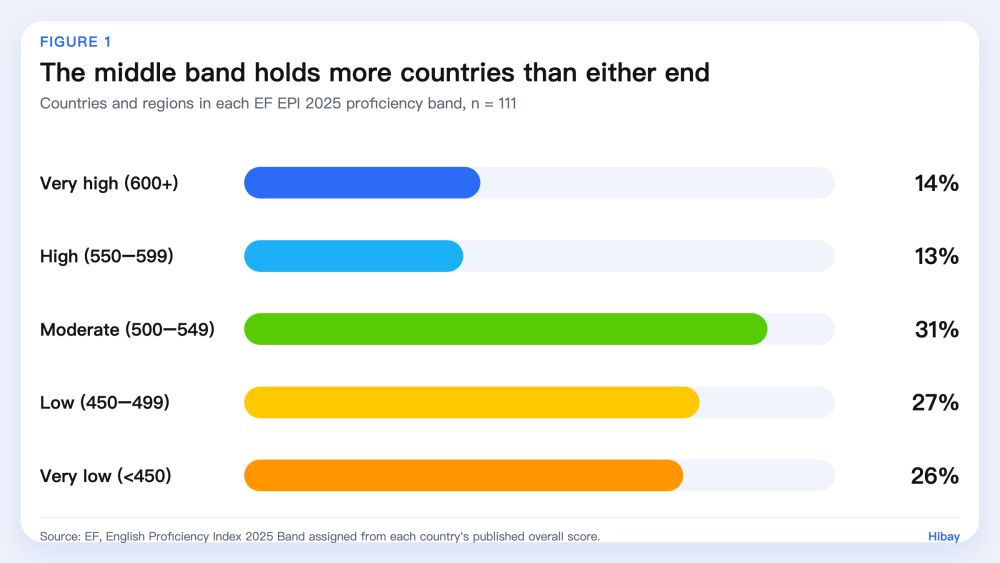
Figure 1. Number of countries and regions in each EF EPI 2025 proficiency band, n = 111 with a full four-skill profile. Source: EF English Proficiency Index 2025.
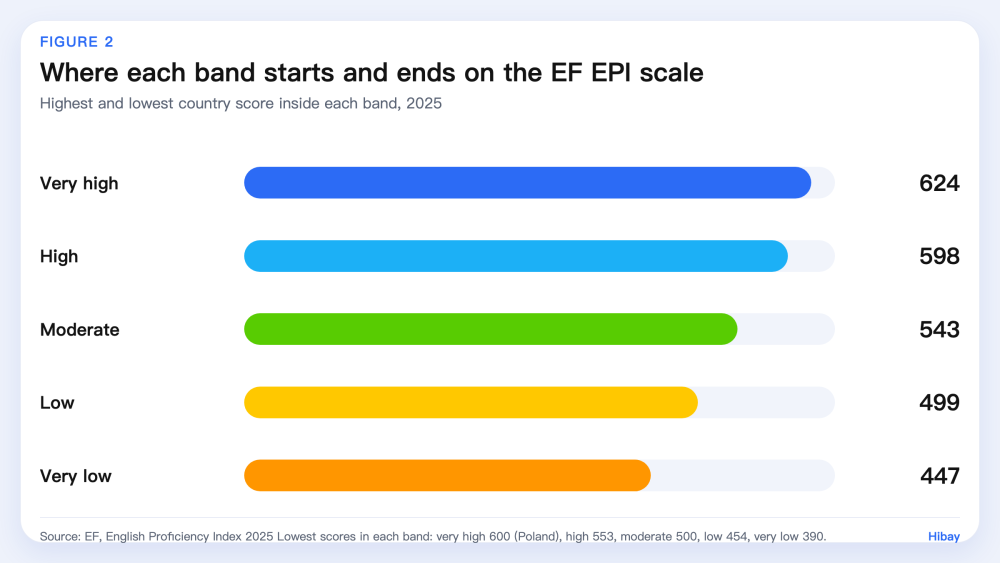
Figure 2. Highest and lowest published country score inside each band, n = 111 countries and regions. Source: EF English Proficiency Index 2025.
Limitations
Four limits apply. The sample is 111 of the 123 countries and regions in the index, because the other 12 do not carry all four skill scores in the detail pages, so a full count would shift the band sizes slightly. The test takers behind each country score are self-selected users of the free EF SET, not a random or representative sample, which the report states as a limitation of the index itself. Band membership is set by a threshold on a rounded score, so a country one point either side of 500 changes band without any change in measured proficiency. Finally, the index measures the people who chose to take an online test, and the report does not publish the number of test takers behind each country, so a band count cannot be weighted by sample size.
What this means for learners
A band is a threshold, not a distance. Vietnam at 500 and Ethiopia at 499 sit in different bands while scoring one point apart, and a learner reading "moderate" or "low" as a description of a national education system is reading a cut point rather than a gap.
The more robust reading of the distribution is the shape: 53 of 111 countries below 500 and 27 above 550, with the largest single group in the middle band. That shape is consistent with the report's own conclusion that global proficiency has plateaued, and it suggests that a country-level band is a weak guide to what an individual learner will score.
Frequently Asked Questions
How many countries are in each EF EPI 2025 band?
Among the 111 countries and regions with a full four-skill profile: 14 very high, 13 high, 31 moderate, 27 low and 26 very low.
Why 111 countries and not 123?
The report covers 123 countries and regions, but only 111 carry a full overall plus four-skill score in the detail pages; the other 12 have partial data and are excluded from this count.
What score marks the top band?
A score of 600 or above places a country in the very high band; the highest 2025 score is the Netherlands at 624.
How to cite
Hibay Product Team. (2026, November 5). EF EPI 2025: 53 of 111 Countries Sit Below 500. Hibay. https://www.hibay.ai/en/news/ef-epi-2025-proficiency-band-counts
References
- EF. EF EPI 2025 proficiency bands and scale. https://www.ef.com/wwen/epi/. Accessed 2026-11-05.
- EF. EF English Proficiency Index 2025 (report PDF). https://ef.com/assetscdn/WIBIwq6RdJvcD9bc8RMd/cefcom-epi-site/reports/2025/ef-epi-2025-english.pdf. Accessed 2026-11-05.