
How to Learn English Quickly for Work: Five Lines for a Shift Handover You Can Say Out Loud
It is ten to six in the morning and the incoming team is already at the machine. This guide answers how to learn english quickly for work when the work is a handover: one fixed five-line order, four scripts at A2 to B1 with the questions colleagues ask back, the read-back check and a fifteen-minute weekly rehearsal.


On this page
It is ten to six in the morning, the incoming team is at the machine, and everything you know about the pallet count, the fault and the loose guard has to leave your head in two minutes. Most shift workers do not fail here because their English is bad. They fail because they tell the story in a different order every night.
This guide answers one question, how to learn english quickly for work when the work is a handover, with a fixed five-line order, four scripts, the read-back check and a fifteen-minute weekly rehearsal.
What every handover has to contain
The UK Health and Safety Executive describes an effective handover as three things: preparation by the outgoing worker, a conversation that exchanges task-relevant information, and a cross-check by the incoming worker before taking responsibility. The third part is the one people skip when they are tired.
Five items cover almost every handover, in a factory, a warehouse, a kitchen or a care home:
| Item | The question it answers | Example in plain English |
|---|---|---|
| The state | What is running, what is stopped? | Line three is running. Line four is stopped. |
| The faults | What broke, when, who knows? | The belt motor is hot. Ticket 4412. |
| Unfinished work | What did you not finish? | Two pallets for order 881 are on the dock. |
| The risks | What could hurt someone? | The guard is loose. Do not start it. |
| The next action | What happens next, and who does it? | The supervisor calls maintenance at 07:00. |
If you can say only one of the five, say the risk. A missing pallet count costs an hour. A missing guard warning can cost a hand.
The five-line handover in English
Learn these five openings first. They tell the listener what is coming before the details arrive.
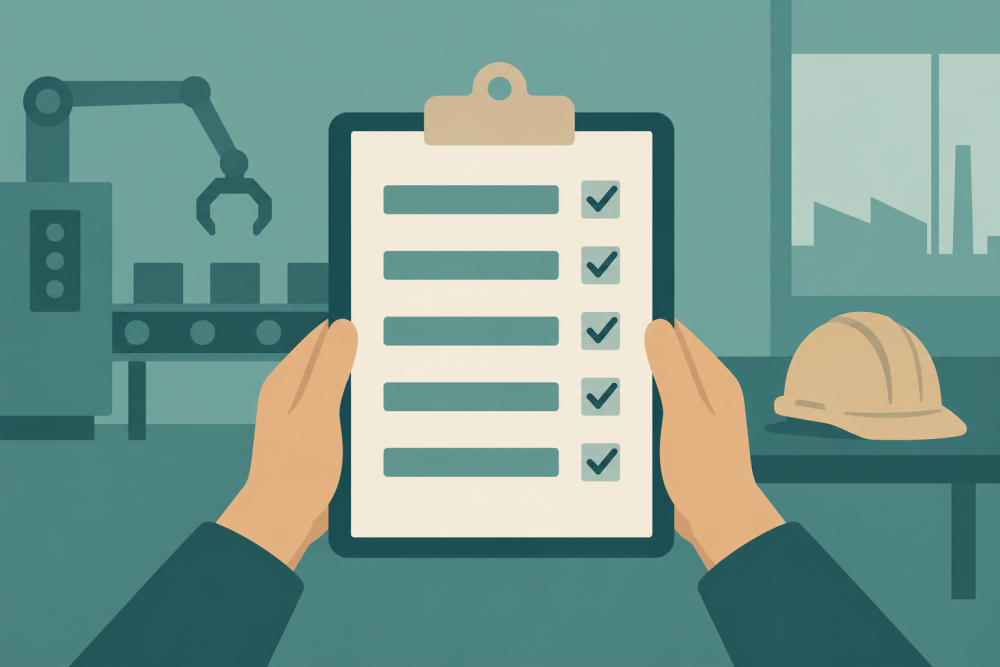
The state: line three is running. Line four is stopped.The fault: the belt motor is hot. Ticket 4412.Unfinished: two pallets for order 881 are on the dock.The risk: the guard is loose. Nobody starts the line.Next: the supervisor calls maintenance at 07:00.
Free speech changes order every night, so the incoming worker has to rebuild your story while you talk. A fixed order turns the handover into a checklist you can still run at five in the morning, and it makes a missing item audible: if you never say the risk line, the other person can hear the gap. The risk line is the one with the safety consequence. Leave out nobody starts the line and the next shift starts a machine with a loose guard. That is why the fourth line is never merged into the second.
Four handovers you can say word for word
Short sentences, one fact each, no idioms. Change the numbers, the times and the names, and keep the five lines in order.
Script 1: the pallet count that did not finish
State: the pick line is finished. The dock is still open.No faults. The scanner in aisle six is slow.Unfinished: order 881 is wrapped. Two pallets are on the dock.Risk: the dock ramp is wet. Tell the driver to go slow.Next: load the last two pallets before 07:30.
Two questions follow: Which order are those pallets for? and Is the paperwork with them?
Script 2: the conveyor fault
State: line four is stopped. Line three is running.Fault: the motor is hot and smells burnt. Ticket 4412.Unfinished: forty boxes are on the line. Quality has not checked them.Risk: the guard is loose. Nobody starts the line until maintenance signs it off.Next: call maintenance at 07:00 and ask for the motor first.
Two questions follow: Is the line locked out? and Who did you call, and when?
Script 3: the medication round
State: fourteen residents on the night list. Twelve have had their medication.No faults. The blood pressure machine is charging.Unfinished: Mr Ahmed's 06:00 medication is not given. Wake him at 06:30.Risk: Mrs Lee refused her pain relief at 03:00 and is still in pain. Check her before breakfast.Next: the nurse in charge reviews Mrs Lee at 06:15.
Two questions follow: Did you record the refusal? and Has the doctor been told?
Script 4: the kitchen stock
State: the hot line is closed. The cold room is at four degrees.Fault: the left oven is not heating. The engineer comes at 10:00.Unfinished: the soup is made but not labelled. Two boxes of tomatoes are not checked in.Risk: the fridge door does not close by itself. Push it until it clicks.Next: label the soup before 07:00 and put the tomatoes in the cold room.
Two questions follow: Which soup is it, and what date goes on the label? and Did the driver sign for the tomatoes?
Reporting a fault or a near miss, and asking someone to repeat
A fault report needs five facts, and none of them is a long word: what, where, when, what I did, what I need.
Line four stopped at 04:10. The motor is hot. I switched it off and put a ticket on it. I need an electrician before we start.
A near miss needs the same honesty: what happened, who was close, what stopped it, what should change. Never say nothing happened, because the report exists to fix the cause.
At 03:40 a pallet fell by the dock door. Nobody was hurt. The strap was loose. We need new straps.
When the words do not come, four phrases carry most of the work:
Sorry, could you say that again more slowly?Can you spell that for me?Do you mean the red valve or the blue valve?I did not catch the last word.
Add one opener: My English is still improving. Please speak slowly. Never guess a number, a part number or a dose to avoid asking twice. A second question costs ten seconds.
Confirming you understood: the read-back and the two-word check
The read-back is the incoming worker's job and it takes fifteen seconds. Repeat the five lines and invite a correction.
So line four is stopped, the motor is hot, and nobody starts it until maintenance signs it off. Is that right?
The US Agency for Healthcare Research and Quality teaches the same move in its SBAR tool for clinical teams: the recommendation is followed by a repeat-back of the answer, to check accuracy rather than to be polite. A nod is not a read-back, and yes, yes in a noisy corridor is not one either.
The two-word check closes the handover. Ask for two words only: Clear or not clear? If the answer is not clear, ask which line is not clear and stay until it is. Then check the risk line on its own: Just the risk line: what will you not do?
Written handovers: a shift log in short English
One event per line, always the same four parts: the time, what happened, what you did, what is next. Verbs first, no long sentences, and the same word for the same thing every night, so pick line or machine and keep it.
04:10 line 4 stopped. Motor hot. Switched off. Ticket 4412.04:15 maintenance called. Electrician after 07:00.05:40 guard on line 4 loose. Line locked out.
Write numbers as digits, and copy part numbers and doses from the label or the chart instead of from memory. Read the log before you touch anything, and ask the person who wrote it about any line you cannot read. The Health and Safety Executive recommends a handover that uses both speech and writing, and a plain log is the writing half.
Safety instructions you must not paraphrase
Some sentences are not yours to improve. Lock out, tag out, do not operate, permit to work, isolated and signed off are instructions, and the exact words on the tag, the permit or the sign are the instruction. Do not translate them into your own words, and do not soften them. Keep the fixed phrase and add your own sentence after it: Line four is locked out. The key is with the supervisor.
Never answer a safety question you have not checked. I have not checked that. I will ask the supervisor. is a complete answer, and it is the right one. If a safety instruction is unclear, stop and ask before you start, not after.
How to learn english quickly for work without study time you do not have
You do not need a course or a free evening. You need one task that repeats, and you already have one: the handover at the end of every shift. Fifteen minutes a week keeps the five lines ready, and it happens in the locker room.
- Minutes 0 to 5: read the five lines aloud from a card, twice, with last night's numbers.
- Minutes 5 to 10: your partner reads three invented facts from a card and you hand them over without looking.
- Minutes 10 to 15: your partner reads the five lines back, you mark the missing line, then say only that line again.
The three facts can be plain: Order 881, two pallets left. Motor hot, ticket 4412. Guard loose, do not start. The point is not the facts. The point is saying them in order while someone waits. A missed week is skipped, not doubled.
What quickly honestly means: one task improves in about four weekly rehearsals, because the sentences stop being translated and start being remembered. A whole language takes longer, and anyone who promises fluency in a few weeks is selling something else.
Frequently asked questions
How can I practise a shift handover if my English is still basic?
Start with the five openings only, not the whole handover. Say The state, The fault, Unfinished, The risk and Next out loud five times, then add one fact to each opening. That is already a complete handover in short sentences.
What do I say when I cannot understand the previous shift's note?
Say what you did understand and ask one specific question about the rest: I cannot read this line. Is it 40 boxes or 14? Then read the note back to the writer or the supervisor. If nobody is available, treat the unclear line as unconfirmed and do not start the equipment.