
Ordering Food in English When You Have an Allergy or a Dietary Restriction
Learn how to order food in English when a nut, dairy or gluten restriction has to be explained: a three-part request, six versions of it, the follow-ups for a vague answer, and a six-sentence pocket card.


On this page
A nut allergy does not usually fail at the vocabulary level. Most learners can already name the dish they want. What fails is the twenty seconds after the order is taken: the waiter says I think it's fine, you are not sure whether that means the kitchen actually checked, and you say thank you.
This guide is about those twenty seconds. It gives you a three-part request that a kitchen can answer, six versions of it for the restrictions that cause the most trouble, and the follow-ups to use when the answer is vague. It does not repeat the general travel phrases for booking a table, reading a menu or asking for the bill: it is about the harder skill of how to order food in English when a restriction has to be explained.
Why one allergy sentence is not enough
Most people learn a single sentence: I'm allergic to nuts. It is correct, and it still does not do the job, for two reasons.
The first is grammatical. I'm allergic to nuts describes you. It does not ask the kitchen to do anything, so a waiter can answer it with a smile and no action.
The second is about what the sentence cannot cover. In packaged food, allergy information is regulated. In the United States, the FDA requires the labels of most packaged foods to name the food source of each major food allergen, and a "may contain" statement is a separate, voluntary warning about possible cross-contact rather than a list of ingredients (FDA, Have Food Allergies? Read the Label, accessed 29 October 2026). A restaurant menu is not a package label. Nothing on it is obliged to tell you what is in the sauce, which oil the fries went into, or whether the same board was used for the bread.
So your sentence has to do the work the label would have done. That means naming the ingredient, saying what happens to you, and asking a question the staff cannot answer from memory.
The three-part request: ingredient, reaction, check question
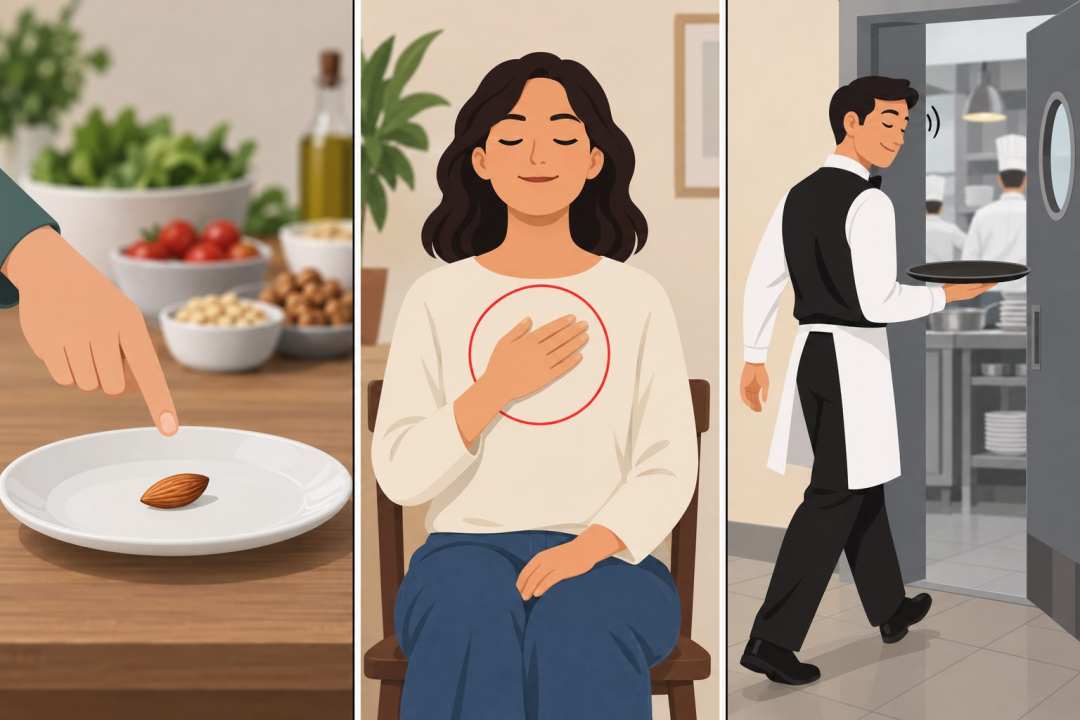
The request has three parts, in this order, because each one narrows the next.
| Part | What you say | What it forces |
|---|---|---|
| Ingredient | I'm allergic to peanuts. | A specific item, not a category the kitchen can interpret loosely |
| Reaction | Even a small amount is dangerous for me. | Severity, so the answer cannot be a little is fine |
| Check question | Could you check with the kitchen whether this dish or its oil contains peanuts? | A real check, instead of a guess |
The third line is the one that changes the answer. Does this contain peanuts? can be answered with a shrug. Could you check with the kitchen? cannot, because it names a person and an action.
If the restriction is not an allergy, say so plainly, because the risk and the required answer are different: I can't have dairy — I get sick, but it isn't life-threatening. Staff hear intolerance and allergy as different problems, and mixing them up can get you a smaller portion instead of a real check.
Six restrictions, six versions of the same three lines
The pattern never changes. Only the ingredient, the reaction word and the object of the check change.
| Restriction | What you say | Why this wording |
|---|---|---|
| Peanuts and tree nuts | I'm allergic to peanuts and all tree nuts. A trace is dangerous for me. Could you check whether the dish, the sauce or the frying oil contains nuts? | Names the oil, which is where nut traces usually hide |
| Dairy | I can't have dairy at all — milk, butter, cream or cheese. Could you check whether this dish is made with any of them? | Lists the four forms a kitchen actually uses |
| Gluten | I have coeliac disease, so I can't have wheat, barley or rye. Could you check whether this dish or its sauce contains any flour? | Names the condition rather than the diet, so it is not treated as a preference |
| Shellfish | I'm allergic to shellfish — prawns, crab and lobster. Could you check whether the stock or the sauce is made with any? | Points at the stock, which menus rarely mention |
| Egg | I'm allergic to egg. Could you check whether the batter, the pasta or the dressing contains egg? | Names the three dishes where egg is invisible |
| Sesame | I'm allergic to sesame — seeds, oil or paste. Could you check the bread and the dips, please? | Bread and dips are the two most common sources |
Read the table once and you will notice that none of the six versions is a translation of the others. Coeliac is not a polite word for gluten-free, and dairy is not a synonym for milk. Use the word the kitchen uses.
Hidden ingredients: shared fryers, sauces and substitutions
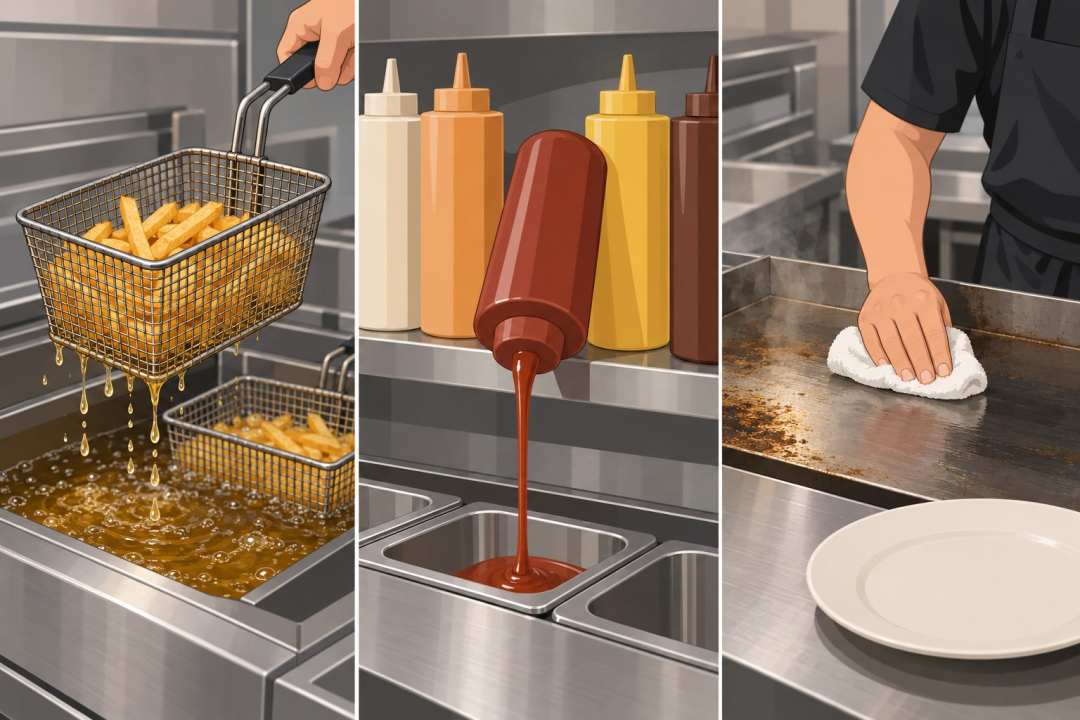
Three places cause most of the accidents, and each has its own question.
- The fryer:
Are the fries cooked in the same oil as anything with nuts? - The sauce:
Does the sauce have any dairy in it — butter, cream or cheese? - The substitution:
Can it be made without sesame, or is the sesame already mixed in?
The reason to ask rather than look for a label is that regulation covers ingredients, not the kitchen. Under EU rules, food businesses must give customers information about the 14 regulated allergens used as ingredients in non-prepacked food, but a cross-contaminant is not an ingredient: chips fried in oil that was previously used for fish do not have to be declared as containing fish (Food Safety Authority of Ireland, Allergen Information for Non-prepacked Food, accessed 29 October 2026). The same oil, the same grill and the same board are exactly the cases the written list will not answer, which is why the check question has to be spoken.
Substitutions deserve one extra line, because a "yes" is not always a solution: If you take the cheese off, is it cooked on the same grill as the meat? Removing an ingredient is easy; removing the equipment is not.
When to ask for the allergen list instead of the menu
If the restaurant has a written allergen list, ask for it by name instead of asking about one dish at a time: Could I see the allergen list for this dish, please? A written list is faster to check and easier to hold the staff to, and in many countries it is the document the kitchen is required to keep. If the answer is we don't have one, that is information too: it tells you the kitchen is working from memory, and you can decide accordingly.
Ask before you order, not after the plate arrives. Once the food is on the table, the conversation changes from "what is in this" to "take it back", and in a busy restaurant the second conversation is much harder to win.
When the answer is vague: two follow-ups and a polite exit
Vague answers have a small vocabulary of their own: I think so, It should be fine, Probably not, I don't think there's any. None of them is a check, and all of them sound reassuring, which is why they are dangerous.
Follow-up one, which asks for the action rather than the opinion: Could you check the label or ask the chef, please? I'm happy to wait.
Follow-up two, which gives the staff an easy way out: If you can't confirm it, I'll order something else. Which dish is prepared without nuts?
The exit, if neither works: I'm sorry — I can't risk it. Could we cancel that dish and order this one instead?
Leaving is a legitimate outcome. A restaurant that cannot answer a clear question about its own food is telling you something, and changing your order costs far less than an evening in a hospital.
A six-sentence pocket card and a ten-minute drill
Six sentences cover the whole conversation. Copy them onto a card or into your phone notes, and read them out loud until the rhythm is automatic.
I'm allergic to peanuts.Even a small amount is dangerous for me.Could you check with the kitchen whether this dish or its oil contains peanuts?Are the fries cooked in the same oil as anything with nuts?Could I see the allergen list for this dish, please?If you can't confirm it, I'll order something else.
Then drill it in three steps. First, record yourself saying the six sentences once, without reading, and listen for the one you stumbled on. Second, role-play the difficult half: have a partner answer I think it's fine and practise the two follow-ups until they come out without a pause. Third, rehearse once in a real restaurant at a quiet hour, ordering only a drink, so the sentences have been said in a real room before they matter.
If the reaction itself has to be explained to a pharmacist or a doctor, that conversation needs different wording: English for doctor visits covers those phrases. If you want a partner for the second step, an AI speaking app can play the waiter on demand. Check that it has a restaurant scenario before you rely on it: the public App Store description of HiBay, for example, lists over 100 scenarios including travel English and a task sequence that runs from Ordering a Burger to Customizing Your Meal (HiBay on the App Store, accessed 29 October 2026). Practise the vague answer on purpose — the reply you need to survive is not the helpful one.
Frequently Asked Questions
How do I ask if a dish contains nuts in English?
Use the three-part request rather than a single question: I'm allergic to peanuts. Even a small amount is dangerous for me. Could you check with the kitchen whether this dish or its oil contains peanuts? The last line is the important one, because it asks a member of staff to go and check instead of answering from memory.
What if the waiter does not know what is in the dish?
Ask for the action, not the opinion: Could you check the label or ask the chef, please? I'm happy to wait. If the answer is still vague, give the staff an alternative: If you can't confirm it, I'll order something else. Which dish is prepared without nuts? A restaurant that cannot answer a clear question about its own food is a restaurant to order a drink in and leave.
Can I ask for the allergen list in English?
Yes, and it is usually the fastest route: Could I see the allergen list for this dish, please? In the EU, allergen information for the 14 regulated allergens has to be available for non-prepacked food, and in Ireland it has to be in writing. A written list answers the ingredient questions in one move, but it will not answer the shared-fryer question, which still has to be asked out loud.
Is "may contain" the same as an ingredient?
No. An ingredient statement names what is in the food; a "may contain" statement is a voluntary warning about possible cross-contact during manufacturing, and not every manufacturer uses one (FDA, accessed 29 October 2026). In a restaurant there is no label at all, which is why you ask a person and wait for a check rather than reading a menu.