
Travel English Phrases: Directions, Hotels and Restaurants
The sentences to say at a hotel desk, in a restaurant and when you are lost — with what staff may answer back, and a short routine for practising them before you travel.

On this page
Three moments on a trip make almost everyone freeze in English: you are lost on a street corner, you are standing at a hotel desk with a queue behind you, or a waiter is asking you something you did not expect. None of those moments needs perfect grammar. They need a small set of sentences you have already said out loud once, so your mouth knows the shape of them.
This page collects the travel English phrases that cover those three moments — asking for and giving directions, hotel reception conversation, and restaurant conversation in English — plus a short routine for practising them before you leave. Every phrase below is a teaching example, not a script a real traveller was recorded saying.
How to ask for and give directions in English
The four questions that cover almost every situation
You rarely need more than these. Each one is short enough to say while nervous, and polite enough for any English-speaking city.
Excuse me, how do I get to the train station?Is it within walking distance?Which way is the old town from here?Am I going the right way for the museum?
Two details make these work. First, start with Excuse me — it signals that you are about to ask a stranger something, and people answer far more willingly. Second, name the place clearly, and if the name is unusual, spell it or show it on your phone: It's the Riverside Hotel — R-I-V-E-R-S-I-D-E.
If you are the one being asked, the same four questions tell you what the other person needs: a destination, a distance, a direction or a confirmation.
Understanding the answer
The hard part is not asking — it is the twenty seconds after. Listen for three things instead of trying to catch every word:
- A landmark.
It's opposite the bank.·It's next to the pharmacy.·It's behind the station.Remember the landmark, not the sentence. - A turn and a count.
Go straight, then take the second left.·Turn right at the traffic lights.·It's the third turning on your right. - A distance or a time.
It's about a ten-minute walk.·It's two stops on the metro.·It's not far — five minutes.
If you lose the thread, one sentence saves the whole exchange: Sorry, could you say that again more slowly? And if you still are not sure: Could you point me in the right direction? A pointed finger is often clearer than a spoken route.
How to give directions back
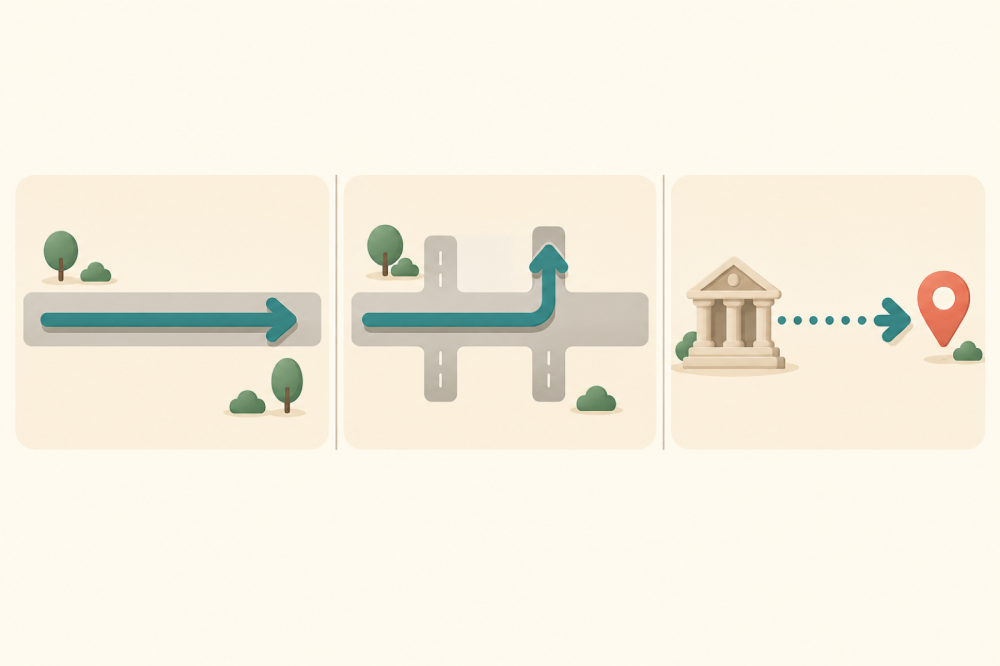
Travellers get asked for directions too, and a short answer is a complete answer. Use the same three ingredients in the opposite order — turn, count, landmark:
Go straight for two blocks, then turn left at the bank.Take the first right — it's opposite the post office.It's just around the corner, next to the coffee shop.
Add It's about five minutes from here if you know the distance. If you do not, saying I'm not sure, sorry — I'm also visiting is a perfectly good reply.
Hotel English: check-in, requests and problems
At check-in
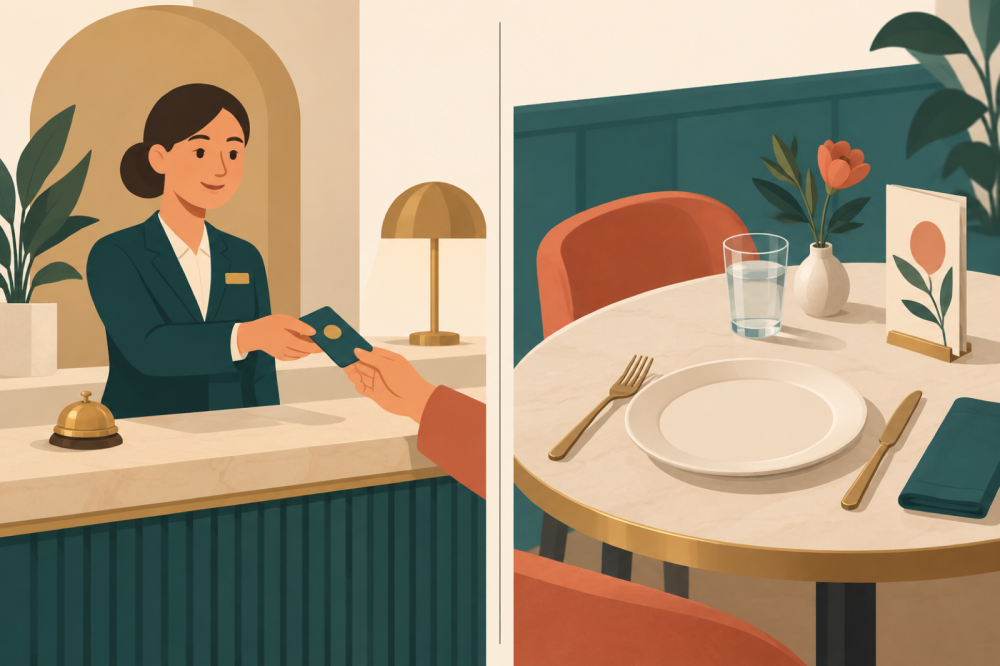
Hotel reception conversation follows a predictable order, which is good news: you can rehearse both sides.
I have a reservation under Wang.(say the surname you booked with)I booked a double room for three nights.Is breakfast included?What time is check-out?Could I have the Wi-Fi password, please?
Staff will usually reply with a time, a floor or a request of their own: Could I see your passport, please? · Your room is on the fifth floor. · Breakfast is from seven to ten. If you only catch one part, Sorry — which floor? or Sorry — what time? is enough to repair it.
Asking for something or reporting a problem
Polite requests follow one pattern: Could I have … for things, and There's a problem with … for faults. The word please at the end does most of the politeness work.
Could I have two extra towels, please?Could I have a wake-up call at seven, please?The air conditioning isn't working.The shower is leaking. Could someone take a look?Could I change to a quieter room?
Starting with a calm statement (The air conditioning isn't working) then a request (Could someone take a look?) sounds reasonable rather than angry — and it usually gets a faster result than complaining.
Checking out
I'd like to check out, please.Could I have the bill, please?Could I leave my luggage here until this afternoon?Could I have a receipt?
How to order food in English: from the table to the bill
Getting a table and reading the menu
Restaurant conversation in English usually starts before you sit down.
A table for two, please.Do you have a table outside?Could I see the menu, please?What do you recommend?
If a dish name is unfamiliar, ask about the contents rather than guessing: What's in the house salad? · Is this dish spicy? · Does it come with rice? These three questions prevent most unpleasant surprises, and they are easier to say than a long apology afterwards.
Ordering with a special request
Most dietary needs fit into one sentence shape: the dish + without or with + the thing.
I'd like the grilled chicken, please.Could I have the pasta without cheese, please?Could I have the dressing on the side, please?I'm allergic to nuts — does this dish contain any?
That last one matters more than politeness: allergies need a clear question, and Does this contain nuts? is clear. If the answer is hard to follow, ask again — staff would rather repeat it than serve you something unsafe.
Asking about the order and paying
Sorry, we ordered about twenty minutes ago — is it coming?Could we have some more water, please?Could we have the bill, please?Could we pay separately?Do you take card?
In many countries Can we split the bill? is normal between friends; in others it is unusual, so Could we pay separately? is the safer phrasing when you are not sure.
Quick reference: ten travel phrases to memorise first
| Situation | What you say | What you may hear |
|---|---|---|
| Lost on the street | Excuse me, how do I get to the station? | Go straight, then take the second left. |
| Confirming distance | Is it within walking distance? | It's about a ten-minute walk. |
| Did not understand | Sorry, could you say that again more slowly? | (they repeat, usually slower) |
| Giving directions | It's opposite the bank, next to the pharmacy. | Thank you! |
| Hotel check-in | I have a reservation under Wang. | Could I see your passport, please? |
| Hotel request | Could I have two extra towels, please? | Certainly, I'll send them up. |
| Hotel problem | The air conditioning isn't working. | I'll send someone to check it. |
| Getting a table | A table for two, please. | This way, please. |
| Ordering with a change | Could I have the pasta without cheese, please? | Of course. |
| Paying | Could we have the bill, please? | Together or separately? |
Ten sentences will not cover a whole trip, but they cover the ten moments where a blank mind costs the most.
How to practise these phrases before you travel
Reading a phrase list once is not practice. Four steps, about fifteen minutes a day, turn the list into something you can actually say:
- Say each phrase out loud, slowly. Twice. The goal is not speed — it is removing the pause before the first word.
- Change one word.
A table for two→a table for four→a table outside. One change proves you are using the pattern, not reciting a line. - Play both sides. Read the question, then answer it as the receptionist or the passer-by.
Is it within walking distance?—Yes, about ten minutes.This is where understanding is actually built. - Repeat the next day from memory, then check. Whatever you cannot recall after a night's sleep is the part that would have failed on the street.
If you want a partner for step 3, HiBay is an English speaking app that lets you practise conversations with AI partners, including travel scenarios, and gives feedback on pronunciation, grammar and vocabulary. The keyword library for this page points to its travel-related practice surfaces — AI Chat · Traveling Abroad and Albums · Travel — which is where these hotel, restaurant and directions exchanges fit most naturally. As with any practice tool, treat it as rehearsal for the real conversation, not a replacement for it.
If your trip involves a work meeting next, the same rehearsal method applies to business English speaking practice; for interview situations, the questions in our English job interview guide use exactly this pattern.
FAQ
How to ask for directions in English
Start with Excuse me, name the place, then use one of four short questions: How do I get to …?, Is it within walking distance?, Which way is … from here? or Am I going the right way for …?. Naming the place clearly matters more than perfect grammar — Excuse me, how do I get to the train station? will be understood even with a strong accent.
How to ask for and give directions in English
Asking and giving use the same three ingredients: a turn, a count and a landmark. To ask: How do I get to the museum? To answer: Go straight for two blocks, then turn left at the bank — it's opposite the post office. If you do not know the way, I'm not sure, sorry — I'm also visiting is a complete and polite answer.
How to order food in English
Use A table for two, please to sit down, Could I see the menu, please? to start, and the pattern I'd like the … or Could I have the … to order. For changes, add without or with: Could I have the pasta without cheese, please? For allergies, ask directly: I'm allergic to nuts — does this dish contain any?
How to give directions in English
Give the shortest useful answer: direction, number of turns, then a landmark. Take the first right — it's opposite the post office. Add a time if you know it (It's about five minutes from here), and use just around the corner or next to the … when the place is close and easy to spot.
How to order food in English conversation
In a real restaurant conversation the exchange has four moves: you ask for a table, you order, you answer one follow-up question (Anything to drink? / How would you like it cooked?), and you ask for the bill. Rehearse the follow-up answers as well as your own lines — Just water, please and Medium, please are two of the most common ones, and they are the lines that make people freeze.