
IELTS Speaking Practice With a Partner: A 30-Minute Rotation
How two candidates can keep IELTS speaking practice free of wasted time: a 30-minute examiner-candidate-observer rotation, question banks you write yourselves, and a one-page scoring sheet built from the four public criteria.


On this page
Two friends preparing for the same test date already own what most people searching for IELTS speaking practice free of charge are missing: a live human who answers back. Yet the usual two-hour session in a cafe produces almost nothing measurable, because both people spend it talking about practice instead of practising. This guide replaces that session with a 30-minute rotation: three named roles, question banks you write yourselves, and a one-page scoring sheet that uses the four criteria IELTS publishes.
Every format detail below comes from IELTS.org and applies to both IELTS Academic and IELTS General Training, because the Speaking test is the same for both. The rotation and the sheet are our own study method. Treat them as a training tool, not as an official assessment or a predicted band.
Why partner practice usually fails
Four problems show up in almost every unplanned partner session, and all four are fixed by a clock, a sheet of paper and a silence rule.
- The clock never leaves Part 1. Partners warm up on familiar questions, chat for ten minutes, and run out of time before the long turn, which is where the marks usually hide.
- There is no evidence, so there is no change. Feedback becomes “that was good”, which is pleasant and useless: nothing recorded means nothing to retest next week.
- Politeness inflates everything. Friends soften the message, so the weakest criterion, usually fluency or grammatical accuracy, is the one nobody names.
- Both people speak at once. When you answer while correcting yourself in the same breath, you are rehearsing a monologue rather than the interview the test actually is.
One format detail helps here. The real Speaking test is a face-to-face interview of 11 to 14 minutes in three parts, and it is recorded. A phone on the table recording your session is therefore not extra work; it is the cheapest close approximation of the real conditions, and it gives the observer something objective to listen back to.
The 30-minute rotation: examiner, candidate, observer
Set three roles before the clock starts. One person answers: the candidate. One person asks the questions and keeps the time: the examiner. One person writes on the scoring sheet and says nothing at all: the observer. With only two people, the examiner observes alone, and the silence rule is what makes it work, because nobody comments until the mock is over.
| Minutes | Role | What happens |
|---|---|---|
| 0-2 | Both | Read the role cards, put today's date on the sheet, set the phone recording face down, lay out the cue cards. |
| 2-6 | Examiner | Part 1: identity questions plus one familiar topic, about four minutes, no interruptions. |
| 6-10 | Candidate | Part 2: one minute of silent preparation, up to two minutes of talk, then one follow-up question. |
| 10-14 | Examiner | Part 3: four minutes of abstract discussion linked to the Part 2 topic; interrupt once to push for depth. |
| 14-17 | Both | Silent scoring. The candidate scores himself or herself first, then the observer reads the sheet out. |
| 17-20 | Observer | Read back one strength and one fix, each tied to something you can hear in the recording. |
| 20-28 | Both | Second pass on the single weakest criterion: rerun one question from the part where it hurt. |
| 28-30 | Observer | Fill in the log line, choose the fix to retest next session, swap roles. |
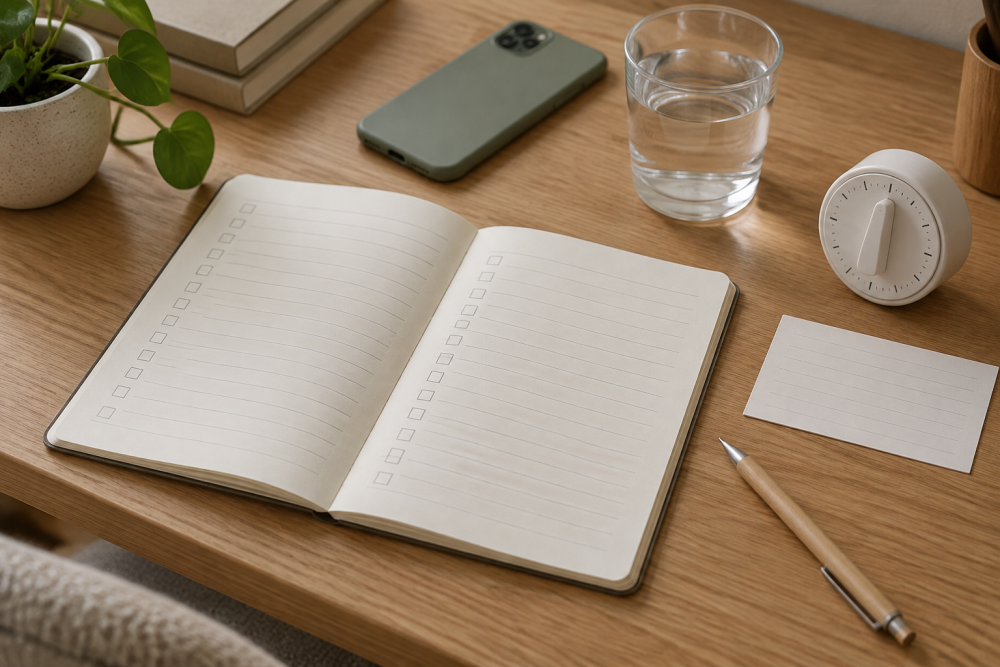
What the role cards say
| Role | Your job for 30 minutes | You are not allowed to |
|---|---|---|
| Examiner | Ask the questions in order, keep the clock, listen, and stop the candidate at the time limit. | Explain, teach, or answer your own question. |
| Candidate | Answer every question, use the preparation minute in silence, keep going when you are unsure. | Ask for a translation, restart, or apologise for your English. |
| Observer | Write evidence: exact words, a timestamp, the moment coherence broke. Score silently. | Speak during the mock, or soften a real problem into a compliment. |
With three people the examiner never writes a word and the observer owns the sheet. With two people the examiner writes after the mock ends, never during Part 3. A missing role should cost you evidence, not practice time.
The 11-minute mock, in the official shape
The real test runs 11 to 14 minutes, so rehearsing the 11-minute floor is the harder version: there is less time to warm up. The public structure is fixed, and your mock should copy it exactly.
- Part 1, about four to five minutes: questions about yourself, your home, your work or study, and one or two familiar topics.
- Part 2, about three to four minutes including preparation: a cue card, one minute to prepare, up to two minutes to speak, then a few follow-up questions.
- Part 3, about four to five minutes: a discussion linked to the Part 2 topic, with no preparation time and more abstract questions.
Keeping the parts in this order matters more than making them the exact length. Each part tests something different: description and small talk first, then a sustained turn, then argument and abstraction. A session that never reaches Part 3 never rehearses half of what the examiner is listening for.
The feedback loop: three minutes of evidence, nine minutes of retry
- The candidate speaks first, for 60 seconds, about what he or she noticed while answering. Self-assessment before the sheet arrives is what makes the observer's notes land.
- The observer reads the sheet aloud: one strength with a timestamp, one fix with a timestamp, and nothing else.
- The pair agrees on a single fix for the session. One, not three.
- The candidate answers one question from the part where that fix belongs, twice in a row, while the observer listens for that one thing only.
The nine minutes of retry are the part most pairs skip. A correction you have never used under time pressure is not a correction yet; it is a note.
Question banks for Parts 1, 2 and 3
Write your own questions and keep them in one shared document. Do not rehearse a list you found online: worked answers invite memorised speech, and examiners notice. The banks below are examples written for this guide, and you should replace them after a fortnight so your answers stay spontaneous. Each question is marked as English practice material, because English is the language you will be tested in; the note beside it is there so you know what you are rehearsing.
Part 1: four familiar questions
What part of your home do you use the most, and why?— answer in 20 to 30 seconds, with one reason and one example.How do you usually travel to work or school?— practise a natural two-part answer: a fact, then a comment about it.Do you prefer to plan your week or decide as you go?— a question like this invites a comparison, so use one clear contrast.What do you do when a plan falls through?— good for a short story in the past tense, in three sentences.
Part 2: one cue card template, one original card
Every cue card has the same four-line shape: a topic sentence, three prompts that structure the talk, and a closing prompt that asks for a reason, an opinion or a change over time. Here is one original card built on that template.
- Topic:
Describe a skill you learned from someone in your family. - First prompt:
what the skill is and when you first saw it done - Second prompt:
who taught you and how they taught it - Third prompt:
how long it took you before you could do it alone - Closing prompt:
and explain whether you still use the skill today
Write four or five cards like this before a session and shuffle them, so the candidate cannot choose the topic. Do not read the card out loud twice: one minute of silent preparation is part of the test.
Part 3: questions that go abstract
Why do some practical skills stay inside families?— practise agreeing first, then adding a condition.Should schools spend more time on practical skills than on exams?— this one needs a position, a reason and a counter-argument.Is it harder to learn a new skill as an adult?— practise hedging with a two-case answer instead of one flat opinion.How might the way people learn skills change in the next twenty years?— speculation about the future is where band 7 grammar usually appears.
A scoring sheet built from the four public criteria
Examiners who hold a certificate from the test provider assess four criteria: fluency and coherence, lexical resource, grammatical range and accuracy, and pronunciation. Those four headings are the only columns you need. The published descriptors are written for examiners at whole-band levels, and a candidate must fully fit the positive features of a level before it applies, so use this table as a direction finder rather than a score generator.
| Criterion | What band 6 looks like | What band 7 looks like | What band 8 looks like | What the observer writes |
|---|---|---|---|---|
| Fluency and coherence | Keeps going and is willing to produce long turns; coherence is sometimes lost through hesitation or self-correction. | Produces long turns without noticeable effort; hesitation is often mid-sentence but does not damage coherence, and discourse markers are used flexibly. | Fluent with only very occasional repetition or self-correction; most hesitation is about content, not about finding words. | Timestamps where the answer stalled, plus the linking words actually used. |
| Lexical resource | Enough vocabulary to discuss topics at length, and generally able to paraphrase. | Vocabulary used flexibly across a variety of topics, with some less common and idiomatic items and some inappropriacies. | A wide resource used flexibly and precisely; skilful use of less common items despite occasional slips in word choice. | Two precise words or phrases worth keeping from this session. |
| Grammatical range and accuracy | A mix of short and complex sentence forms; errors in complex structures rarely impede communication. | A range of structures used flexibly; error-free sentences are frequent, and a few basic errors persist. | A wide range of structures used flexibly; the majority of sentences are error-free. | One recurring error pattern, quoted as the exact sentence it appeared in. |
| Pronunciation | A range of phonological features with variable control, and occasional passages that lack clarity. | All the positive features of band 6 and some, but not all, of band 8; generally understood throughout without much effort. | A wide range of features with sustained rhythm; easily understood throughout, and accent has minimal effect on intelligibility. | One word that was hard to understand, and how it sounded on the second attempt. |
Three rules keep the sheet honest. Score whole numbers, because the descriptors are written that way. Write evidence before you write a number: a timestamp, a quote, or the exact moment comprehension broke. Never fix anything during the mock, because a correction that arrives while you are speaking destroys the fluency you are trying to measure.
- Score the criterion you targeted first, even if another one looks worse: the sheet tracks progress, not the whole candidate.
- Do not average anything. A partner's sheet cannot produce a reliable overall band, and an invented number is worse than no number.
- Keep the sheet and the log in the same notebook, so this week's evidence sits next to last week's.

What to do when one partner is much stronger
An unequal pair is normal. It becomes a problem only when the stronger partner quietly turns into a teacher, and the weaker partner stops answering under pressure. Four tactics keep the session useful for both people.
- Swop the roles rather than the level. The stronger partner examines first and then answers the same questions, against the same sheet and the same rules.
- Cap model answers at 20 seconds. A ninety-second demonstration teaches nothing; a 20-second alternative phrasing gives the weaker partner something to imitate immediately.
- Diff two answers to the same question. Both people answer, then compare on three points only: how the answer opened, how it was structured, and how it ended. Sharing one question makes the gap visible without anyone having to say it out loud.
- Set different targets. The weaker partner chases one criterion, usually fluency. The stronger partner practises the band 8 features that are hardest to fake: precise less common vocabulary, flexible structures, and a rhythm that survives a long answer.
One more rule: the stronger partner's speaking time is not a bonus. If the session drifts into a monologue, the weaker partner has stopped rehearsing under pressure, which is the only thing the session exists for.
How to keep a two-week record
Six sessions in two weeks are enough to see whether a fix survives. Keep one line per session in a single table, and let the scoring sheet feed it.
| Session | Target criterion | Evidence (timestamp or quote) | The one fix | Retested? | Kept? |
|---|---|---|---|---|---|
| Example entry, not a real learner | Fluency and coherence | 1:48 - three long pauses inside one answer | Finish the thought before correcting the grammar | Same result twice | Drop |
Change one thing at a time. A fix needs two retests before you decide: if the evidence improves twice, keep it and choose a new fix; if it does not, drop it without argument and pick another. After two weeks, look at the last column only. Two or three surviving fixes are a real gain; ten unfinished ones are a hobby.
If you want a third pair of ears on the pronunciation column between sessions, an app that records a conversation and plays back the parts you found hard is a reasonable substitute. The public description of the Hibay app lists English conversation practice and IELTS speaking preparation, which is as much as a store listing can tell you. The rotation above is what turns recordings into a training plan.
Frequently asked questions
How can two people practise IELTS Speaking without an examiner?
Use the three roles even when there are only two of you. One person asks the questions and keeps the clock, the other answers, and the examiner writes evidence only after the mock has finished. What matters is not the number of people but the silence rule during the test block and the written evidence afterwards.
How long should each partner practice session be?
Thirty minutes is enough for one full mock, a feedback loop and a retry, and short enough to repeat twice a week. Two partners should take one 30-minute block each, either back to back or on alternate days, so that both people spend time answering rather than only asking.
Can a partner give me an IELTS Speaking band score?
Not a reliable one. The published descriptors are written for certificated examiners, and a candidate must fully fit the positive features of a band before it applies, which is a high bar for a friend to judge. What a partner can do is record evidence against the same four criteria, so you can see whether a fix is holding, session after session.