
Free IELTS Writing Checker: AI Band Score for Task 1 and Task 2
An IELTS writing checker estimates a band by comparing your text with the published IELTS criteria, so the useful part of any report is the criterion it names. This guide sets out how Task 1 and Task 2 are marked, what a free AI check can and cannot prove, and a draft-and-revise loop you can run this week.


On this page
If you have just finished a timed practice essay and you want a number rather than a vague feeling, the phrase most candidates type into a search box is ielts writing checker task 2 free. Whatever the interface promises, a checker compares your text with the published IELTS band descriptors and reports an estimate for each criterion. That is worth understanding before you trust the result, because those descriptors are public documents you can read yourself, and an estimate is only as useful as the evidence behind it.
This guide covers what the official criteria say, how Task 1 and Task 2 are marked differently, what an automated estimate can and cannot prove, and a practice loop that turns feedback into a better next draft. Every claim about the test links to the IELTS or British Council page it comes from.
How IELTS Writing Is Marked
Both the Academic and the General Training Writing tests contain two tasks, and the tasks are assessed independently. Task 2 carries more weight in the writing score: the British Council states that Task 2 contributes twice as much as Task 1. For Academic Writing the test lasts 60 minutes, with about 20 minutes and at least 150 words for Task 1, and about 40 minutes and at least 250 words for Task 2, as set out on the British Council's free Academic Writing practice page.
Each task is marked on four criteria, and the first criterion changes with the task. Task 1 is marked on Task Achievement, Coherence and Cohesion, Lexical Resource and Grammatical Range and Accuracy; Task 2 replaces Task Achievement with Task Response and keeps the other three. The IELTS key assessment criteria document puts the difference plainly: Task Achievement asks how fully, appropriately, accurately and relevantly the response fulfils the task, while Task Response asks how fully you address the prompt and how adequately you extend and support your main ideas.
The exact wording sits in the IELTS Writing band descriptors, updated in May 2023, with one row for each band and one column for each criterion. Any checker worth using has to argue from those sentences, because they are the only public statement of what a band means. A report that gives you a score without naming a criterion does not tell you what it measured.
Task 1 and Task 2 Are Different Jobs
Read the criteria as a description of two different jobs. In Academic Writing, Task 1 presents visual information such as a graph, chart, table, map or process diagram, and the Band 7 descriptor asks for a clear overview of the main trends, differences or stages. A sentence that performs that summary move sounds like Overall, household recycling rose steadily between 2010 and 2020, with the sharpest increase after 2016. The overview is not decoration: a checker looking for Task Achievement looks for that summary near the start, before the detail paragraphs that select and compare key features.
Task 2 is an essay, and its first criterion asks for a clear position developed throughout. A sentence that states a position without repeating the question could read While some people argue that standardised tests are the fairest measure, others believe they reward speed rather than understanding. That sentence sets up two positions and commits to discussing both, which is what the descriptors mean by exploring an idea rather than listing advantages in one paragraph and disadvantages in the next.
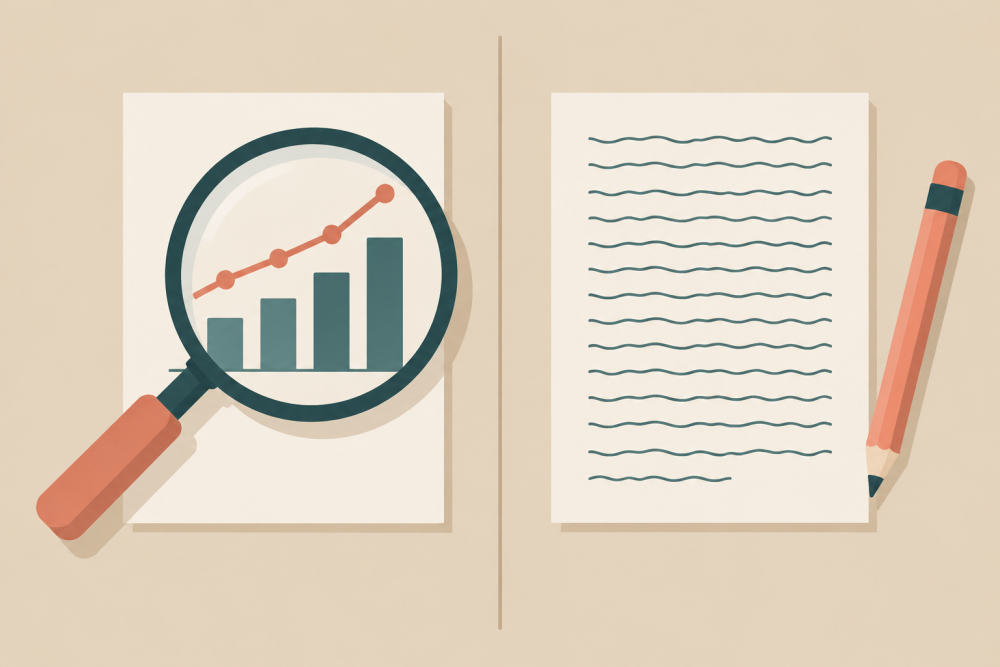
Because the tasks are marked separately, and Task 2 counts twice as much, a single overall writing band can hide a large gap between them. A candidate who describes data fluently and writes an underdeveloped essay will see the higher Task 1 result absorbed by the lower Task 2 result. A report that separates the four criteria is more useful than one number, because it tells you which half of the test is costing you the band.
What an Automated Band Estimate Can and Cannot Prove
An automated check reads your text against descriptor wording. It can tell you whether a Task 1 answer contains an overview, whether a Task 2 answer answers the question that was asked rather than a related one, whether paragraphs have a single controlling idea, whether linking words are varied or mechanical, whether topic vocabulary is repeated, and how many words you wrote. Those are the features the descriptors name, so a report that maps them back to a criterion is doing something real.
Two limits matter more than the output. First, a checker cannot settle judgement calls, because the descriptors are written for human examiners: phrases such as fully extended and well supported describe a standard a reader applies, not a rule a parser can test. Second, an automated estimate is not an official result; only a registered IELTS examiner produces one. Treat the report as a list of things to check rather than a verdict on your English, because the useful question is never whether the number was fair but which paragraph lost the thread.
A Practice Loop That Uses the Feedback
Write under exam timing first, because an untimed essay says very little about exam performance: twenty minutes for Task 1 and forty for Task 2, with no dictionary and no rewriting during the timed section.
Then run the check and read the four criteria as four separate problems. Choose the lowest one and rewrite only that part of the essay. If coherence is the weak point, rewrite your topic sentences and the links between paragraphs and leave the grammar alone. If lexical resource is the weak point, replace repeated general words with the terms your topic needs, such as the vocabulary of trends for Task 1 rather than general words such as good or bad.
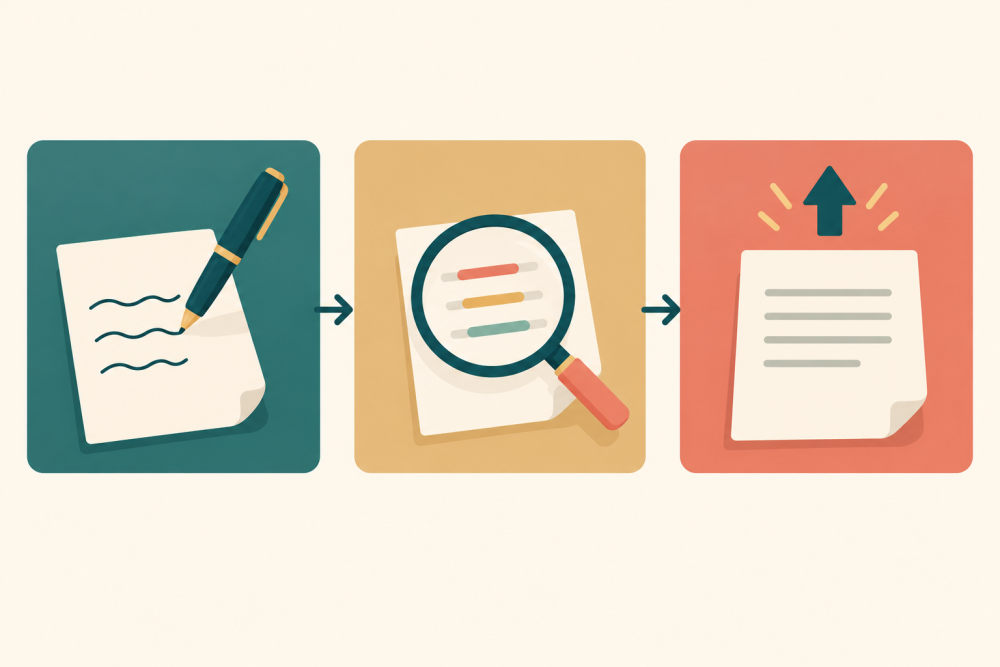
Keep both versions and compare them criterion by criterion, so improvement becomes something you can point at instead of a feeling that the second attempt was better. Three drafts that each fix one criterion teach more than ten drafts that fix nothing in particular. After two weeks, a list of your recurring slips is your personal error profile, and it is more specific than any band score a checker can hand you.
Where HiBay Fits
HiBay's App Store listing describes exam preparation tools alongside its scenario practice: the app lets you mock the speaking test, review your writing essays and practise listening in one place, which matters if you are preparing for all four skills rather than writing alone (HiBay on the App Store). If writing is the skill you are pushing this month, keep a speaking routine running beside it, because the two halves of the exam share vocabulary and structure: IELTS Speaking Mock Test walks through recording and reviewing all three parts under exam conditions, and IELTS Speaking Practice AI shows how to choose practice tasks and use feedback you can check.
Frequently Asked Questions
Is there a free AI tool that checks my IELTS Writing Task 1 and Task 2 essays and gives a band score?
Free checkers exist, and the first thing to check is whether the report separates the four criteria instead of printing one number. Ask for two things. First, the criterion names IELTS publishes: Task Achievement or Task Response, Coherence and Cohesion, Lexical Resource, Grammatical Range and Accuracy. Second, the sentence or paragraph each score is attached to, so you can see what the tool reacted to. For a realistic check, paste a Task 1 answer of at least 150 words and a Task 2 answer of at least 250 words written under exam timing, because short answers break the word-count expectations the descriptors assume.
how can i evaluate my ielts writing
Start with what you can measure without a tool: word count and timing. Task 1 expects at least 150 words in about 20 minutes and Task 2 at least 250 words in about 40, and candidates who run out of time rarely reach their best band. Then apply the descriptors yourself to a single essay, one criterion at a time. Underline your overview or position statement, mark the topic sentence of every paragraph, circle repeated general words, and count sentences that contain more than one clause. What you find is usually one criterion dragging the others down, and that is the one to work on in the next draft.
how to check ielts writing task 1
Check Task 1 in the order the descriptors do. First look for an overview: one or two sentences stating the main trends, differences or stages without figures, placed before the detail. Then check that you selected key features instead of listing every number, and that each body paragraph groups comparable items. Next check topic vocabulary for accuracy: rise, fall, plateau and fluctuate describe movement over time, while higher, lower and twice as many describe comparison. Finally verify the word count and your timing, at least 150 words in about 20 minutes.