
IELTS Speaking Part 3 Sample Answers: Build, Don't Memorize
Part 3 asks you to discuss, compare and speculate, so sample answers are useful as structure rather than scripts. A routine for handling any Part 3 question.


On this page

Search for IELTS Speaking Part 3 questions and sample answers and you get one of two things: a long list of questions with model answers too polished for anyone to produce in ten seconds, or a tips page that tells you to "develop your answers" without showing how. Neither prepares you for the part of the test where most candidates actually lose marks.
Part 3 is not the personal storytelling of Part 1 and not the two-minute monologue of Part 2. It is a discussion, and the examiner keeps widening it, asking you to compare, predict, evaluate or advise. Sample answers are worth reading for their skeleton, not their sentences. Here is a routine for turning almost any Part 3 question into an answer you can deliver under pressure.
Step 1: Name the Type of Question You Just Heard
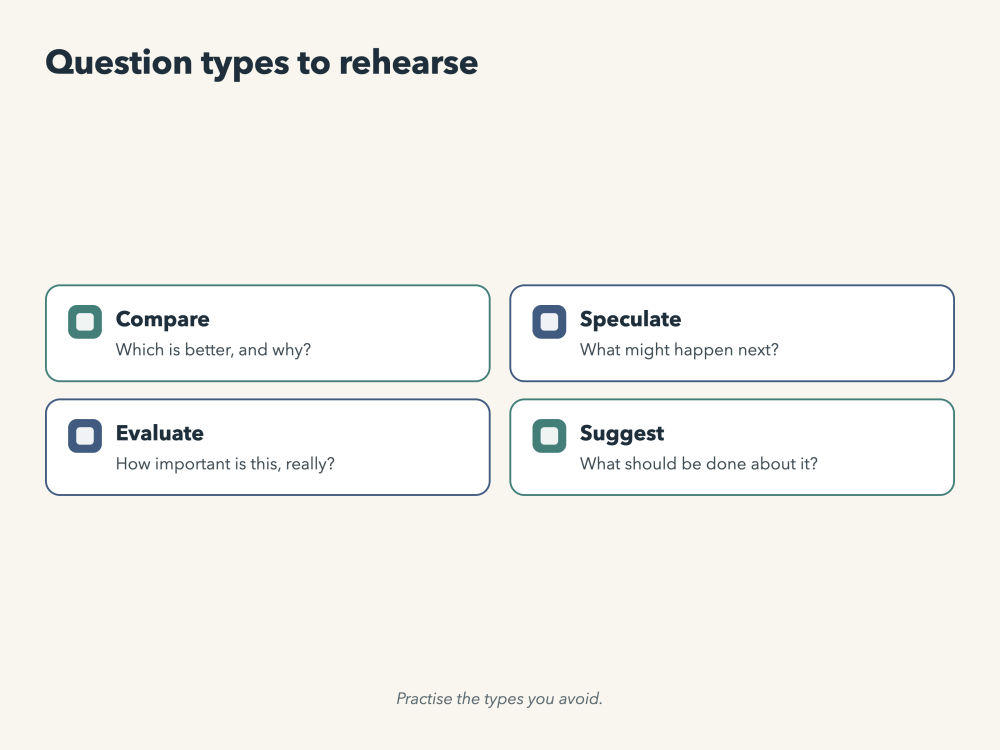
Part 3 questions are not random. They come in a handful of recognizable shapes: asking your opinion, asking you to compare two things, asking you to speculate about the future, asking you to judge whether something is a good idea, and asking what you would recommend to someone else. The moment you hear the shape, you know the frame your answer needs, and you stop hunting for the perfect opening line.
Candidates who freeze in Part 3 are usually not short of English. They are short of a frame, so they try to build a whole answer and a whole structure at the same time. Naming the type first splits that job in two, and the second half becomes much easier.
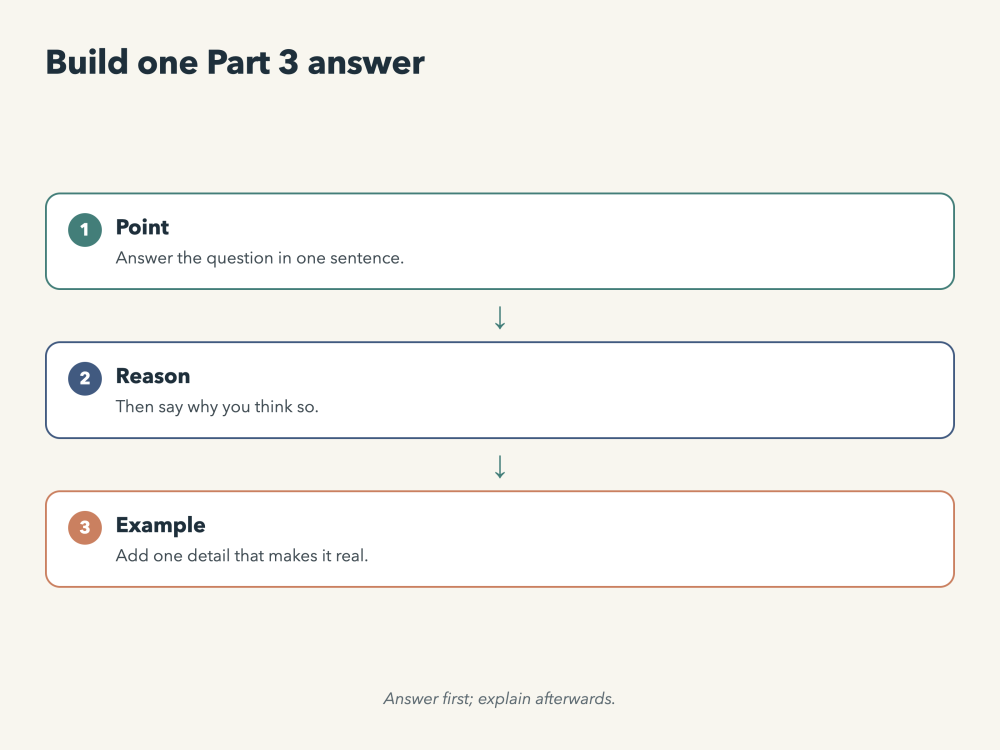
Step 2: Answer First, Justify Second
The most common structural mistake in Part 3 is building up to your answer instead of leading with it. If the examiner asks whether technology has made people more isolated, an answer that opens with three clauses of background before reaching a position sounds hesitant even when the English is accurate.
State your position in the first sentence, then support it. "On balance, I think it has, though not in the way people usually mean." Now the examiner knows where you stand and can follow your reasoning, and you have bought yourself time to develop it. The same applies to advice, comparison and prediction questions: commit to a line, then explain it.
Step 3: Read Sample Answers for Their Skeleton
A good Part 3 sample answer has a shape you can reuse even when the topic is unfamiliar: a claim, a reason, a concrete example, and often a concession that shows you can see the other side. That sequence, not the vocabulary, is what the examiner is scoring under fluency and coherence.
So when you read a sample answer, do not copy the words. Copy the moves. Ask yourself where the writer stated the position, where they gave a reason, where they grounded it in something specific, and where they admitted a limitation. Then take the same four moves onto a question they never answered. A memorized sentence collapses the moment the examiner follows up; a memorized structure survives almost anything.
Step 4: Practice the Question Types You Avoid
Most candidates rehearse the questions they already find easy, which is why their weakest type is still their weakest on test day. If prediction questions make you uncomfortable, spend a whole session on nothing else until the frame feels automatic.
Hibay's IELTS practice room runs Part 2 and Part 3 with the test's own flow and scores each answer against the IELTS criteria, alongside sentence-level corrections and a polished version of what you said. The scores are practice feedback, not an official band, which is the right way to use any automated score. What matters for Part 3 is the repetition of the frame under a timer, not the number at the end.
Step 5: Keep a Small Store of Abstract Language
Part 3 rewards language that can hedge and generalize, because abstract questions rarely have one clean answer. Keep a few phrases ready: "to some extent," "it depends on," "I'd imagine that," "the trade-off is." These let you take a position without overclaiming, which is exactly what the examiner is listening for in a discussion.
The trap is collecting a hundred of these and using none, because they never became automatic. Ten phrases you actually deploy under pressure are worth more than fifty you recognize on a page.
Step 6: How Many Questions, and How Long?
Part 3 is roughly four to six questions in four to five minutes, and each answer is usually expected to run for around thirty to forty seconds. That is longer than a Part 1 answer and much shorter than Part 2, which is why the structure has to do the work: there is no time to plan once you start speaking.
If your answer keeps ending after one sentence, you are almost certainly answering the literal question and stopping. Add the reason. If it keeps running past a minute, you are over-explaining a single point instead of moving through the frame.
Pick one question type this week, the one you dislike most, and answer six questions of that type on your phone. Then listen back and check only one thing: did your position come first. If the strain is in Part 2 rather than Part 3, work through the Part 2 cue cards guide first, then put the whole sequence together in a free IELTS Speaking mock test once a week. If you want the timer, the criteria and the sentence-level corrections in one place, run a Part 2 to Part 3 sequence in Hibay's IELTS practice room.
Frequently Asked Questions
How many questions are in IELTS Speaking Part 3?
Expect around four to six questions in four to five minutes, though the examiner can add follow-ups. Each answer usually runs thirty to forty seconds.
How do I improve my IELTS Speaking Part 3 answers?
Learn the question types, always answer before you justify, and rehearse the types you avoid under a timer. Record yourself and check whether your position came first.
Can I memorize sample answers for Part 3?
No. Part 3 is abstract and follow-up driven, so a memorized answer only fits the question it was written for. Memorize the structure instead, and let the words be yours.
How can I practice Part 2 cue cards and Part 3 questions with feedback?
Run them in sequence, not separately, since the fatigue in Part 3 is what reveals your weaker frames. An app with an exam mode and per-criterion feedback shortens the loop, and Hibay's IELTS practice room runs both parts with the test's own flow.
What should I do if I have no ideas for a Part 3 question?
Say so honestly and think aloud, then take the simplest defensible position. "That's not something I'd thought about, but I'd probably…" is a real answer; silence is not.