
IELTS Listening Map and Plan Labelling: Getting Your Bearings First
The speaker says the place is opposite the car park and just past the footbridge, and by then the recording has moved on. This guide answers how to follow a map description in Listening Section 2: the orientation step that has to happen in the preview seconds, the position and direction words that decide a letter, the deliberate wrong turn, and a ten-item campus plan drill with a key - the same marking routine you can run on any ielts listening mock test with answers.


On this page
The words arrive once and they are gone: opposite the car park, just past the footbridge. By the time you look down at the plan you are inside the next sentence, and the letter never leaves the box.
This page answers one question, how to follow a map description in IELTS Listening Section 2, in the order the recording works: what the visual asks, the orientation step in the preview seconds, the words that decide a letter, the deliberate wrong turn, and a ten-item plan drill with a transcript and key for every item. Test detail comes from the IELTS test owners' format pages and published sample tasks, read on 2 November 2026; no band score or result promise appears below.
What map, plan and diagram questions ask you to do
The official description is narrower than candidates expect. You complete labels on a visual, and the visual may be a diagram such as a piece of equipment, a set of pictures, a plan of a building, or a map of part of a town. The skill is the same in each: understand a description of a place and relate it to the drawing, including directions such as straight on or through the far door.
Where it appears is worth knowing. The library sample in the official sample tasks booklet is Part 2, Questions 11 to 15, and the computer-delivered sample is an extract from Part 2 in which a tour guide describes places in a US town. That fits the format: Part 2 is the one-speaker part giving information about a product, location or service.
Three mechanics then decide how you work:
- The answer is a letter. The library sample offers nine letters for five gaps, so you place a letter rather than write a word.
- The labels follow the recording: question 12 is answered after question 11, never before.
- Ten questions per part, one mark each, so one missed label is ten per cent of a part.
The words in these recordings are ordinary. The marks go when the letter arrives two sentences late.
Orienting the map before the audio starts
Before the first question there is a pause while the instructions are read, and it is the only moment when you can answer one question with no audio: where am I standing on this plan?
Cambridge English's classroom activity for this task type treats that as the first skill rather than a warm-up. It shows the plan with the options covered and asks where the tour might start, then stops the recording after my desk is just on your right as you go in and has every student point to their own position. Wrong at that moment means every direction after it is wrong too.
Fix four things in the pause:
- Find the starting point: the entrance, the gate or a printed marker, often the place the speaker opens with,
here we are at the entrance. - Decide which way the walker faces. Left and right belong to the walker, not to the page.
- Read the option box once and count. More letters than gaps means at least one letter is decoration.
- Guess the route: a building plan starts just inside the entrance, a town map where the group is standing.
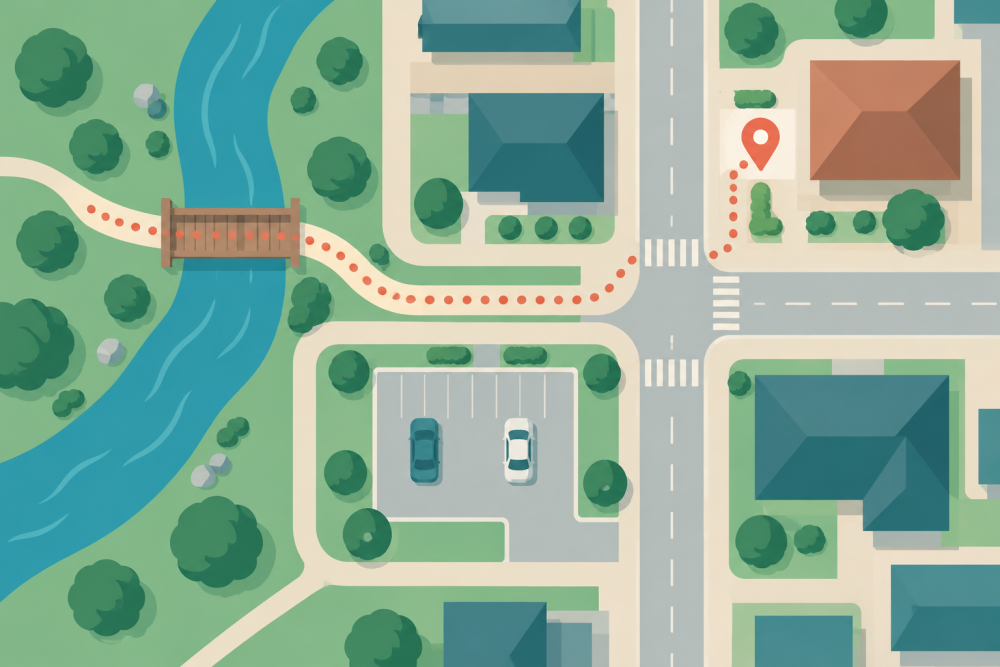
The reader's own sentence tests all four: opposite the car park, just past the footbridge. Two anchors and one relation. just past puts the footbridge behind you, and opposite then checks the side, because opposite sits across the route from the car park. With the entrance fixed and the walker facing north, it resolves in about three seconds.
The position vocabulary that decides the answer
Every phrase has an anchor already printed on the plan and a relation saying where the answer sits against it. Name both when the sentence ends and you can find the box; hear only the anchor and you are guessing. The wording below comes from the published tapescript of the official library sample, so it is real rather than invented.
| Phrase | What it settles on the plan | The line it comes from |
|---|---|---|
at the entrance | the fixed start, before any direction | So here we are at the entrance to the town library |
just by the main entrance | an object at the doorway, not inside the room | you'll usually find me at the desk just by the main entrance |
just on your right as you go in | the walker's right at the threshold | my desk is just on your right as you go in |
opposite this | across the route, facing the last thing named | opposite this the first room on your left |
just beyond | a short way after an anchor, close enough to be its neighbour | Just beyond the librarian's desk on the right |
carry straight on | no turn at all; the same line continues | If you carry straight on you'll come into a large room |
on the far wall | the wall at the end of the room you face | on the shelves on the far wall |
just past | after you have gone by the anchor | just past the fiction shelves |
next door to that | immediately adjacent, sharing a wall | next door to that is the children's library |
to the right of | the right side of a named area, not a direction of travel | a large room to the right of the library area |
Two habits follow. The distance words do the work: just beyond, just past and next door all mean close, but only one means you have already gone by. And the anchor is often furniture rather than a room, so a plan that looks empty still has plenty to hold on to.
Direction language: past, opposite, at the end of, just beyond
Opposite is across the route and facing the anchor: the other side of a path, corridor or street, roughly level with the thing named. Past means you have gone by it and the answer is further along, and just past keeps that distance short. Just beyond treats the anchor as a boundary, which is why it turns up with doors, desks and bridges. At the end of is terminal: nothing continues after it.
That is a ladder. just past is nearest, just beyond a step further, at the end of as far as the line goes, which is how two options sitting close together on the plan get separated.
Town maps scale it up. The computer-delivered sample places a school house in the middle of the block past Ash but before Oak Street, a block, a past and a before in one sentence, and puts the Welcome Centre on the southwest corner of Elm and Main Streets. The negative form is as common, and the published classroom activity collects don't go through the first door, but ..., turn sharp right, just past the ... there's a ... as good candidate language.
The deliberate wrong turn and how to recover
Three mechanisms point a sentence at the wrong letter while the right answer arrives.
A place that existed before: It was originally the art collection but that's been moved to another building. Art collection is an option, multimedia is keyed, and originally marks a past state rather than a present one.
A place promised later: We're hoping to add a section on local tourist attractions too, later in the year. Tourist information earns nothing, because a plan for the future is not a position on the plan today.
A word borrowed from another option: CD-Roms you can borrow to use on your computer at home sits inside the multimedia description, and Computers is on the list. The word is real, the object is not. The same shape appears with a seminar room, and that can be booked for meetings or talks, where the meeting word belongs to the room just described and the label being tested follows it: next door to that is the children's library.
Twelve worked instructions follow. The first four come from the published library sample, where the key is the proof; the rest are written for the campus plan below.
| Plan | What you hear | The letter it tempts | The letter it is | The word that decides |
|---|---|---|---|---|
| Library | It was originally the art collection but that's been moved to another building | A | F | originally |
| Library | We're hoping to add a section on local tourist attractions too, later in the year | I | B | hoping to add |
| Library | a seminar room, and that can be booked for meetings or talks | E | B | next door to that |
| Library | CD-Roms you can borrow to use on your computer at home | C | F | in that room |
| Campus | The café is the first building past the bridge - sorry, no, that's the studio: the café faces the water | G | F | sorry, no |
| Campus | Don't go through the door in front of you, go through the far door - the lecture theatre is at the back | C | H | don't go through |
| Campus | It used to be the post room, but that's moved to the new building: this one's the bike shed | J | B | used to be |
| Campus | The playing field is closed until the spring, so the gym is where the matches happen | K | I | closed until the spring |
| Campus | The sports hall is straight ahead of you - sorry, that's the library; the sports hall is off to the left | C | D | sorry |
| Campus | The clinic is at the end of the stream path, past the sports hall - not the building right by the bridge | D | E | at the end of |
| Campus | We're hoping to open a second café in the studio later this year, so ignore the sign there for now | G | F | hoping to open |
| Campus | Some people call the post room the old studio, but the studio is past the café; the post room is south of the stream | G | J | but |
Recovery has three rules. Write a letter only when the anchor and the relation agree, so that a correction has something to overwrite. Take a correction at once and do not spend the next sentence arguing with it. And never rub out a letter you confirmed against a second anchor: the phrase that panics you usually belongs to the next question.
Roads, buildings and the words for what is between them
Town maps and building plans ask for different nouns.
On a town map you will hear street, road, corner, block, junction, crossroads, bridge, footbridge, car park and the street names themselves. The computer-delivered sample uses on the other side of Main Street, The next street up Main is Ash Street and On the Southside of Ash, where on the other side of does the work of opposite and the next street up is a direction dressed as a street name.
Inside a building the nouns are entrance, reception, corridor, stairs, lift, wing, hall and the far door, positioned with on the left of, to the right of, at the back of and facing.
What sits between two places is where letters are won: between needs two anchors and puts the answer in the gap, next to and beside share a wall or an edge, opposite and across from cross a route. Hence the two-anchor rule. When an instruction names two places, the second is usually where you are and the first is what you have just passed, which is exactly what the sentence that opened this page does: footbridge behind you, car park opposite, answer on the far side of the route.
A ten-item plan drill with an answer key
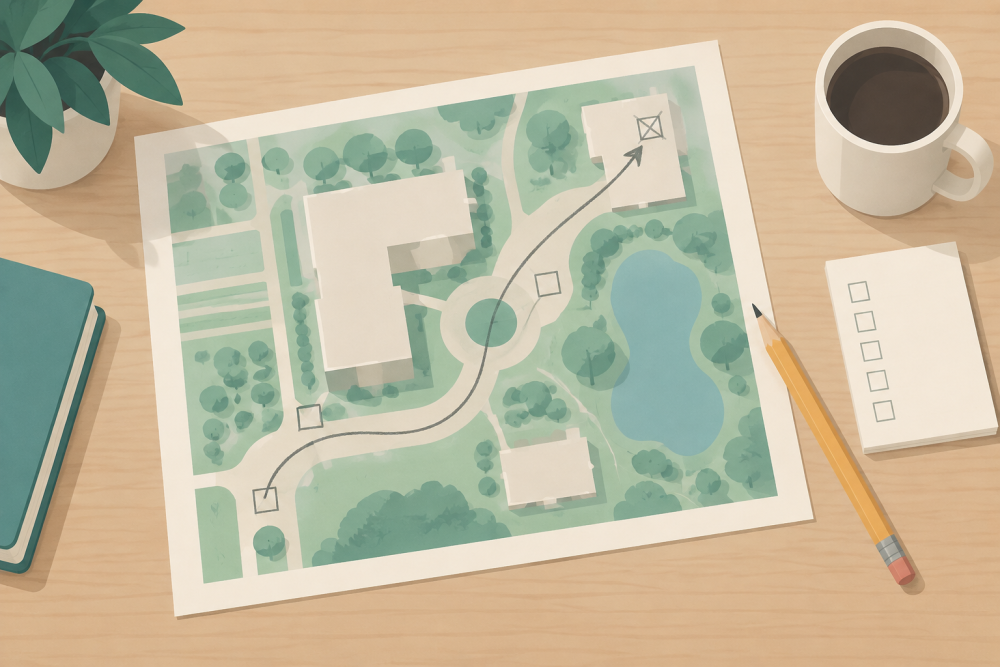
The campus below is written for this page, so no real institution is described and no recording exists. Read the option box until you can see the grounds, then cover the answer columns and work through the ten instructions as if they were played once.
The grounds are a rectangle with Mill Road along the south edge and the main gate in the middle of that edge. A footpath runs north from the gate, crosses a stream at a wooden footbridge, and splits on the far bank; the stream runs west to east across the middle of the campus.
| Letter | Place | Where it sits |
|---|---|---|
| A | car park | the south-west corner, immediately left of the gate |
| B | bike shed | just inside the gate, right of the footpath |
| C | library | straight ahead across the footbridge |
| D | sports hall | west of the library, beside the stream |
| E | clinic | the north-west corner, at the end of the stream path |
| F | café | east of the library, at the corner of the north bank |
| G | studio | the far end of the east path, just past the café |
| H | lecture theatre | the large building in the middle of the north campus |
| I | gym | the south-east corner, south of the stream |
| J | post room | between the gate and the gym, east side |
| K | playing field | the open ground east of the gym |
| L | bus stop | on Mill Road, west of the gate |
Label items 1 to 10 with the letters A to L. Two letters are never used.
| Item | The instruction you hear | Answer | The phrase that places it |
|---|---|---|---|
| 1 | You'll find the car park in the south-west corner, immediately to the left of the gate | A | immediately to the left |
| 2 | The bike shed is the first building on your right as you come through the gate | B | the first building on your right |
| 3 | Follow the footpath over the footbridge and you'll see the library straight ahead of you | C | straight ahead |
| 4 | The sports hall is the low building on your left as you come off the bridge | D | on your left as you come off |
| 5 | The café is on the other side of the library, at the corner of the north bank | F | on the other side of |
| 6 | The studio sits at the far end of the east path: go past the café and it is the last building before the trees | G | at the far end |
| 7 | In the middle of the north campus there's a large building facing the stream; that's the lecture theatre | H | in the middle |
| 8 | The clinic is on the north-west corner, at the end of the stream path, past the sports hall | E | at the end of |
| 9 | Coming back over the bridge and turning left, the post room is between the gate and the gym | J | between the gate and the gym |
| 10 | The last one isn't inside the campus at all: the bus stop is on Mill Road, west of the gate | L | west of the gate |
The two unused letters are the gym and the playing field, which is the point: both are named in the recording and neither is an answer. Mark yourself in three columns rather than one. Right letter with the right reason means you heard anchor and relation. Right letter with the wrong reason means a guess landed. Wrong letter sends you back to the phrase in the last column, because that is where the position was decided.
Marking your own ielts listening mock test with answers to find the pattern
One missed label tells you nothing. Forty questions in which two or three are map labels tell you something, provided you sort the losses before you look at the score.
- Sit the part without pausing, because the whole point is that the description moves on.
- Mark with the key, and label every lost map item orientation (you never found the anchor), relation (you found the anchor but not the position) or correction (you had it and the speaker moved it).
- Count them. The largest is what to drill: orientation with the four-step pause, relation with the table of phrases, correction with the twelve sentences.
- Sit a second paper and count again. The number that falls is the part you actually changed.
This is not a guide to running a mock test; it is what to do with the map items once the key is in front of you. It works on any ielts listening mock test with answers, on paper or on a computer, because the task is identical in both formats.
The transcript is the part worth keeping. The HiBay app's exam section covers IELTS Listening Sections 1 to 4 with a mock test, transcripts and translation, and for this task type the transcript is the useful half: reading the sentence back shows whether you missed the anchor, the relation or the correction.
Frequently asked questions
What should I look at first on an IELTS Listening map question?
The starting point, before the option list: find the entrance, the gate or the point the speaker calls here we are, and decide which way the walker is facing. From there a left is the walker's left, and every phrase has somewhere to land. Only then read the letters.
Are map and plan questions always in IELTS Listening Section 2?
In the official samples they are: the library sample is Part 2, Questions 11 to 15, and the computer-delivered sample is a Part 2 extract. Part 2 is the one-speaker part that gives information about a product, location or service, which is the recording a description of a place needs. The test owners do not publish a rule that confines the task type to that part, so prepare for Part 2 first and stay ready to meet a plan anywhere.