
IELTS Listening Mock Test: Computer-Based and Paper Are Different Practice
What actually changes between paper and computer ielts listening mock test with answers practice, and how to convert existing paper material into screen practice.

On this page
You have two paper practice books and a test date on a computer. The listening audio is the same, the questions are the same, and yet candidates who score well on paper regularly lose half a band on screen in their first attempt.
The differences are few and specific, which is why they are fixable in a few sessions. This is what changes in a computer-delivered listening test, and how to turn a paper ielts listening mock test with answers into practice for the screen.
What is identical, so you do not relearn the test
Four parts, ten questions each, forty questions, about thirty minutes of audio, each recording heard once. Question types are the same: form completion, multiple choice, matching, map labelling, note completion.
The band conversion is the same. The skills are the same: prediction, tracking, spelling, keeping pace with a recording that does not wait.
If you have been practising on paper, most of your preparation carries over. Do not restart with a new method.
The four differences that change practice
Answer entry. On paper you write in a booklet and transfer later. On screen you type into a box, and the box accepts what you type, including mistakes.
Review time. Paper gives you ten minutes at the end to transfer answers. Computer delivery gives you two minutes to check, which changes when you must commit.
Audio control. Computer delivery usually provides a volume control and, depending on the test centre, individual headphones. You can adjust; you cannot pause.
Navigation. On screen you move with buttons and can flag questions for review, but you cannot flick through the whole paper the way you can turn pages.
Where paper practice teaches the wrong habit
Writing on the question paper is the big one. On paper, notes beside the question are normal and useful. On screen there is no question paper, only a notes sheet that is not marked.
The second is postponing. Paper candidates often leave uncertain answers and plan to decide during the ten-minute transfer. On screen, the two-minute check is not enough to reconsider more than a handful of items, so an uncertain answer should be committed immediately and flagged, not left blank.
The third is spelling. Handwriting forgives a letter that looks like another letter. A text box does not: accomodation is wrong on both, but on screen there is no examiner goodwill and no margin note.
Converting a paper mock in thirty minutes
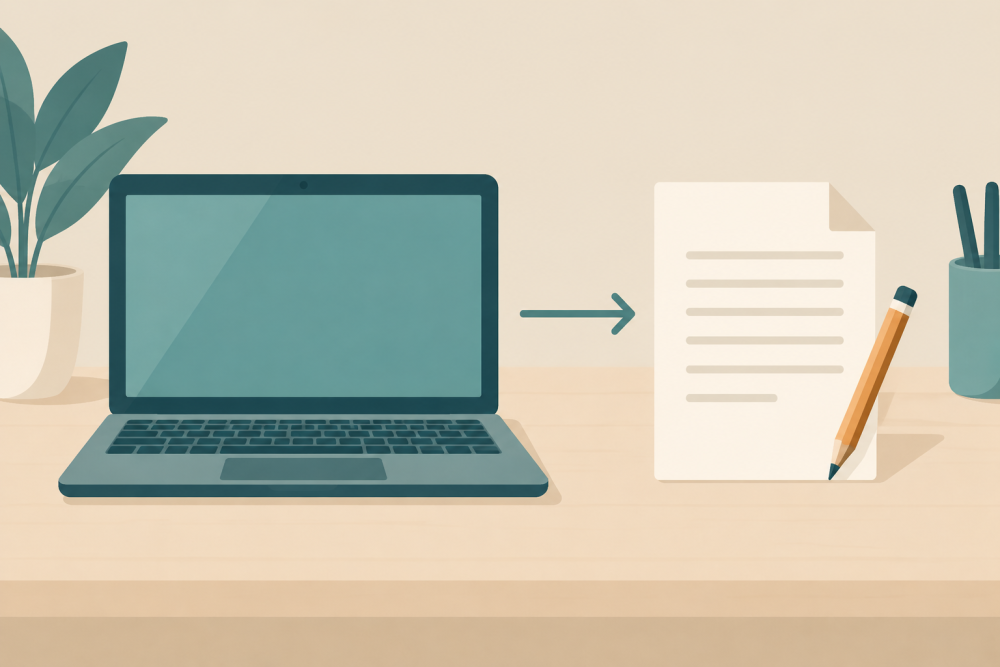
Step one: read the questions on screen instead of on paper. Photograph the page, open it on a laptop, and answer in a text file.
Step two: time the review at two minutes, not ten. When the audio ends, start a two-minute timer and stop writing at the end of it.
Step three: type every answer. No handwriting, even for numbers and names.
Step four: mark it yourself, and count spelling errors separately from comprehension errors.
That conversion costs nothing and reproduces the two differences that actually cost marks.
A typed-answer drill for the formats that fail
Spelling. Say a word aloud from a list of twenty common listening answers, then type it: accommodation, Wednesday, receipt, necessary, forty, fourteen, nineteen, ninety.
Numbers. Type these as you hear them: £15.50, 1,200, 08:45, 3 March, Room 204.
Plurals. Listen for the final sound and type it: two tickets versus one ticket, three months versus a month.
Ten minutes a day for a week removes most of the avoidable losses.

What to rehearse in the last week
Do two full mock tests on screen, at the same time of day as your test, with headphones.
Practise the two-minute check once per test, and decide in advance what you will look at: spelling, plurals, and any flagged item.
Stop practising transfer. It is the habit most likely to cost you time on screen, and a week is long enough to break it.
Frequently asked questions
Is computer-based IELTS Listening harder?
The audio and questions are comparable; the delivery is less forgiving. You type instead of writing, you get about two minutes to check instead of ten, and you cannot annotate a question paper, so candidates who rely on postponing answers tend to lose more marks on screen than on paper.
Can I write notes in computer-based IELTS Listening?
You are given a notes sheet and a pencil, but the notes are not marked, and anything you want scored must be typed into the answer box. Treat notes as working memory for numbers and names, and type the answer as soon as you are reasonably sure of it.