
IELTS Listening: What to Do in the Gap Between Sections
Most easy marks in IELTS Listening are lost in the thirty seconds between parts. Here is a three-step gap routine, a prediction table by answer type, a twelve-minute drill and the ielts listening tips for band 9 advice most lists leave out.

On this page
The first question of every IELTS Listening section is the cheapest mark on the paper and the one most often lost. The recording stops, you hear a short instruction, and by the time Part 2 starts on a different place with a different speaker, question 11 is gone.
Everything about the test here comes from the test owners' published format pages and sample tasks, read on 4 November 2026: four parts, ten questions each, forty questions in about thirty minutes, each recording heard once. This page reports no personal score and promises no band.
Where the gaps sit in the IELTS Listening paper
There is no interval in which the four parts stop. The recording runs, and between one part and the next it does three things in order: it announces the end of the part, it gives thirty seconds to check answers, and it introduces the next part and the people in it while you look at those questions.
| Moment | What the recording does | What it means for your pencil |
|---|---|---|
| End of a part | Announces the end of that section | Last three seconds for a spelling check only |
| Check time | Thirty seconds to check answers | Fix what is written, do not add new answers |
| Start of the next part | Introduces the speakers and the situation | Read the first two questions of the new part |
The introduction is not decoration: it says who is speaking and where, which is what a prediction is built from. Two students and a tutor sound nothing like one speaker describing a facility.
Why the first question of a section is the one people miss
Three things change at once at a boundary: the topic, the speaker and the accent. A candidate still inside the last question of the previous part hears the new recording as background noise, and questions 11 and 12 are spoken inside ordinary conversation.
The first item is usually the easiest, which makes the loss worse: often a name, a number or a single noun in a clear sentence with nothing competing against it. Marks go there for one reason. Nobody was looking at it.
The three-step gap routine
Fix the order in which you do the three things, and the boundary stops being a gamble.
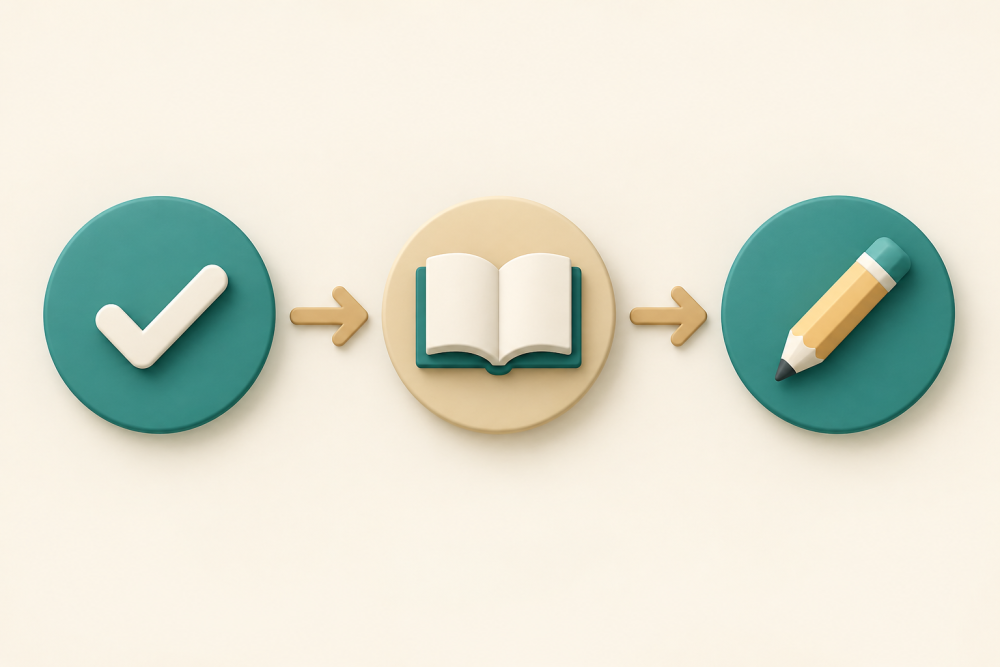
- Check the last answer, but only for spelling, plural and word limit. Three seconds is enough; a missing answer will not be invented in thirty.
- Read the first two questions of the next part, question words first.
- Write the answer type in the margin before the audio restarts.
Step three is the one people skip, so make it physical: beside the question number write N for a noun, No for a number, Nm for a name, V for a verb form. When the recording starts, you are no longer asking what the answer is; you are waiting for one category of word.
The words to listen for are consistent. The end of a part is signalled by a closing line and by check your answers; the new part by turn to and a sentence about who is speaking.
A prediction table you can write from memory
| Answer type | How it looks on the page | Margin | The trap |
|---|---|---|---|
| Name | A person, place or company | Nm | A surname spelled out, then corrected |
| Number | After a currency sign or unit | No | Two numbers close together, the second rejected |
| Time or date | Beside a day, month or clock | No | A time moved fifteen minutes later |
| Noun | Completes a phrase | N | A plural you hear as singular |
| Verb form | After to, will or have | V | A tense shift signalled one clause earlier |
The table is short on purpose. You are not classifying the whole paper, only the two items you will meet first.
What to stop doing in the gap
Some habits use the thirty seconds and return nothing.
- Re-reading an answered question. The answer is written; the second reading produces doubt, not information.
- Hunting for a word you are sure you wrote. If it is not on the page, searching costs the next two answers.
- Erasing. Cross out once and write beside it, so the first attempt shows which pattern fooled you.
- Reading the whole next part. Ten questions in thirty seconds is a scan, and it leaves you with no priorities.
The gap has room for three actions and no more. Anything that does not fit is a job for the review at the end.
Four boundaries in twelve minutes: a timed drill
Take one full recording, four parts, and rehearse only the boundaries. Play the paper straight through once without stopping, and write in each gap exactly what you did.

| Transition | What you should have done | What you score |
|---|---|---|
| Part 1 to 2 | Checked the last answer, read questions 11 and 12 | Was question 11 answered? |
| Part 2 to 3 | Two margin codes before the audio restarted | Were the codes there before the first word? |
| Part 3 to 4 | Read the two note lines and the word limit | Was the limit seen before the answer? |
Score three things per boundary: was the first question of the next part answered, was a margin code written before the audio restarted, and did you touch the previous part again. Twelve minutes of audio, five minutes of scoring, and the pattern is visible on the first attempt.
Where ielts listening tips for band 9 usually stop short
Most advice on this paper stops at "read ahead", which is true and unusable: it does not say when, or what to stop doing. The gap is the only place where reading ahead is actually possible, and it is also the place where most candidates spend the time on the question they have just finished.
Treat the boundary as a routine rather than a decision and the first question of every part stops being a coin toss. HiBay's AI conversation practice gives section-by-section feedback against IELTS-style criteria, which trains the habits that survive a single play: catching a paraphrase, holding a number to the end of the sentence, moving on without regret. It guarantees no score.
Frequently asked questions
How long is the pause between IELTS Listening sections?
Thirty seconds of check time after each of the first three parts, then the next part's introduction and the time to look at its questions.
Those thirty seconds are for checking what is already written. The longer look at the new questions comes with the introduction, which is why the routine here starts before that introduction ends.
Do I get extra time to transfer IELTS Listening answers?
On paper, yes: ten minutes at the end to copy your answers onto the answer sheet. On computer, there is nothing to transfer and two extra minutes to check.
What matters is not the length of either period but what it is for: ten minutes is enough to lose marks on a spelling you had right, and two minutes is enough to fix one.