
IELTS 2024-2025: Higher Bands Come With Wider Skill Spreads
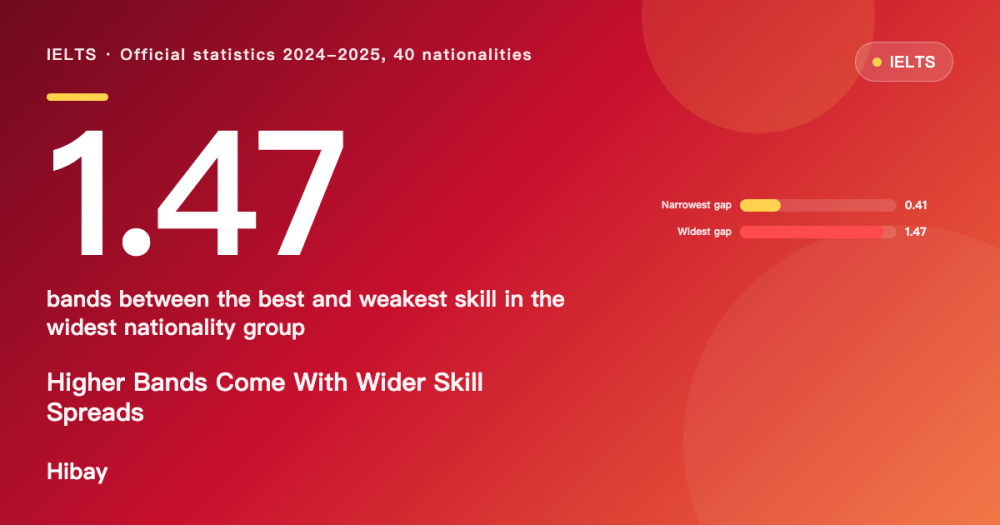
Official IELTS 2024-2025 Academic means for 40 nationalities: the gap between a group's best and weakest skill runs from 0.41 to 1.47 of a band.

สารบัญ
IELTS reports one overall band and four skill bands, and the four do not move together. This report asks how far apart they sit inside a single nationality group. It uses the official IELTS test-taker performance file for 2024-2025, specifically the Academic means for 40 nationalities, and measures the spread inside each group as the highest skill mean minus the lowest. The spread runs from 0.41 of a band in Bangladesh to 1.47 in Germany, and it correlates with the overall mean at r = 0.70. The figures describe group averages published by IELTS, not individual candidates, and the table covers only the nationalities IELTS chose to list.
Key findings
- Across the 40 nationalities in the official Academic table, the distance between a group's strongest and weakest skill mean ranges from 0.41 band points in Bangladesh to 1.47 in Germany.
- Wider spreads go with higher overall bands: the Pearson correlation between a group's overall mean and its spread is 0.70 across the 40 rows.
- The five highest-scoring nationalities average 1.20 points of spread against 0.71 for the five lowest-scoring ones, about 1.7 times as wide.
- Six of the 40 nationalities spread more than a full band across the four skills, and 20 spread less than 0.80.
- Writing and reading sit furthest apart in the widest cases: in Germany reading averages 8.10 and writing 6.63, a 1.47-point range inside one nationality.
Background
An IELTS candidate receives a whole-number or half-band score for Listening, Reading, Writing and Speaking, and the overall band is derived from those four. Because the skills are scored separately, a national average that looks comfortable on the overall band can hide a large internal difference, and preparation that raises one skill does not necessarily move the others [1]. The same pattern appears one level up: EF's 2025 index of adult English skills reports that the gap between a country's strongest and weakest skill is close to twice as wide in very high proficiency countries as in low and very low proficiency ones [2]. This report tests whether the IELTS tables show a comparable pattern across nationality groups.
Data and method
All figures come from the IELTS test-taker performance data for 2024-2025, published by the IELTS partners, sheet "AC mean by nationality" [1]. That sheet reports, for each nationality, the mean band score in Listening, Reading, Writing and Speaking plus the overall mean, for candidates who sat the Academic test. Forty nationalities are listed. Means are group averages of individual candidate scores, and the sheet prints no candidate count per nationality, so no per-group sample size can be quoted.
Three definitions apply throughout. The spread of a group is the highest of its four skill means minus the lowest, calculated from the two-decimal means exactly as the sheet publishes them, so subtracting the printed values reproduces the number shown here. The correlation is Pearson's r between the 40 overall means and the 40 spreads, computed on the published two-decimal values. The groups labelled lowest five and highest five are the five nationalities with the lowest and highest overall means, and their figures are the mean of those five spreads.
Data are aggregated group means; no individual candidate record is used, and no group here is smaller than the sheet's own publication threshold. Values are rounded to two decimal places, and shares and counts to whole numbers. IELTS notes that the nationality table lists the top nationalities alphabetically rather than by the size of their candidature, so the 40 rows are not a random sample of test takers.
Results
The spread widens as the overall band rises. Across the 40 rows the correlation is 0.70, and the two ends of the table are far apart: the five nationalities with the lowest overall means average 0.71 points between their best and weakest skill, while the five with the highest overall means average 1.20 points, about 1.7 times as wide. Germany is the clearest case, with an overall mean of 7.57 built from reading at 8.10 and writing at 6.63. Italy (1.24), Spain (1.16) and Malaysia (1.11) follow the same shape.
Figure 1. Spread between the highest and lowest skill mean, in band points, for the six widest of the 40 nationalities, n = 40 nationalities. Source: IELTS test-taker performance data 2024-2025 [1].
At the other end, the four skills sit close together. Bangladesh has a spread of 0.41 points, Cambodia 0.42 and Japan 0.52, and in all three the overall mean is modest: 6.00, 6.03 and 5.82. A narrow spread is not the same as a strong profile. Those groups are internally consistent around a mid-band average rather than strong everywhere.
Figure 2. Spread between the highest and lowest skill mean, in band points, for the five narrowest of the 40 nationalities, n = 40 nationalities. Source: IELTS test-taker performance data 2024-2025 [1].
| Nationality | Overall | Reading | Listening | Writing | Speaking | Spread |
|---|---|---|---|---|---|---|
| Germany | 7.57 | 8.10 | 7.80 | 6.63 | 7.51 | 1.47 |
| Italy | 7.00 | 7.36 | 7.49 | 6.25 | 6.65 | 1.24 |
| Spain | 7.09 | 7.49 | 7.39 | 6.33 | 6.89 | 1.16 |
| Bangladesh | 6.00 | 6.23 | 5.82 | 5.83 | 5.88 | 0.41 |
| Japan | 5.82 | 5.93 | 5.99 | 5.65 | 5.47 | 0.52 |
| Oman | 5.41 | 5.20 | 5.01 | 5.36 | 5.81 | 0.80 |
Read each row as one nationality group, not one candidate: the columns are the published group means and the last column is the highest of the four minus the lowest.
The relationship is a tendency, not a rule. Mongolia has a spread of 1.01 at an overall mean of 6.35, wider than Egypt at 0.97 and an overall 6.67, and Japan combines a low overall mean with one of the narrowest spreads in the table. China, at an overall 5.91, spreads 0.71 points because reading and listening sit above writing and speaking, while Vietnam reaches 0.88 with speaking at 5.61 against reading at 6.38. In short, the size of the internal gap is only partly predicted by the average band.
Limitations
Four limits matter. First, these are group means published by IELTS, not individual scores: a nationality spread of 1.47 does not mean that individual candidates differ by that much, and it says nothing about the distribution inside the group. Second, the 40 rows are the nationalities IELTS chose to publish, listed alphabetically rather than by candidature size, so they are neither exhaustive nor a random sample, and a country's appearance depends on how many of its candidates sat the test. Third, no candidate counts are printed, so no figure here can be weighted by group size, and a small group and a very large one carry equal weight in the correlation. Fourth, a mean is an observational summary: the correlation between band level and spread does not show that a higher band makes the four skills diverge, and the IELTS tables cannot separate test preparation, education systems or migration routes as explanations. The 2024-2025 window is a single edition, so year-to-year stability is untested here.
What this means for learners
Compare your own four skill bands before you book a retake. If one skill sits more than a band below the others, that gap is where the next round of work is likely to pay, and repeated speaking practice with feedback is one way to close a gap in the skill that is hardest to rehearse alone. Treat an overall band as a summary rather than a description: two candidates with the same overall band can carry very different profiles, and university or visa requirements are usually set per skill as well as overall. Hibay offers speaking practice and feedback between study sessions, though its feedback is not an official IELTS result and does not predict a band score.
Frequently Asked Questions
Which IELTS skill varies most between countries? Writing is the lowest of the four skill means in 31 of the 40 Academic nationalities in the 2024-2025 table, and reading is the highest in 28 of them, which is why the widest spreads are usually a reading-to-writing distance (see Results).
Do higher-scoring countries have bigger skill gaps? In these tables, yes as a tendency: the correlation between overall mean and spread is 0.70 across 40 nationalities, and the five highest-scoring groups average 1.20 points of spread against 0.71 for the five lowest. The relationship is not a rule, and Mongolia and Egypt are the counterexamples cited above (see Key findings).
Is a big skill spread bad? The IELTS tables do not answer that. A wide spread means a group's average performance is uneven across the four skills, not that any individual is weak, and the data here cannot be linked to admission outcomes or to score gains (see Limitations).
How to cite
Hibay Product Team. (2026, November 2). IELTS 2024-2025: Higher Bands Come With Wider Skill Spreads. Hibay. https://www.hibay.ai/en/news/ielts-skill-spread-vs-overall-band-2024-2025
Figures are from the public sources listed below and may be cited with attribution.
References
- IELTS Partners (British Council, IDP IELTS, Cambridge University Press & Assessment). IELTS test taker performance 2024-2025: Academic mean performance by nationality. https://ielts.org/cdn/ielts-downloadable-assets/ielts-research/ielts-research-data/ielts-test-taker-performance-data-2024-2025.xlsx. Accessed 2026-11-02.
- EF Education First. EF English Proficiency Index 2025. https://www.ef.com/assetscdn/WIBIwq6RdJvcD9bc8RMd/cefcom-epi-site/reports/2025/ef-epi-2025-english.pdf. Accessed 2026-11-02.