
IELTS Speaking Bands 6, 7 and 8: What the 2026 Descriptors Change
A line-by-line reading of the official IELTS Speaking band descriptors, with counts for the wording that separates Band 6, Band 7 and Band 8.

ໃນໜ້ານີ້
Examiners score IELTS Speaking against four published criteria, and candidates ask what separates Band 6 from Band 7 and Band 8. This report reads the official Speaking Band Descriptors line by line: 9 band rows by 4 criteria, 36 descriptor cells, taken from the 4-page public PDF. The clearest change at Band 7 is a negation: "Coherence may be lost at times" becomes "these will not affect coherence". Three of the 36 cells, all in Pronunciation, describe no band at all. The scale shows what examiners weigh; it does not predict a score.
Key findings
- Of the 36 descriptor cells, 3 are cross-references to neighboring bands rather than descriptions, and all 3 are in the Pronunciation column, at Band 3, Band 5 and Band 7.
- Hesitation appears in 5 of the 9 Fluency and coherence cells, at Bands 5 to 9, while pause-based wording appears in 3 of the 9, at Bands 2 to 4.
- "Understood" appears in 4 of the 9 Pronunciation cells, at Bands 4, 6, 8 and 9, and the qualifier tightens from "requires some effort" to "effortlessly".
- Paraphrase appears in 5 of the 9 Lexical resource cells, at Bands 4 to 8, and only 2 sentences in the table repeat verbatim across two bands of the same criterion.
- The Band 6 row is the longest of the nine at 154 tokens, and its Pronunciation cell holds 64 tokens against 20 at Band 7, one of the three cross-references.
Background
IELTS Speaking is rated by a certified examiner on four equally weighted criteria — Fluency and coherence, Lexical resource, Grammatical range and accuracy, and Pronunciation — whose average gives the Speaking score [2]. IELTS points candidates to the descriptors, together with recorded sample answers, to see the level of English to expect at each band [3]. The document is subtitled "Scoring criteria for Academic and General Training tests", so a wording change applies to both versions [1].
Data and method
Every figure here was counted from the official Speaking Band Descriptors, the 4-page public PDF downloaded from ielts.org and read on October 30, 2026 [1], and verified identical to the online copy. No candidate or examiner records are involved and no sample was drawn: a rating scale is a document rather than a survey, so n is not applicable and the unit of analysis is the descriptor cell.
src/extract_bd.py reads the PDF with pypdf, takes row boundaries from the table's drawn cell rectangles, places each line by its vertical and horizontal position, and rebuilds 9 band rows by 4 criteria, or 36 cells; Band 0 is excluded because its row reads "Does not attend / Does not complete the test".
Keyword coverage counts, out of the 9 cells of one criterion, those whose text contains a search string. Cross-reference share counts, out of 36 cells, those whose text begins "Displays". Token count is whitespace-separated items in one cell, with words split across a line rejoined as one hyphenated token. Verbatim repetition counts, out of 36 cells, sentences of 3 tokens or more repeated identically in two bands for one criterion. All results are aggregated counts of wording; figures are rounded to the nearest whole percent.
Results
The grid is not uniform: of the 36 cells, 3 describe no band of their own. The Pronunciation cells at Bands 3, 5 and 7 read "Displays all the positive features of band 6, and some, but not all, of the positive features of band 8", so that band's pronunciation is defined by reference to its neighbors.
| Criterion | Band 6 wording | Band 7 wording | What changes at Band 7 |
|---|---|---|---|
| Fluency and coherence | "Coherence may be lost at times as a result of hesitation" | "these will not affect coherence" | the consequence of hesitation is removed |
| Lexical resource | "Resource sufficient to discuss topics at length" | "Resource flexibly used" | sufficiency becomes flexibility |
| Grammatical range and accuracy | "these rarely impede communication" | "Error-free sentences are frequent" | tolerated error becomes counted success |
| Pronunciation | "Can generally be understood throughout without much effort" | cross-reference to Bands 6 and 8 | no wording of its own |
Read each row across: Band 7 keeps the Band 6 topic and raises the demand, except in Pronunciation.
In Fluency and coherence the behaviors named at Bands 6 and 7 are nearly the same; the judgment attached to them changes. Band 6 accepts that "Coherence may be lost at times as a result of hesitation, repetition and/or self-correction", and Band 7 keeps the same three phenomena in "Some hesitation, repetition and/or self-correction may occur, often mid-sentence" while adding "However, these will not affect coherence." Hesitation wording runs from Band 5 to Band 9, 5 of the 9 cells; pause wording covers Bands 2 to 4, 3 of the 9, then stops.
Grammatical range and accuracy moves from tolerated error to counted success. Band 6 offers "a variety of structures with limited flexibility" and accepts errors in complex structures that "rarely impede communication"; Band 7 asks for "A range of structures flexibly used. Error-free sentences are frequent."; Band 8 asks for a "Wide range of structures" whose "majority of sentences are error free". Error-free wording appears in 3 of the 9 cells, at Bands 4, 7 and 8, so it reads as a Band 7 threshold.
Lexical resource moves from sufficiency to flexibility: "Resource sufficient to discuss topics at length" at Band 6, resource "flexibly used" with "an awareness of style and collocation" at Band 7, "Wide resource, readily and flexibly used" at Band 8. Paraphrase appears in 5 of the 9 cells, at Bands 4 to 8, and "Effective use of paraphrase as required." repeats word for word at Bands 7 and 8 — one of only 2 sentences repeated verbatim across two bands in one criterion. The other opens Band 8 and Band 9: "Fluent with only very occasional repetition or self-correction".
"Understood" appears in 4 of the 9 Pronunciation cells, at Bands 4, 6, 8 and 9, and the qualifier tightens: "cannot be understood" at Band 4, "without much effort" at Band 6, "easily understood" at Band 8, "effortlessly understood" at Band 9. Accent arrives late and twice only: "minimal effect on intelligibility" at Band 8, "no effect" at Band 9, 2 of the 9 cells.
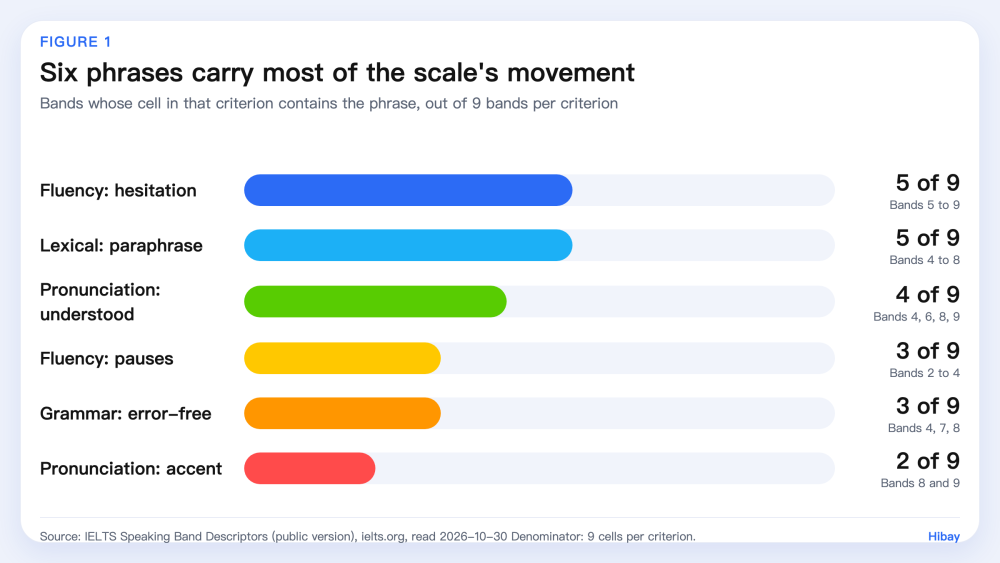
Figure 1. Nine band descriptors per criterion; bars show how many of those nine cells contain the phrase. Source: IELTS Speaking Band Descriptors (public version) [1].
Band 5 keeps the focus on searching — "Hesitations are often associated with mid-sentence searches for fairly basic lexis and grammar" — and its Pronunciation cell is a cross-reference to Bands 4 and 6. Band 9 reverses the function of hesitation: "Any hesitation that occurs is used only to prepare the content of the next utterance and not to find words or grammar."
Length follows the cross-references. Band 6 is the longest row at 154 tokens (41 in Fluency and coherence, 21 in Lexical resource, 28 in Grammatical range and accuracy, 64 in Pronunciation); Band 7 totals 126 and Band 8 totals 132. The Pronunciation column runs 17, 33, 18, 58, 20, 64, 20, 40 and 34 tokens from Band 1 to Band 9, and the dips at Bands 5 and 7 are the cross-reference cells.
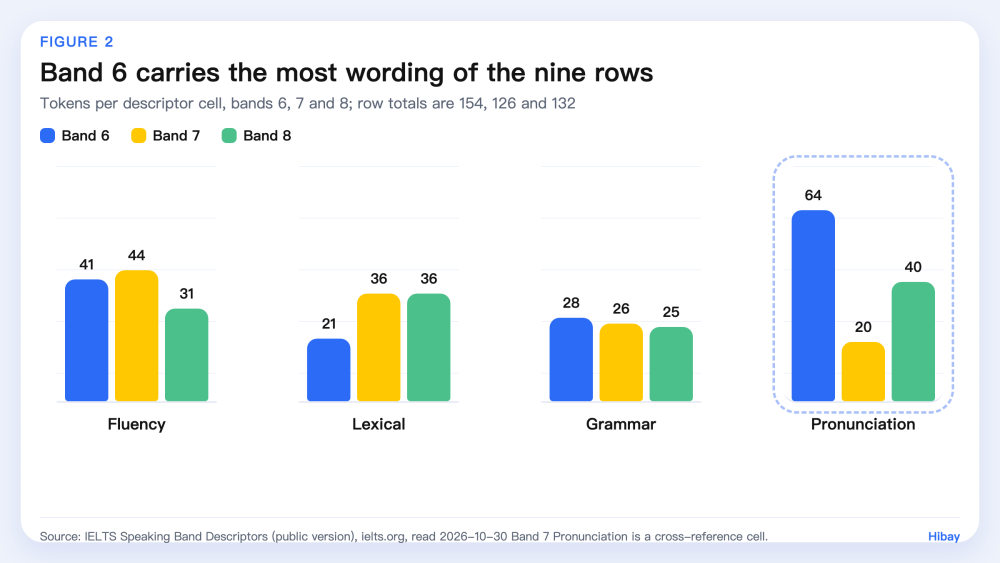
Figure 2. Tokens per descriptor cell, bands 6, 7 and 8; row totals are 154, 126 and 132. Source: IELTS Speaking Band Descriptors (public version) [1].
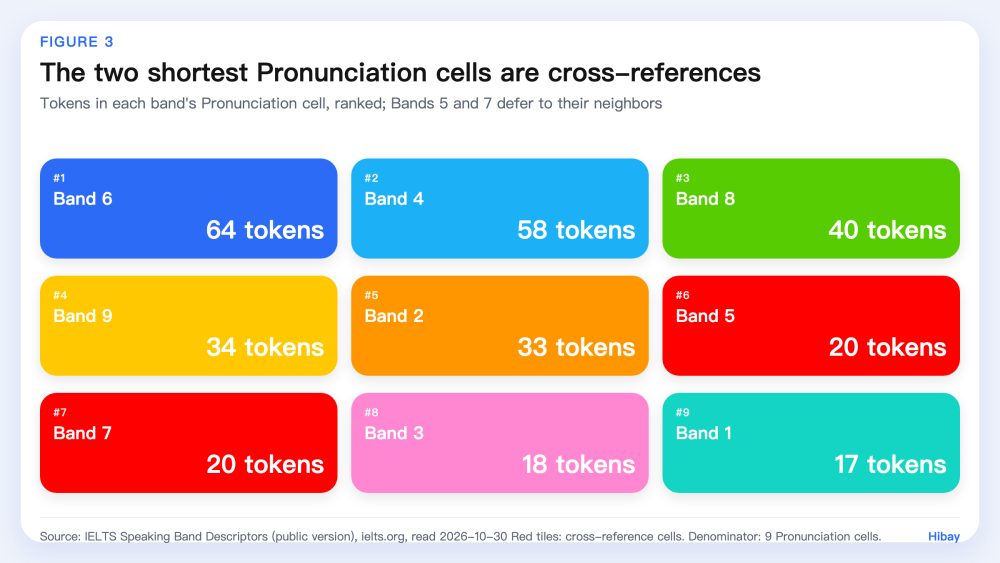
Figure 3. Tokens in each band's Pronunciation cell, Band 1 to Band 9, ranked; the cells at Band 5 and Band 7 are cross-references. Source: IELTS Speaking Band Descriptors (public version) [1].
Limitations
Four limits apply. First, a rating scale is not a dataset: these counts measure wording, not candidate performance, so the sample size is not applicable, and the 0.90 inter-rater reliability IELTS reports for Speaking [4] concerns consistency between examiners rather than the distribution of scores. Second, frequency is not weighting: a phrase in 5 of 9 cells does not carry 5 of 9 of the criterion, and a band is a threshold rather than a score, since "A candidate must fully fit the positive features of the descriptor at a particular level" [1]. Third, the counts depend on the extraction rules above and on this 4-page version; the document says "Please visit IELTS.org for updates", so a later edition would change the wording. Fourth, the public PDF summarizes examiner training rather than reproducing it, and candidates are rated on average performance across all parts of the test [1], so no single cell decides a result.
What this means for learners
Read one band above your target and look for the clause your band's row lacks — "these will not affect coherence" at Band 7, "Error-free sentences are frequent" at Band 7, "easily understood" at Band 8 — then practice that behavior rather than a general impression of fluency. Because the Band 7 Pronunciation cell carries no wording of its own, the target there is the Band 8 detail: stress and intonation held across long utterances. A tool such as Hibay can give repeated feedback on those features between sessions, but practice feedback is not an official score.
Frequently Asked Questions
What is the difference between IELTS Speaking Band 6 and Band 7? Band 7 says hesitation "will not affect coherence", where Band 6 says coherence "may be lost at times"; Band 7 wants "Error-free sentences are frequent", where Band 6 tolerates errors that "rarely impede communication"; and Band 7 wants resource used "flexibly", where Band 6 is satisfied with "sufficient" (see Results).
Do Academic and General Training candidates share the same Speaking descriptors? Yes. The PDF is subtitled "Scoring criteria for Academic and General Training tests" and carries one set of four columns for both [1], so every count here applies to both (see Data and method).
Why does the Band 7 Pronunciation box not describe pronunciation? It is one of the 3 cross-reference cells, reading "Displays all the positive features of band 6, and some, but not all, of the positive features of band 8". Only 33 of the 36 cells describe their own band (see Results).
Which words recur most across the descriptors? Hesitation and paraphrase, each in 5 of the 9 cells of their criterion, then "understood" and other intelligibility words in 4 of the 9 Pronunciation cells; "accent" is rarest, in 2 cells (see Results).
Do the descriptors tell me what score I would get? No. They describe what an examiner weighs, and a candidate must fully fit one descriptor level to be placed there [1]; the score also reflects average performance across all parts of the test (see Limitations).
How to cite
Hibay Product Team. (2026, October 30). IELTS Speaking Bands 6, 7 and 8: What the 2026 Descriptors Change. Hibay. https://www.hibay.ai/en/news/ielts-speaking-band-descriptors-band-6-7
Figures are from the public sources listed below and may be cited with attribution.
References
- IELTS. Speaking Band Descriptors (public version). https://ielts.org/cdn/ielts-downloadable-assets/ielts-guidance-and-support/ielts-guides/ielts-speaking-band-descriptors.pdf. Accessed 2026-10-30.
- IELTS. IELTS scoring in detail: band scores explained. https://ielts.org/take-a-test/your-results/ielts-scoring-in-detail. Accessed 2026-10-30.
- IELTS. Resources for setting your IELTS scores. https://ielts.org/organisations/ielts-for-organisations/understanding-ielts-scoring/resources-for-setting-your-ielts-scores. Accessed 2026-10-30.
- IELTS. Test Statistics. https://ielts.org/researchers/our-research/test-statistics. Accessed 2026-10-30.