
Hardest IELTS Requirements to Understand: 8,395 Test Takers, 2026
In a 2026 survey of 8,395 IELTS test takers in 165 countries, 28% found minimum English score requirements the hardest rule to understand.

នៅលើទំព័រនេះ
How hard are English language requirements to interpret, and what finally tips a test taker toward one test? This report uses IELTS Voices 2026, a global online survey of 8,395 recent and prospective IELTS test takers in 165 countries, fielded from March 19 to April 17, 2026 [1]. The most confusing item was minimum English score requirements, selected by 28% of the 3,830 respondents who answered that question. A university or institution website listing IELTS was the largest booking influence among study respondents at 44%. The survey covers self-reported perceptions at one point in time, not measured outcomes.
Key findings
- Among the 3,830 IELTS Voices 2026 respondents who answered the requirements question, 28% found minimum English score requirements hardest to understand, the most-selected of the five options.
- Understanding different application routes drew 25%, the validity period of test scores 24%, visa rules related to English testing 24%, and knowing which tests are required 15%.
- A university or institution website listing IELTS as an accepted test was the largest booking influence among study respondents at 44%, against 17% of professional registration and 7% of permanent residency or migration respondents.
- An external requirement from a government authority, school, university or employer led among work (34%) and professional registration (43%) respondents, while 32% of migration respondents credited their own research.
- In a separate single-response question, 48% of 7,838 respondents weighed cost and goals equally, and 41% would pay more for the test they believed gave the best chance of success.
Background
IELTS Voices 2026 was run by the IELTS partners, the British Council, IDP IELTS and Cambridge University Press & Assessment, and presents itself as the largest study of its kind on test takers' motivations, experiences and outcomes [1]. Policy shifts across major destinations, including higher visa charges and stricter English standards, have put language requirements at the center of study, work and migration planning [1]. The report's own framing is that when requirements are difficult to find, inconsistent or hard to verify, comparing options becomes more challenging for applicants [1].
Data and method
The data comes from IELTS Voices 2026, a global online survey of 8,395 recent and prospective IELTS test takers in 165 countries, fielded from March 19 to April 17, 2026 by the British Council, IDP IELTS and Cambridge University Press & Assessment [2]. Respondents were recruited through the three partners' test center and market networks. Recent test takers had sat IELTS within the previous two years; prospective test takers were planning to sit it. The questionnaire took about 15 minutes to complete, and study was the most common stated reason for testing (63%) [2].
Each metric below is defined by its numerator and denominator. The clarity figure is the share of the 3,830 respondents who answered "Which parts of the English language requirements were hardest for you to understand?" and selected each option; multiple selections were allowed, so the option shares overlap. The booking figure is the share of the full sample of 8,395 who selected each option when asked "Who or what helped you decide to book an IELTS test?", with up to three selections; the report publishes the top five options and splits each into four purpose columns. Each column keeps the same overall base of 8,395, and the report states the column order as study, permanent residency or migration, work, and professional registration. The cost figure is a separate single-response question with a printed base of 7,838.
All results are aggregated shares as published in the report; no individual responses were available to us, and no value is recalculated from raw counts here. Figures are rounded to the nearest whole percent.
Results
Minimum English score requirements were the single most confusing part of the process. Among the 3,830 respondents who answered the requirements question, 28% chose minimum English score requirements, ahead of understanding different application routes at 25%, and both the validity period of test scores and visa rules related to English testing at 24% each; 15% selected which tests are required for their application [2]. Because the question allowed multiple selections, the five shares add up to more than 100%, so confusion was spread across the chain rather than concentrated in one document.
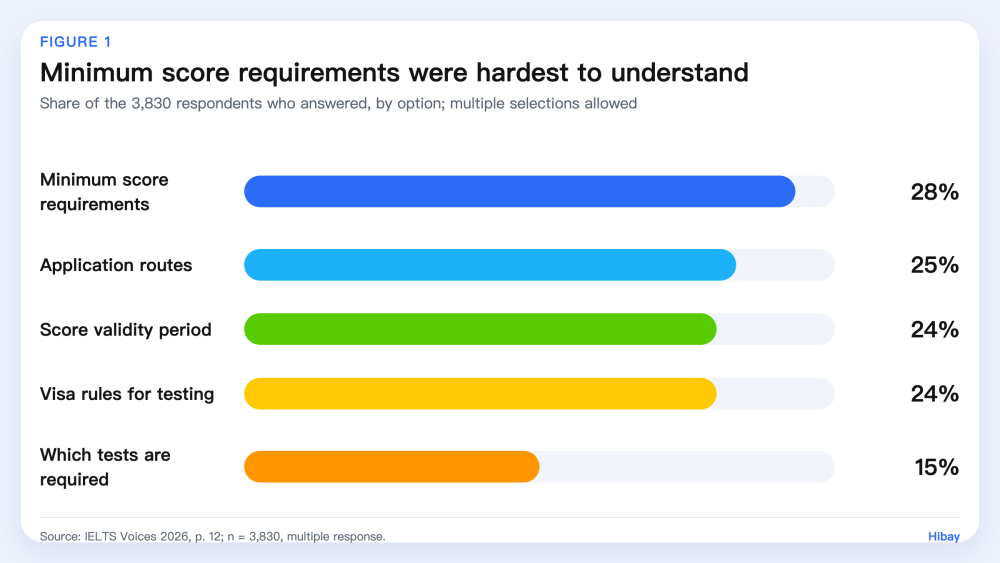
Figure 1. Share of respondents naming each part of the English language requirements as hardest to understand, n = 3,830; multiple selections allowed. Source: IELTS Voices 2026 [2].
The middle of that distribution was tight: application routes (25%) sat within one percentage point of score validity (24%) and visa rules (24%). Differences between source markets were wider than the global ordering. Among respondents from China and Taiwan, 31% found visa-related English-language requirements difficult to understand, and among applicants from Pakistan and Nigeria, 36% found test score validity unclear [2].
Recognition, not low cost, was the frame test takers used when comparing tests. Asked which single factor they would prioritize when choosing an English language test, 82% of 7,989 respondents chose a test accepted by the widest range of universities and authorities, and among respondents taking IELTS for study purposes, 42% would consider multiple study destinations [2].
Who test takers listened to depended on why they were testing. Among study respondents, 44% said a university or institution website listing IELTS as an accepted test helped them decide to book, against 13% of work respondents and 7% of permanent residency or migration respondents. A requirement imposed by a government authority, school, university or job organization led among work respondents (34%) and professional registration respondents (43%), and my own research led among migration respondents (32%). Two sources moved less with purpose: the IELTS official website ranged from 17% of study respondents to 25% of migration respondents, and friends or family from 12% to 17% [2].
| Test-taking purpose | University or institution website | My own research | Required by an authority or employer |
|---|---|---|---|
| Study | 44% | 31% | 27% |
| Permanent residency or migration | 7% | 32% | 31% |
| Work | 13% | 29% | 34% |
| Professional registration | 17% | 29% | 43% |
Read a column to compare purposes on one source, or a row to see which sources one purpose relied on; every cell uses the full booking base of 8,395.
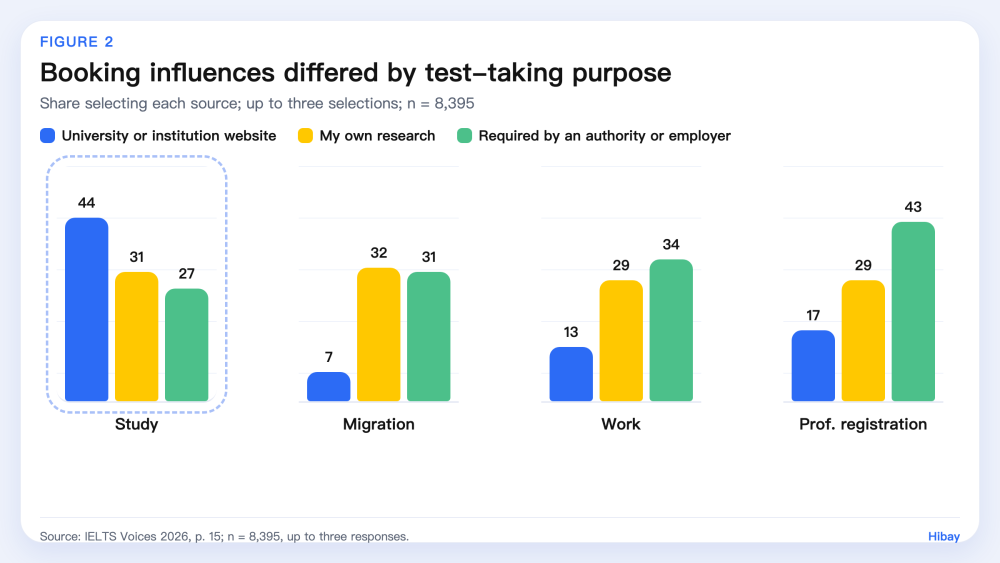
Figure 2. Share who said each source helped them decide to book an IELTS test, by test-taking purpose, n = 8,395; up to three selections allowed. Source: IELTS Voices 2026 [2].
Cost was not the deciding factor for most respondents. Asked how they would choose between two English tests both accepted for their application, 48% of 7,838 respondents said cost and achieving their goals were equally important, 41% would choose the test they believed gave the best chance of success even if it cost more, and 11% would choose the cheaper test even if they felt less confident [2].
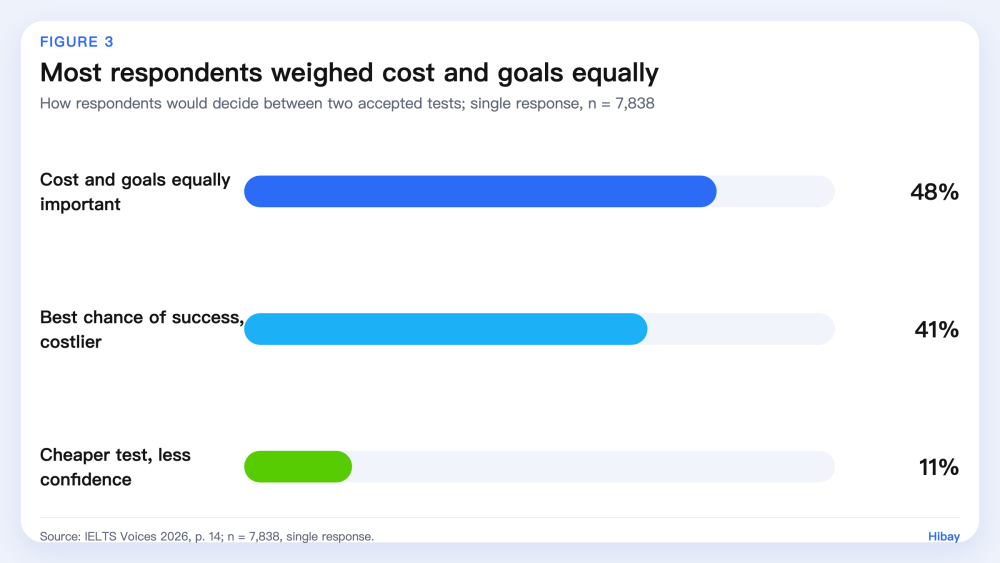
Figure 3. How respondents would decide between two English tests both accepted for their application, n = 7,838; single response. Source: IELTS Voices 2026 [2].
Limitations
Four limits shape how these numbers should be read. First, the data is self-reported: respondents described what they found confusing and what they said helped them decide, which the report treats as perceptions and intentions rather than measured behavior [2]. Second, the sample is IELTS test takers only, recent within two years or prospective, recruited through the three IELTS partners' own networks, so it does not represent English learners generally and is likely to over-represent people already close to sitting IELTS. Third, base sizes differ by question: 3,830 respondents answered the requirements question, against 8,395 for the booking question and 7,838 for the cost question, so the clarity results and the decision results rest on different groups. Fourth, fieldwork ran from March 19 to April 17, 2026 and captures a single moment, while multiple-response questions mean option shares overlap instead of dividing respondents cleanly.
What this means for learners
Start with the number, not the product: look up the minimum English score your target institution or visa route publishes, since that item drew the largest share of confusion among respondents. Then map the routes you are considering, study, work and migration, and check how long a result stays valid for each; validity and visa rules trailed score requirements by one point. Hibay can support spoken practice ahead of a test day, but practice feedback is not an official result and does not replace the requirements published by the organizations you apply to.
Frequently Asked Questions
Which part of the English language requirements is hardest for IELTS test takers to understand? Minimum English score requirements, named by 28% of the 3,830 respondents who answered that question; see Results. Understanding different application routes followed at 25%, with validity period of test scores and visa rules both at 24%, and 15% named which tests are required.
What is the base for the hardest-requirements question? The report prints n = 3,830 for that question, against 8,395 respondents in the whole survey, as set out in Data and method. The question allowed multiple selections, so the shares count how often each option was picked, not a division of the sample.
Who or what helped most IELTS test takers decide to book? It depended on purpose. Among study respondents, 44% said a university or institution website listing IELTS as an accepted test helped them decide, as reported in Results; work and professional registration respondents were led by an external requirement (34% and 43%), and migration respondents by their own research (32%).
Did test takers simply choose the cheapest test? No: 48% of 7,838 respondents said cost and goals were equally important and 41% would pick the test they believed gave the best chance of success even at a higher cost, while 11% would choose the cheaper option. The question asked how they would decide between two accepted tests, not what they paid.
How many people took part in IELTS Voices 2026? 8,395 recent and prospective IELTS test takers across 165 countries, surveyed between March 19 and April 17, 2026, as described in Data and method. Base sizes differ by question, so check the base printed beside each result before comparing figures.
How to cite
Hibay Product Team. (2026, October 30). Hardest IELTS Requirements to Understand: 8,395 Test Takers, 2026. Hibay. https://www.hibay.ai/en/news/ielts-voices-2026-requirements-clarity
Figures are from the public sources listed below and may be cited with attribution.
References
- IELTS. IELTS Voices 2026: Insights into the motivations, experiences and outcomes of English language test takers. https://ielts.org/researchers/our-research/research-reports/ielts-voices-insights-into-the-motivations-experiences-and-outcomes-of-english-language-test-takers. Accessed 2026-10-30.
- IELTS. IELTS Voices 2026 research report (PDF, 24 pages). https://ielts.org/cdn/ielts-downloadable-assets/ielts-research/ielts-research-reports/ielts-voices-2026-research-report.pdf. Accessed 2026-10-30.