
Duolingo English Test Reach in 2025: 219 Countries, 148 First Languages
What Duolingo's 2025 report and DET demographic data show about test takers: 219 countries, 148 first languages, and Africa's rising share of sessions.

目次
English proficiency is now part of how people move between education systems, so it matters which test a learner can actually reach. This report draws on Duolingo's 2025 language report and its DET demographic report, covering test sessions from October 1, 2024 to September 30, 2025 and July 1, 2024 to June 30, 2025 [1][2]. People from 219 countries and 148 first languages took the Duolingo English Test, and Africa's share of test sessions rose from 7% to 8.30%. The figures describe test sessions only, not how well anyone performed.
Key findings
- In 2025, people from 219 countries and 148 first languages took the Duolingo English Test, a notable increase from 2024 [1].
- Asia accounted for 55% of all DET test sessions in the 2025 report window and 55.52% of certified sessions in the demographic report's window [1][2].
- Africa's share of DET test sessions rose from 7% to 8.30% year over year, with Nigeria, Ethiopia, and Ghana named as the drivers [1][2].
- Mandarin, Spanish, and Arabic speakers remained the three largest non-English first-language groups among DET test takers, together about 31% of all sessions [1].
- Mainland China (12.88%) and India (12.43%) were the two most frequently reported identity-document countries and together accounted for 25% of DET test takers [2].
Background
English proficiency is an access requirement for study and work in much of the world, and demand for certification has grown with it: Duolingo reports test takers from 219 countries and 148 first languages in 2025, a notable increase from 2024 [1]. The countries that generate those sessions change from year to year, so the company publishes region and country breakdowns of its test-taker population alongside the totals [2].
Data and method
This report uses four Duolingo sources [1][2][3][4]. The 2025 Duolingo Language Report covers learners who studied languages on Duolingo between October 1, 2024 and September 30, 2025, with data aggregated by country or by language to ensure learner privacy [1]; its Duolingo English Test figures describe the same window. The Duolingo English Test: Demographic and Score Properties of Test Takers report (August 15, 2025 version) summarizes all certified DET sessions between July 1, 2024 and June 30, 2025, filters sessions to test takers who reported an age between 16 and 90, reports aggregate statistics only for subgroups with at least 30 responses, and limits its country-level tables to countries with more than 500 test sessions [2]. The DET Technical Manual supplies the first-language and country counts, and its authors note that it and the demographic report use different date ranges, so their values may differ [3].
Metrics here are shares of test sessions unless stated otherwise. A region share is the number of certified DET sessions whose test taker submitted a government identity document issued in that region, divided by all certified DET sessions in the window; region comes from the country on that identity document, which may differ from citizenship, birth country, or residence. A country share uses the same denominator with the identity-document country as the numerator. A first-language share is the share of sessions accounted for by test takers who reported a given first language; first language and gender became optional for test takers on May 1, 2025. Intention is self-reported and required at registration, and every completed session is counted, so test takers who repeated the test appear more than once. Neither source publishes the total number of sessions or test takers. Figures are rounded to the nearest whole percent, except where a source reports two decimals, in which case this report keeps the source value.
Results
Duolingo states that people from 219 countries and 148 first languages took the Duolingo English Test, a notable increase from 2024, without publishing the size of that increase in sessions or test takers [1]. The technical manual puts it in slightly different words: 148 unique first languages are represented among test takers, and the test has been administered to test takers from 219 countries and dependent territories [3]. For comparison, the 2024 edition named India, China, Canada, Brazil, and Indonesia as the countries with the most DET test takers, in that order [4].
Asia remained the largest source of test sessions. Sessions tied to Asian identity documents were 55.52% of the certified total, against 14.78% for North America, 14.34% for Europe, 8.30% for Africa, 6.96% for South America, and 0.11% for Oceania [2]. The 2025 language report rounds Asia's share to 55% and presents it as the leading region [1].
| Region | Share of certified test sessions | Share stated in the 2025 Duolingo report |
|---|---|---|
| Asia | 55.52% | 55% |
| North America | 14.78% | not reported |
| Europe | 14.34% | not reported |
| Africa | 8.30% | 8.30%, up from 7% |
| South America | 6.96% | not reported |
| Oceania | 0.11% | not reported |
The table reads as follows: the first two columns come from the demographic report's session-level breakdown by identity-document region for July 1, 2024 to June 30, 2025, and the third column records whether the 2025 language report states a separate share for that region [1][2].
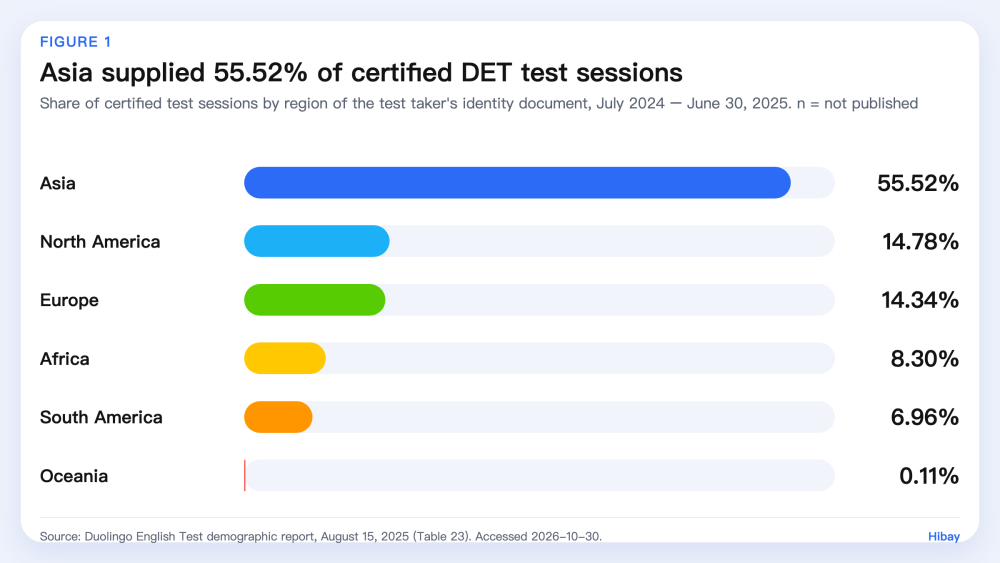
Figure 1. Share of certified DET test sessions by region of the identity document, July 2024 to June 30, 2025, n = not published. Source: Duolingo DET demographic report [2].
Africa is the region whose share moved. It rose from 7% to 8.30% year over year, and Duolingo attributes the increase to Nigeria, Ethiopia, and Ghana [1][2]. For 81% of test takers the identity-document country and the country where they took the test were the same, and the remaining 19% were presumably residing outside their country of origin when they tested [2].
At country level the distribution is concentrated. Mainland China (12.88%) and India (12.43%) together accounted for 25% of test takers, followed by Canada at 5.49%, the United States at 4.23%, and Brazil at 3.49%; South Korea (3.39%), Mexico (3.36%), France (2.95%), Nepal (2.71%), and Pakistan (2.40%) complete the ten most frequently reported countries [2].
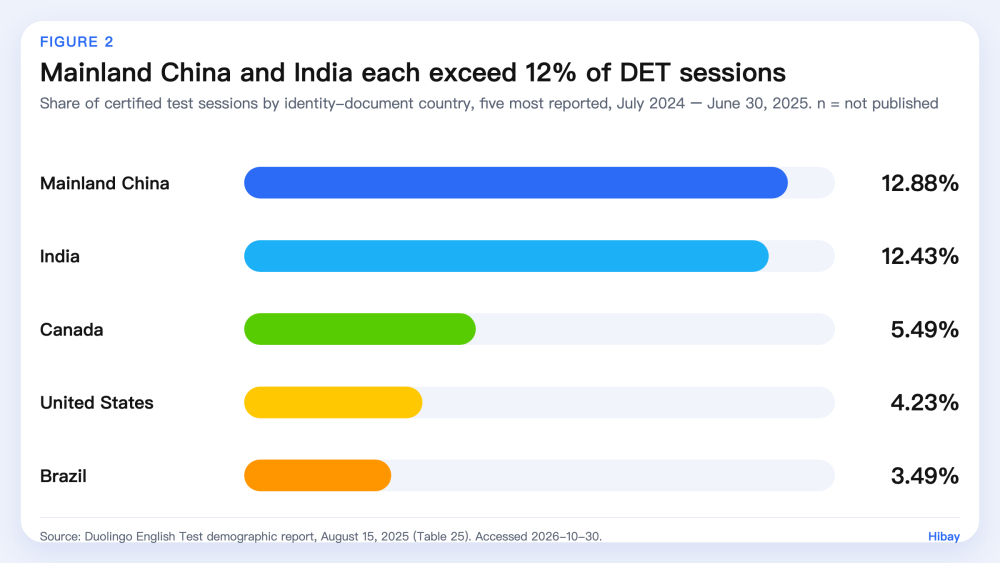
Figure 2. Share of certified DET test sessions by the five most frequently reported identity-document countries, July 2024 to June 30, 2025, n = not published. Source: Duolingo DET demographic report [2].
Mandarin, Spanish, and Arabic speakers remained the three largest non-English first-language groups among test takers, together about 31% of all sessions [1]. English also appears among the most frequent first languages, and 43% of English-L1 test takers came from India and Canada, which places one of the largest language groups in only two countries [3].
What test takers report about their purpose fits the same picture: 47.69% took the DET for undergraduate admission and 33.82% for graduate admission, while 8.44% chose none of the listed purposes, 7.11% selected secondary school, and 2.93% selected work [3].
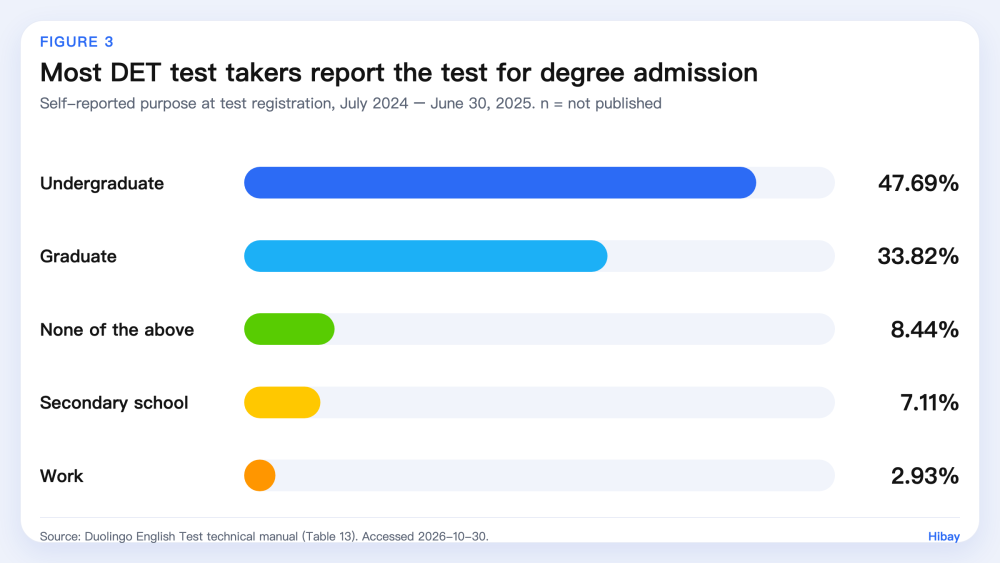
Figure 3. Self-reported purpose for taking the DET, July 2024 to June 30, 2025, n = not published. Source: Duolingo DET technical manual [3].
Limitations
Comparisons across years are limited by the sources themselves. The 2025 language report covers October 1, 2024 to September 30, 2025, while the demographic report covers certified sessions from July 1, 2024 to June 30, 2025; Duolingo notes that the two documents use different date ranges and that their values may differ, and the growth from 2024 is described rather than quantified [1][2][3]. The reach counts are not one series either: the 2024 edition described the test as taken in over 230 countries and territories, while the 2025 documents count 219 countries, and the newer report does not restate the older figure [1][4]. DET test takers are a self-selected sample, which the demographic report itself calls a convenience sample, so people who certify their English elsewhere are outside these figures. Region and country shares rest on the identity document presented at testing, which may differ from citizenship or residence, and they count sessions rather than people, so repeat test takers are counted more than once. First language and gender became optional on May 1, 2025, which can understate first-language coverage later in the window. Small groups are omitted too: aggregate statistics need at least 30 responses and country-level figures cover countries with more than 500 test sessions. Neither source publishes a total number of sessions or test takers, so no absolute volumes can be derived from these percentages.
What this means for learners
The regional figures are a practical check on logistics rather than difficulty: the test is used across 219 countries, and 81% of test takers sat it in the country that issued their identity document, so testing close to home is the normal case [2]. If you plan to certify your English, confirm which tests each program accepts before you book anything, and check requirements country by country rather than by region. Preparation tools such as Hibay give practice feedback; they are not an official score.
Frequently Asked Questions
How many countries do Duolingo English Test takers come from? Duolingo reports test takers from 219 countries and 148 first languages in 2025, which it describes as a notable increase from 2024 (see Results) [1]. The demographic report counts sessions by the country on the test taker's identity document, and 81% of test takers tested in the country that issued that document [2].
Which region takes the Duolingo English Test the most? Asia, which accounted for 55% of all DET test sessions in the 2025 report and 55.52% of certified sessions in the demographic report's window (see Results) [1][2]. No other single region came close to that share in the same breakdown.
Where is the fastest movement in DET test takers? Africa, whose share of test sessions rose from 7% to 8.30% year over year, with Nigeria, Ethiopia, and Ghana named as the drivers (see Results) [1][2]. A rising share and a large base are different things, though: Asia still supplied more than half of all sessions.
Do these numbers measure English proficiency? No. The figures here describe who takes the test and where they come from, not how well anyone performs (see Limitations) [2]. The demographic report also states that test takers are a self-selected sample and that country shares follow the identity document presented at testing.
How to cite
Hibay Product Team. (2026, October 30). Duolingo English Test Reach in 2025: 219 Countries, 148 First Languages. Hibay. https://www.hibay.ai/en/news/duolingo-english-test-2025-reach
Figures are from the public sources listed below and may be cited with attribution.
References
- Duolingo. 2025 Duolingo Language Report. https://blog.duolingo.com/2025-duolingo-language-report/. Accessed 2026-10-30.
- Duolingo. Duolingo English Test: Demographic and Score Properties of Test Takers, July 2024 to June 2025 (August 15, 2025 version). https://duolingo-papers.s3.us-east-1.amazonaws.com/other/demographic+report+(Aug+15+2025+version).pdf. Accessed 2026-10-30.
- Duolingo. Duolingo English Test: Technical Manual. https://duolingo-papers.s3.us-east-1.amazonaws.com/other/technical_manual/DET_technical_manual_2025_07.pdf. Accessed 2026-10-30.
- Duolingo. 2024 Duolingo Language Report. https://blog.duolingo.com/2024-duolingo-language-report/. Accessed 2026-10-30.