
TOEFL 2025: Europe Averages 92 and Africa 74
Averaging ETS's published national TOEFL means by region puts Europe at 92.1 and Africa at 73.5, an 18.6-point gap across 153 countries and regions.

On this page
ETS publishes a 2025 TOEFL iBT mean for each country and region it reports, and grouping those published means by the region ETS assigns gives a wide spread: Europe averages 92.1 out of 120, Africa 73.5, and the six regional averages cover an 18.6-point range. The figures are unweighted averages of national means, not candidate-weighted scores, and ETS states explicitly that its country table is not intended for ranking countries. The data cover test takers between January and December 2025.
Key findings
- Across 153 countries and regions with a published 2025 mean, Europe averages 92.1 out of 120 and Africa 73.5, an 18.6-point gap.
- The four middle regions sit close together: Pacific 91.5, Americas 83.3, Asia 83.2 and Middle East 80.1.
- Europe's highest national mean is 101, shared by Ireland and Slovenia; its lowest is Turkey at 77.
- Africa's highest is South Africa at 92 and its lowest is Congo at 62, the same value as the lowest mean in the whole table, held by the United Arab Emirates.
- Within regions the national spread is often larger than the gap between regional averages: Africa's national means run across 30 points.
Background
The TOEFL iBT reports a total score out of 120 plus four section scores out of 30, and ETS publishes an annual summary with a table of means by native country and by native language [1]. The 2025 edition covers test takers who sat the test between January and December 2025 and prints means for countries and regions with at least 30 examinees in the group [2].
ETS attaches a caution to that table: it does not endorse ranking countries on TOEFL scores, because the test measures individuals, the number of test takers differs by country, and those test takers are not representative of any national population [2]. The regional averages below are a description of the published table under that caution, not a league table.
Data and method
The source is the country table of the ETS TOEFL iBT Test and Score Data Summary 2025, which lists a Reading, Listening, Speaking, Writing and total mean for each country and region with at least 30 examinees [2]. The table is organised into six geographic sections — Africa, Americas, Asia, Europe, Middle East and Pacific — and each row keeps the section it appears under.
Rows were read from the published table and grouped by that section, giving 153 countries and regions with a reported mean. The regional figure is the unweighted mean of the national means in the group, so a small country and a large country count equally; this is the reason the figures describe the table rather than the test-taking population. All values are quoted as published, to one decimal place where computed, and no estimation or imputation is used. The sample is the set of published group rows in the source table, the key metric in each case is a published group mean or a share or difference computed from published means, and all values are aggregated at group level with no individual record used.
Results
Europe's average of 92.1 is the highest of the six and Africa's 73.5 the lowest, an 18.6-point spread on a 120-point scale. The Pacific section, with only four countries reporting a mean, sits just behind Europe at 91.5, and the three middle sections cluster within 3.2 points of each other: Americas at 83.3, Asia at 83.2 and Middle East at 80.1.
The national extremes inside each region are much wider than the gaps between the regional averages. In Europe, Ireland and Slovenia both report 101 while Turkey reports 77, a 24-point range inside the highest-scoring region. In Africa, South Africa reports 92 and Congo 62, a 30-point range. The Middle East runs from the United Arab Emirates at 62 to Iran and Israel at 92, and Asia from Singapore at 97 to Turkmenistan at 70. The two lowest national means in the whole table, 62, belong to Congo and the United Arab Emirates, in different regions.
The regional ordering is stable in one respect: Europe's average is above every other region's, and Africa's is below every other region's, whatever measure is used, since the national means inside those regions do not overlap at the top or bottom of the table.
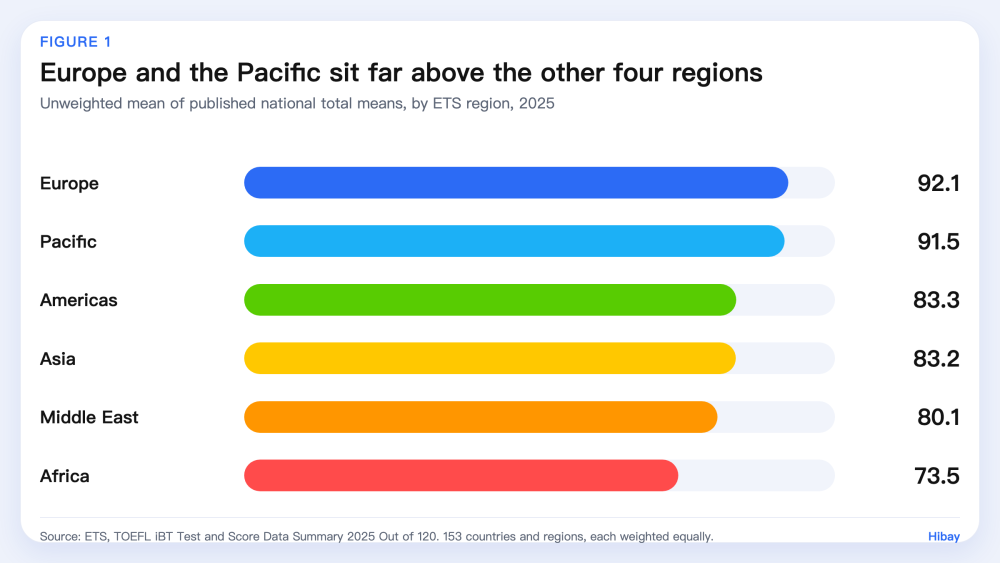
Figure 1. Unweighted mean of published national TOEFL iBT total means by ETS region, 2025, n = 153 countries and regions. Source: ETS, TOEFL iBT Test and Score Data Summary 2025.
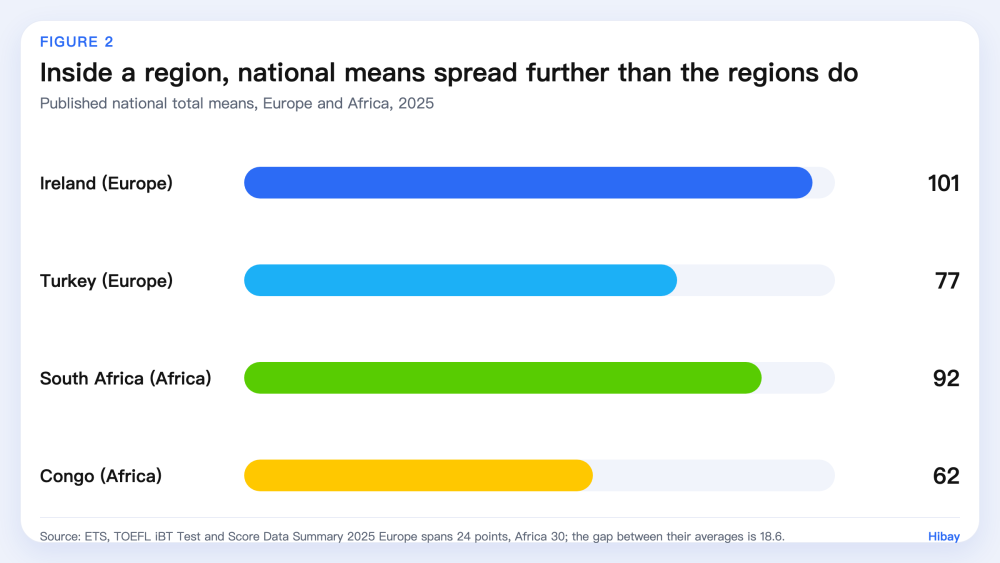
Figure 2. Highest and lowest published national means inside the Europe and Africa sections of the ETS table, n = 41 European and 36 African countries and regions. Source: ETS, TOEFL iBT Test and Score Data Summary 2025.
Limitations
The regional averages are unweighted, and that is the single largest limitation. A country with a few dozen examinees and a country with tens of thousands contribute equally, so the figures cannot be read as the average score of test takers in a region. The table also only includes groups with at least 30 examinees, which means small countries with unusual candidate profiles are absent, and the countries present in each section are the ones ETS chose to report rather than a defined population. Test takers are self-selected: they take the TOEFL because they need it for study, work, licensure or immigration, and the mix of purposes differs by region. Finally, ETS states that the table should not be used to rank countries, because national means reflect who takes the test as much as how well they speak English.
What this means for learners
A regional average is a description of published groups, and the more useful number for a learner is the range inside the region. In Europe the national means span 24 points and in Africa 30, which is wider than the 18.6-point gap between the regional averages themselves: knowing that a learner comes from Europe says less than knowing which country's group they belong to.
That is also why a national mean should not be treated as a target. A learner's own score is measured against the test's scale, and the published tables are built for institutions comparing applicants from the same background, not for candidates comparing themselves with a national group.
Frequently Asked Questions
Which region has the highest TOEFL scores?
In the 2025 ETS table, the unweighted average of national means is highest in Europe at 92.1 out of 120, followed by the Pacific at 91.5. Africa is lowest at 73.5.
Why does ETS say not to rank countries?
ETS states that the test measures individuals, that the number of test takers varies by country and that candidates are not representative of national populations, so country means reflect who takes the test as much as English ability [2].
Is the regional average the same as the average score of test takers in that region?
No. The figures here weight each country equally. A candidate-weighted average would need the number of examinees per country, which the summary does not publish.
How to cite
Hibay Product Team. (2026, November 5). TOEFL 2025: Europe Averages 92 and Africa 74. Hibay. https://www.hibay.ai/en/news/toefl-2025-regional-score-gap
References
- ETS. TOEFL iBT Test and Score Data Summary 2025. https://www.ets.org/pdfs/toefl/toefl-ibt-test-score-data-summary-2025.pdf. Accessed 2026-11-05.
- ETS. TOEFL iBT Test and Score Data Summary 2025, Table 16, total and section score means by native country. https://www.es.ets.org/pdfs/toefl/toefl-ibt-test-score-data-summary-2025.pdf. Accessed 2026-11-05.