
EF EPI 2025: 50 Countries Gained, 54 Lost, Median Change Zero
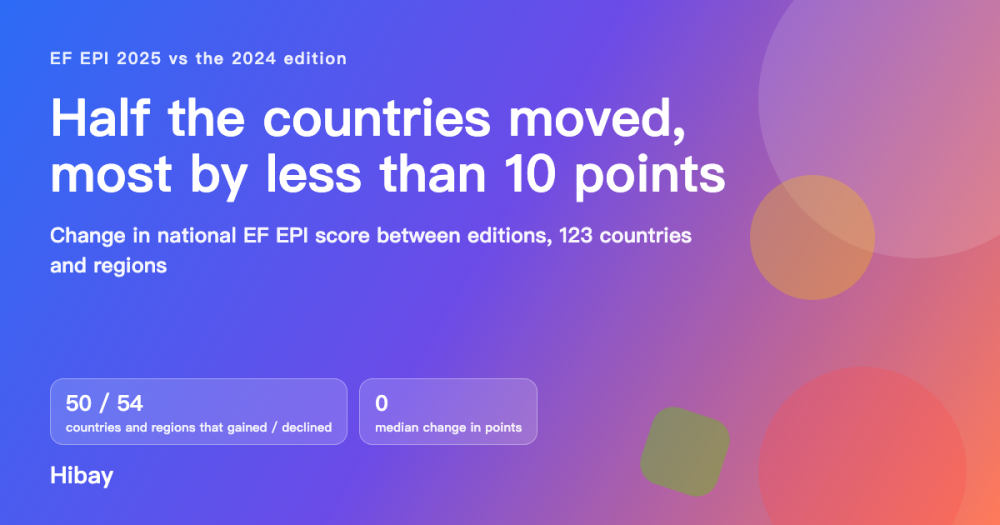
Comparing the EF EPI 2025 scores with the 2024 edition: 50 countries gained, 54 declined and 7 held steady, with a median change of zero points.

On this page
The EF English Proficiency Index 2025 ranks 123 countries and regions on more than 2,200,000 EF SET test takers from 2024, and its appendix prints each country's score next to the same country's score in the 2024 edition. Of the 111 countries and regions with both values, 50 gained points, 54 declined and 7 were unchanged, and the median change was 0 points. Eleven countries appear as new or re-entering with no earlier score, and the index does not measure every adult in the countries it ranks; it is built from a self-selected online test.
Key findings
- Of the 111 countries and regions with a comparable 2024 edition score, 50 improved, 54 declined and 7 were unchanged, a median change of 0 points and an average change of -0.3 points [1].
- Twenty-five countries gained at least 10 points and 23 lost at least 10; Slovakia's 22-point gain and Lithuania's 26-point drop were the largest moves in the appendix [1].
- Eleven countries are marked new or re-entering in 2025 and have no 2024 edition score, among them Zimbabwe, Latvia, North Macedonia and Bosnia and Herzegovina [1].
- Eleven countries moved up a proficiency band and 7 dropped one: Germany, Poland and Slovakia reached the very high band, while Japan, Mexico, Mongolia and Kyrgyzstan fell from the low band to the very low band [1].
- On a base of 123 countries and regions, the 2025 edition places 15 in the very high band, 17 in high, 32 in moderate, 30 in low and 29 in very low [1].
Background
Country rankings answer "how does my country compare", and readers usually ask the follow-up question the ranking alone cannot answer: is it moving. The EF EPI is the largest public ranking of adult English skills, built from a free adaptive test that adults take voluntarily, and each edition includes an appendix that places the new score beside the edition before it [1]. The 2025 edition also publishes skill scores for the first time, which changes what can be compared with earlier editions. This report reads the comparison the appendix already prints rather than recalculating country scores, so the numbers below describe movement between two published editions.
Data and method
Source and window. The data are the 2025 EF EPI report and its appendices [1]. The scores come from EF SET tests taken during 2024, published as part of the 2025 edition; the comparison scores come from the 2024 edition as reprinted in the same appendix.
Sample. More than 2,200,000 EF SET test takers were grouped into 123 ranked countries and regions. EF includes countries with a minimum of 400 test takers and cities with a minimum of 100, and it calculates national scores as three-year rolling averages, so each published national score blends the current year with the two previous editions' published figures [1]. EF describes the 2024 sample as 46% female and 40% male, with 14% not providing gender information, and an average age of 26 among those who reported it, 85% of whom were under 35 [1].
Definitions. A change is the published 2025 score minus the published 2024 edition score, as printed in the appendix. A band move applies the EF thresholds to both scores: 600 and above is very high, 550 to 599 high, 500 to 549 moderate, 450 to 499 low, and below 450 very low [1].
This article's own counts. Every count below was produced by reading the appendix row by row. Changes use base = 111 countries and regions, because 11 of the 123 ranked entries are marked new or re-entry and carry no 2024 edition score. Band moves use the same 111. The 2025 band distribution uses base = 123, the full ranking, and its five counts sum to 123.
Processing. Only published, aggregated country-level figures are used; no individual test taker record is involved. Figures are quoted as printed, in whole points.
Design. The index is observational, and the figures describe published test results for one testing year.
Results
The typical country barely moved. Half the countries with a comparable score gained points and half lost them: 50 improved against 54 declines, with 7 unchanged, a median change of 0 points and an average of -0.3 points. That average hides a wide spread, but it does establish that the 2025 edition does not describe a year of broad improvement, which is consistent with EF's own finding that the last year the index reported global gains was 2020 [1].
Most countries moved by less than 10 points, and the extremes are concentrated in a small group. Twenty-five countries gained at least 10 points and 23 lost at least 10. Slovakia's 22-point gain, Malawi's 18 and Germany's 17 lead the positive side; Lithuania's 26-point drop, Armenia's 22 and Cyprus's 21 lead the negative side. The five largest moves, in both directions, span a range of scores from Malawi at 465 to Germany at 615, so the movement is not confined to one part of the ranking.
| Country | Change against the 2024 edition | 2025 score |
|---|---|---|
| Slovakia | +22 | 606 |
| Malawi | +18 | 465 |
| Germany | +17 | 615 |
| Lithuania | -26 | 543 |
| Armenia | -22 | 515 |
The change column is the published difference between the two editions; the 2025 score is the score those countries now carry.
Band changes are the visible version of the same movement, and they depend on where a country sits relative to a threshold. Eleven countries moved up a band and 7 dropped one. Germany, Belgium, Slovakia, Romania, Finland, South Africa and Poland crossed 600 into the very high band; Vietnam moved from low to moderate, Honduras from moderate to high, and Malawi and Palestine from very low to low. On the other side, Greece left the very high band, Lithuania and Cyprus left the high band, and Mongolia, Japan, Kyrgyzstan and Mexico fell below 450 into the very low band. A country close to a cut-off can change band on a one-point move, which is why the band counts and the point counts tell slightly different stories.
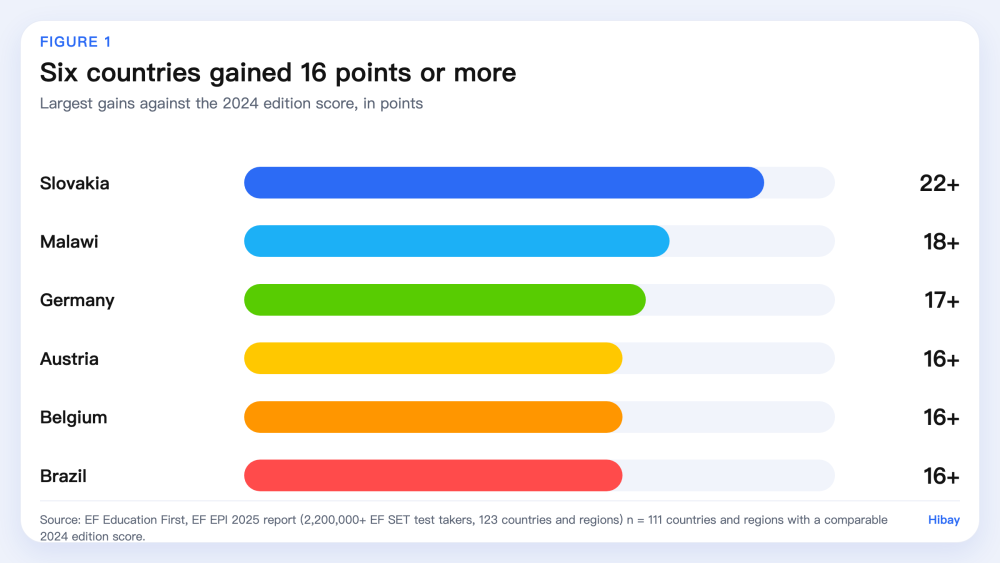
Figure 1. The six largest gains against the 2024 edition score, in points, n = 111 countries and regions with a comparable 2024 edition score. Source: EF Education First, EF EPI 2025, Appendix D.
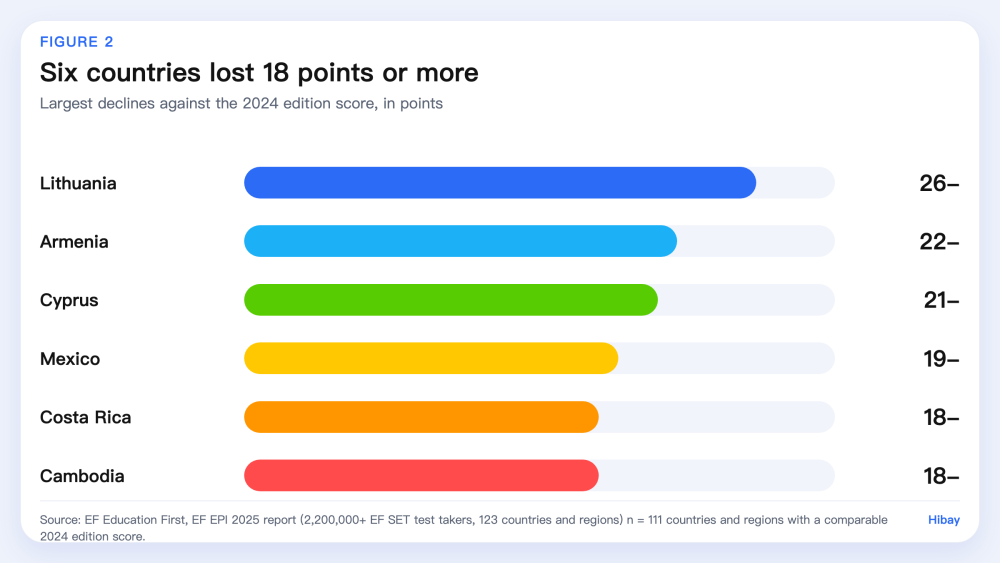
Figure 2. The six largest declines against the 2024 edition score, in points, n = 111 countries and regions with a comparable 2024 edition score. Source: EF Education First, EF EPI 2025, Appendix D.
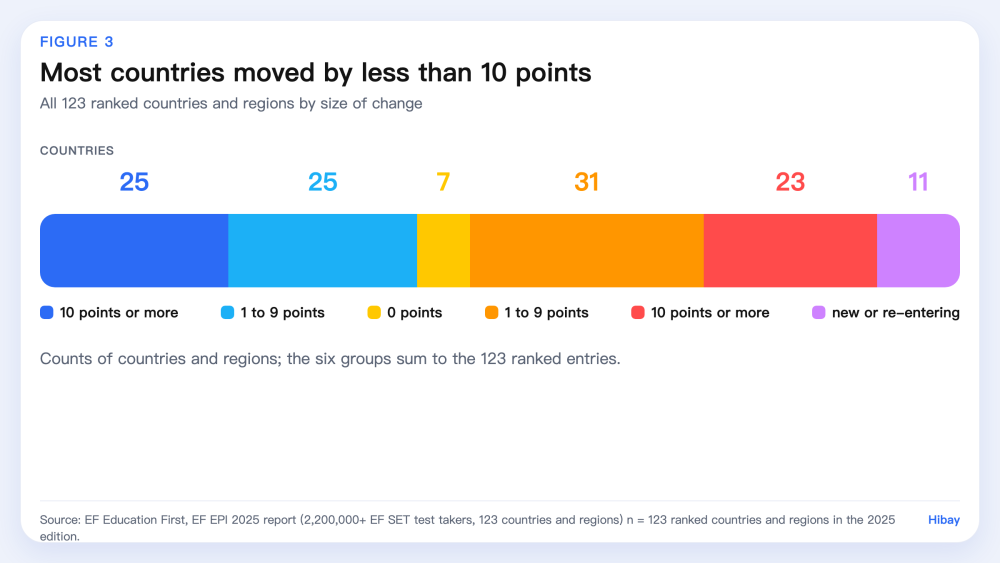
Figure 3. All 123 ranked entries by size of change against the 2024 edition, including the 11 new or re-entering countries, n = 123 countries and regions. Source: EF Education First, EF EPI 2025, Appendix D.
The 2025 distribution is the sum of those movements. Of the 123 ranked countries and regions, 15 sit in the very high band, 17 in high, 32 in moderate, 30 in low and 29 in very low. The range runs from 624 in the Netherlands, which scored 636 in the 2024 edition, down to 390 in Cambodia.
Limitations
Four limits apply. First, the EF SET sample is self-selected: EF states that the test-taking population may not represent the wider population, that the test is free and online, and that people without internet access are excluded, so a national score may sit above or below the general population. Second, the appendix compares two editions of the same index, not the same people, and because national scores are three-year rolling averages, a single year's change is smoothed by design and cannot be read as a clean year-on-year measure. Third, the 2025 edition introduced optional speaking and writing sections during the first half of 2024, and less than 20% of test takers in most countries chose them, which limits comparison with earlier editions. Fourth, this article uses published country-level aggregates only, so the movement of one country says nothing about any individual learner, and the patterns are associations rather than evidence about what produced a gain or a decline.
What this means for learners
A national score is an average of people who chose to take a free online test, and the movement between two editions is small enough that no individual can infer their own progress from it. What the appendix does show is that movement is uneven: some countries shifted more than 20 points while most moved by less than 10. For a learner, that argues for measuring the same skills repeatedly at the level of a person, rather than tracking a country average. Speaking is the skill with the least coverage in national testing, and a speaking practice routine is a way to keep that measurement local; practice feedback is not an official score, and Hibay does not issue one.
Frequently Asked Questions
Is English proficiency improving worldwide? Not in the 2025 edition. Of the 111 countries and regions with a comparable 2024 edition score, 50 improved and 54 declined, so the median change was 0 points and the average -0.3 points (see Results).
Why does a country's score differ from the one I saw last year? Two reasons. EF recalculates national scores as three-year rolling averages, and the appendix prints the change against the previous edition's published score rather than against a fresh measurement of the same people. Comparing editions therefore measures two curves, not one cohort.
Which country has the highest English proficiency in 2025? The Netherlands, at 624, down 12 points from its 2024 edition score of 636. Croatia at 617 and Austria at 616 follow, and Cambodia at 390 is the lowest of the 123 ranked entries.
What separates the proficiency bands? The cut-offs are 600 for very high, 550 for high, 500 for moderate and 450 for low, with everything below 450 in the very low band. In 2025, 15 countries and regions sit in the very high band and 29 in the very low band.
How to cite
Hibay Product Team. (2026, October 30). EF EPI 2025: 50 Countries Gained, 54 Lost, Median Change Zero. Hibay. https://www.hibay.ai/en/news/ef-epi-2025-year-over-year-changes
Figures are from the public sources listed below and may be cited with attribution.
References
- EF Education First. EF English Proficiency Index 2025: A Ranking of 123 Countries and Regions by English Skills. https://www.ef.com/assetscdn/WIBIwq6RdJvcD9bc8RMd/cefcom-epi-site/reports/2025/ef-epi-2025-english.pdf. Accessed 2026-10-30.