
EF EPI 2025: 15 Different Skill Orders Across 111 Countries
Ordering each country's four English skills produces 15 distinct patterns in the EF EPI 2025; one pattern covers 44 countries and Reading comes first in 88.

On this page
The EF English Proficiency Index 2025 publishes a score for each of reading, listening, speaking and writing, which allows each country's four skills to be put in order. Doing that for the 111 countries and regions with a full four-skill profile produces 15 distinct orders. One of them, reading above listening above writing above speaking, covers 44 countries; Reading is the strongest skill in 88; and Listening is the strongest in exactly one, Saudi Arabia. The index draws on 2.2 million self-selected EF SET results from 2024.
Key findings
- The four skills can be ordered in 15 distinct ways across the 111 countries and regions with a full four-skill profile in the EF EPI 2025.
- The most common order, Reading above Listening above Writing above Speaking, covers 44 countries; the next two cover 16 and 12, so three patterns account for 72 of 111.
- Reading is the strongest skill in 88 countries, Writing in 11, Speaking in 11 and Listening in exactly one, Saudi Arabia.
- Writing is the strongest skill in a South Asian cluster — Bangladesh, India, Nepal, Sri Lanka, Myanmar, Cambodia and the Philippines among them — and in four Central Asian and East African countries.
- Speaking is the strongest skill only where overall proficiency is low: the 11 countries include Angola, Benin, Cameroon, Congo, Iraq, Pakistan, Somalia, Sudan and Yemen.
Background
The EF EPI 2025 is the first edition to report speaking and writing scores alongside reading and listening, which it describes as a move from receptive to productive skills [1]. The report states that reading is the strongest skill in nearly 80% of countries, that speaking is the weakest in a majority, and that the gap between strongest and weakest skill is wider in high-proficiency countries [2].
Those statements describe the individual skills. Ordering all four in each country asks a slightly different question: how many different profiles exist, and whether a country's position in one skill predicts its position in another. The answer is a set of patterns rather than a single ranking.
Data and method
The source is the EF EPI 2025 report, using the proficiency detail pages that give each country's overall score plus reading, writing, speaking and listening scores [2]. The sample is the 111 countries and regions that carry all four skill scores plus an overall score; the other 12 of the 123 covered by the report have partial data and are excluded.
For each country the four scores are sorted from highest to lowest, and the resulting order is recorded as a pattern of the letters R, L, W and S. Ties are recorded in the order the report prints the scores, which affects a small number of countries with two identical values. The counts are then taken over those patterns, and the named countries are the ones the report lists with that ordering. No score is adjusted, and the data are aggregated at country level with no individual record used. The sample is the set of published group rows in the source table, the key metric in each case is a published group mean or a share or difference computed from published means, and all values are aggregated at group level with no individual record used.
Results
Fifteen patterns appear. The largest by far is R>L>W>S, with 44 countries, followed by R>L>S>W with 16 and R>W>L>S with 12. Those three cover 72 of the 111, so most countries share a broadly similar profile: reading first, listening second, and speaking last or second to last.
The remaining patterns are much smaller. Eight countries put reading first, speaking second, writing third and listening last; five put speaking first with reading second; and five put writing first with reading second. The rest are scattered across single countries and pairs, which is why the count reaches 15 rather than staying in single figures.
Which skill comes first divides countries sharply. Reading leads in 88, Writing in 11, Speaking in 11 and Listening in one. The Writing-first group is geographically clustered: Bangladesh, India, Nepal, Sri Lanka, Myanmar, Cambodia and the Philippines are all in it, alongside Bolivia, Rwanda, Tajikistan and Uzbekistan. The Speaking-first group is the opposite in proficiency terms, made up of Angola, Benin, Cameroon, Congo, Iraq, Libya, Pakistan, Somalia, Sudan, Yemen and Afghanistan, all in the low or very low bands.
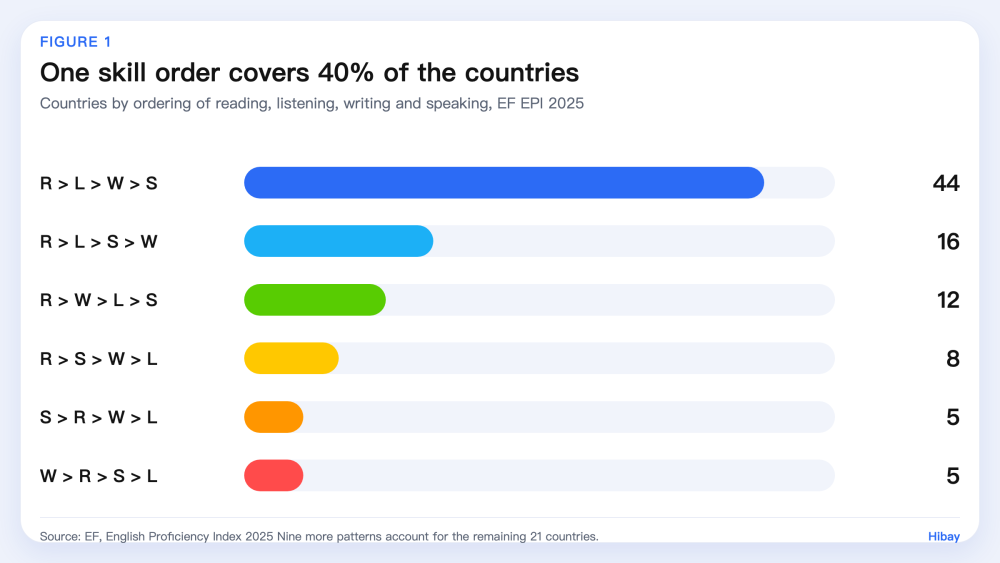
Figure 1. The three most common orderings of the four skill scores, out of 15 patterns across n = 111 countries and regions. Source: EF English Proficiency Index 2025.
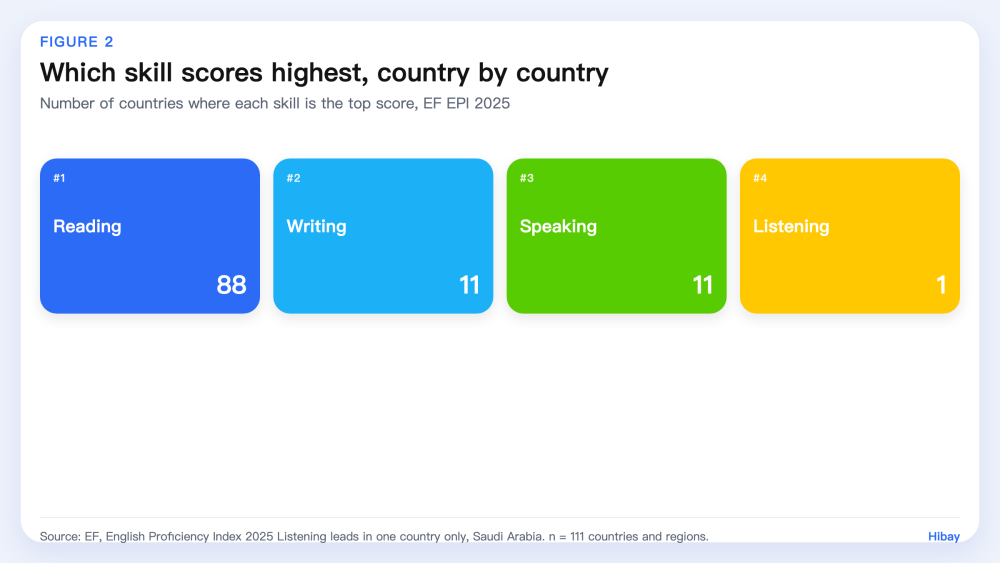
Figure 2. Count of countries where each skill is the highest-scoring of the four, n = 111 countries and regions. Source: EF English Proficiency Index 2025.
Limitations
The pattern count depends on the sample: 111 of the 123 countries and regions in the index have all four skill scores, and adding the remaining 12 could add patterns or shift the counts. Ordering scores that are rounded to whole points also creates ties, and a country with two equal scores could be recorded under either order; the report does not publish the underlying decimals. The skill scores come from an optional part of the EF SET, and the report notes that most test takers certify only their receptive skills, so productive-skill scores rest on a smaller and possibly different group. Finally, the test takers are self-selected, and the report publishes no candidate counts per country, so the patterns describe published group scores rather than the English profile of a national population.
What this means for learners
A country's weakest skill is not a fixed fact about the country. In 44 countries the order is reading, listening, writing, speaking, but in 11 countries writing comes first and in 11 speaking does, and those groups sit at opposite ends of the proficiency scale. A learner reading that "speaking is the weakest skill" is reading a majority finding, not a universal one.
The useful question for a learner is which order their own four scores form. A profile with reading first and speaking last is the common pattern and matches the regional averages; a profile with writing first, as in the South Asian cluster, points to a different practice emphasis than the global average suggests.
Frequently Asked Questions
How many different skill orders are there in the EF EPI 2025?
Across the 111 countries and regions with a full four-skill profile, the four scores fall into 15 distinct orderings.
Is reading the strongest skill everywhere?
No. Reading is the highest-scoring skill in 88 of 111 countries. Writing leads in 11, Speaking in 11 and Listening in one, Saudi Arabia.
Why does the pattern count matter?
Because a national average describes one skill at a time, while the pattern describes the relationship between all four. Countries with the same overall band can have very different profiles, which changes what practice is likely to help.
How to cite
Hibay Product Team. (2026, November 5). EF EPI 2025: 15 Different Skill Orders Across 111 Countries. Hibay. https://www.hibay.ai/en/news/ef-epi-2025-skill-order-patterns
References
- EF. EF English Proficiency Index 2025, key findings. https://www.ef.com/wwen/epi/. Accessed 2026-11-05.
- EF. EF English Proficiency Index 2025 (report PDF). https://ef.com/assetscdn/WIBIwq6RdJvcD9bc8RMd/cefcom-epi-site/reports/2025/ef-epi-2025-english.pdf. Accessed 2026-11-05.