
EF EPI 2025: Skill Gaps Are Widest Where English Is Strongest
The EF EPI 2025 published skill scores for the first time: the gap between a country's strongest and weakest skill is almost twice as wide in the most proficient countries.

On this page
The EF EPI 2025 published skill scores for the first time: the gap between a country's strongest and weakest skill is almost twice as wide in the most proficient countries.
The EF English Proficiency Index 2025 is the first edition to publish separate scores for reading, listening, speaking and writing, and those scores show that countries with the strongest English are also the most internally uneven. The index covers 2,200,000 EF SET results from 123 countries and regions. The gap between a country's strongest and weakest skill is almost twice as wide in very high proficiency countries as in low and very low proficiency ones, gaps larger than 20 points are the norm in every band, and only 7 countries sit close together across all four skills. The skill scores cover only test takers who chose the optional productive-skill sections, which is a minority in most countries.
Key findings
- Across the 123 countries and regions in the index, the average gap between a country's strongest and weakest skill is almost twice as wide in very high proficiency countries as in low and very low proficiency countries.
- Skill gaps larger than 20 points are the norm across all proficiency bands, so an uneven profile is the default rather than the exception.
- Only 7 countries score at a nearly homogenous level across all four skills, a group that includes a cluster in Central America and the Caribbean.
- Reading is the strongest skill in nearly 80% of countries and the weakest in only 1, while listening is the weakest skill in 31 countries, especially in South Asia and West Africa.
- Writing is the strongest skill in 10 countries, and 8 of those 10 have listening as their weakest skill, including Myanmar, Bangladesh, Bhutan and Nepal.
Background
The EF EPI has ranked countries on adult English since 2011, and until this edition it measured only receptive skills, reading and listening [1]. The 2025 index adds speaking and writing, which makes it possible for the first time to compare a country's receptive and productive scores side by side. The result is a different picture of what a national English level means: a single number can hide a country that reads well and speaks poorly, and it can hide the opposite. Globally, the report finds listening comprehension scores trailing reading comprehension scores by more than 20 points, which is the widest single gap in the index.
Data and method
All figures come from the EF English Proficiency Index 2025 [1]. The index is based on n=2,200,000 EF SET results collected in 2024 and covers 123 countries and regions; a country's published score for the year is averaged with the two preceding years to reduce year-to-year turbulence. Skill scores are new in this edition and are defined as the average score for that skill within a country, for example the average of all speaking tests taken in that country in 2024, so a country's four skill scores do not add up to its national score.
The gap measure used throughout this report is the highest of a country's four skill scores minus the lowest, and the comparison between proficiency bands is the report's own: it compares the average gap in the very high band against the average gap in the low and very low bands. Where this report states that a skill is a country's strongest or weakest, it means that skill has the highest or lowest of the country's four published skill scores. Counts are the report's own, drawn from its 123-country table. One coverage limit matters for every figure here: speaking and writing were optional sections in 2024, and in most countries fewer than 20% of test takers chose to test them, so the productive-skill scores rest on a smaller and self-selected group than the receptive ones. Figures are aggregated at country level and no individual result is published.
Results
The headline pattern runs against intuition. Countries in the very high proficiency band spread, on average, almost twice as far between their best and weakest skill as countries in the low and very low bands. Building English proficiency appears to be associated with specializing rather than evening out. The report's reading is that education systems and labor markets reward some skills before others, and that the sequence in which skills develop is uneven by design.
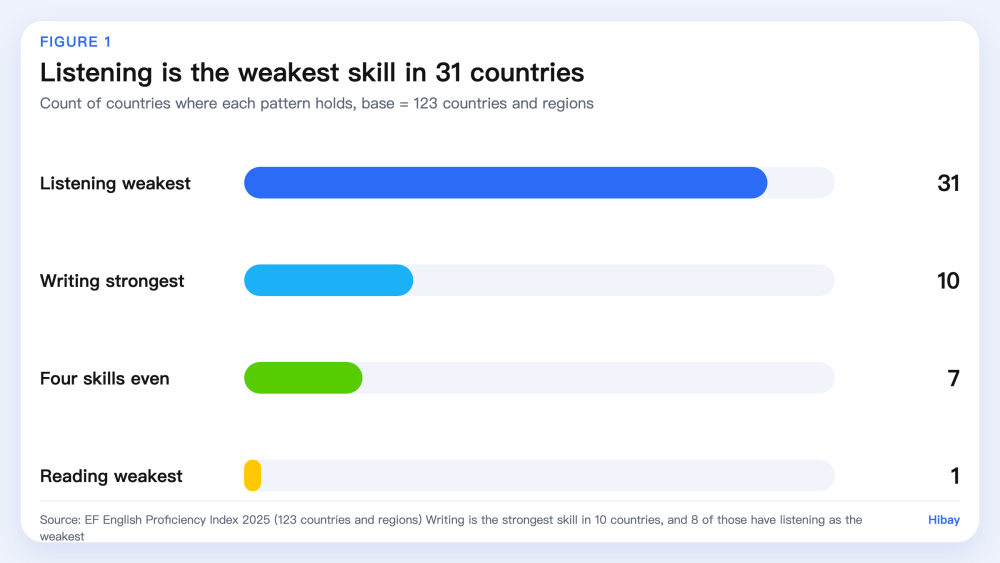
Figure 1. Where each skill sits inside a country's four skill scores, count of countries out of 123. Source: EF EPI 2025 [1].
Reading dominates the strong end. It is the strongest skill in nearly 80% of the countries in the index, and there is only a single country where reading is the weakest skill. The report explains this as the skill that school systems can develop most easily, even in large classes, and the one adults meet passively in packaging, manuals, video games and websites. Listening sits at the other end: it is the weakest skill in 31 countries, a pattern the report concentrates in South Asia and West Africa and attributes in part to accent exposure, because EF SET audio uses speakers from the United States, Canada, the UK and Australia. Globally, listening trails reading by more than 20 points.
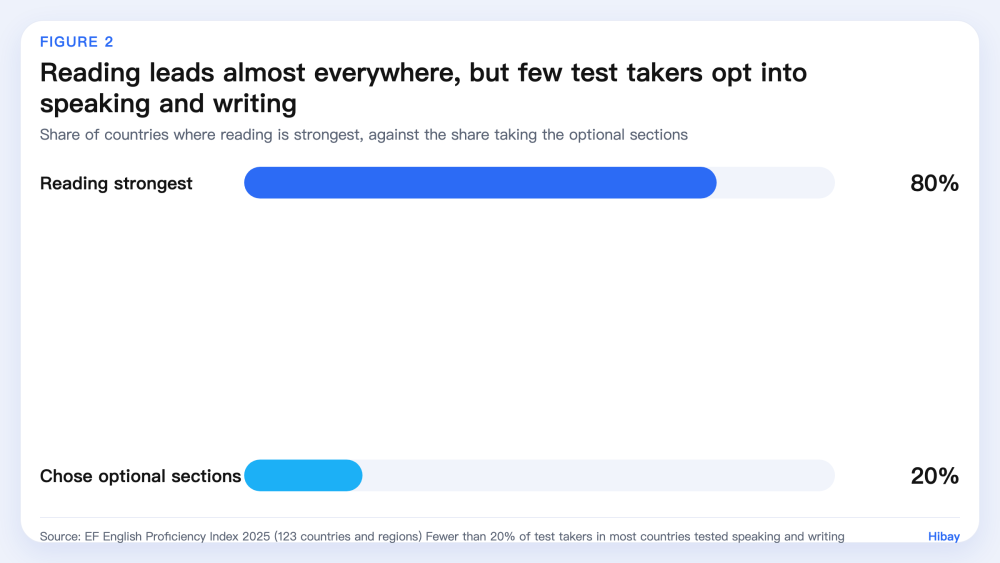
Figure 2. Share of countries where reading is the strongest skill, against the share of test takers in most countries who chose the optional speaking and writing sections. Source: EF EPI 2025 [1].
Writing tells a third story. It is the strongest skill in 10 countries, and in 8 of those 10 the weakest skill is listening, a group that includes Myanmar, Bangladesh, Bhutan and Nepal. The report suggests a cluster of education systems or workplaces where written English is prized. It also finds the reverse pattern tied to writing systems: most countries where writing is the weakest skill use a non-Latin, right-to-left script, while countries using non-Latin scripts written left to right do not show proportionally weaker writing.
Speaking is the exception to the pattern that strong countries are uneven, in the sense that it has the lowest worldwide average score of the four skills, and only 3 countries reach the high proficiency band for speaking. All three have English as an official language, and none reaches the very high band. Even the strongest-skilled countries are not strong everywhere.
Limitations
Four limits apply. First, EF SET is a free online test with self-selected participants, so none of these country profiles is a random sample of that country's adults. Second, the productive-skill scores come from optional test sections, and in most countries fewer than 20% of test takers completed them, which means speaking and writing scores describe a much narrower group than reading and listening scores and are not directly comparable to them in coverage. Third, skill scores are national averages of whoever sat that section, so a country's four scores are not four measurements of the same people, and the report notes they do not sum to the national score. Fourth, the comparison between proficiency bands is a comparison of group averages in an observational index: it shows that bigger skill gaps are found in higher-band countries, not that reaching a higher band produces the gap. Accent effects, curriculum choices and migration patterns are all plausible alternative explanations that this data cannot separate.
What this means for learners
The practical reading of an uneven profile is about direction, not ranking. If a country's strongest skill is reading, the weak link for most learners there is likely to be listening or speaking, and those are also the skills that are hardest to rehearse alone, because conversations do not pause and transcripts are not provided. Listening practice with unfamiliar accents is the specific exposed gap in the data, since the index's own audio comes from four native-speaker varieties and 31 countries score listening lowest. For test takers, a single overall number will not show which skill is holding a profile back. Hibay offers speaking practice and feedback between study sessions, though its feedback is not an official proficiency test result and does not predict a score.
Frequently Asked Questions
Do richer or more proficient countries have more balanced English skills?
No, the opposite in this index: the average gap between a country's strongest and weakest skill is almost twice as wide in very high proficiency countries as in low and very low proficiency countries, and only 7 countries of the 123 score at a nearly homogenous level across all four skills (see Key findings).
Which English skill is weakest worldwide? Speaking has the lowest worldwide average score, and listening is the weakest skill in 31 countries. Globally, listening also trails reading by more than 20 points (see Results).
Why is listening weaker than reading? The report points to exposure and accent: EF SET recordings use speakers from the United States, Canada, the UK and Australia, and familiarity with other accents and modes of speech may play a role in South Asia and West Africa, where listening is most often the lowest-scoring skill (see Results).
How reliable are the new speaking and writing scores? They come from optional sections that fewer than 20% of test takers in most countries chose to take, so they describe a narrower and self-selected group than the reading and listening scores do (see Limitations).
How to cite
Hibay Product Team. (2026, November 4). EF EPI 2025: Skill Gaps Are Widest Where English Is Strongest. Hibay. https://www.hibay.ai/en/news/ef-epi-2025-skill-gaps-by-proficiency
Figures are from the public sources listed below and may be cited with attribution.
References
- EF Education First. EF English Proficiency Index 2025. https://ef.com/assetscdn/WIBIwq6RdJvcD9bc8RMd/cefcom-epi-site/reports/2025/ef-epi-2025-english.pdf. Accessed 2026-11-04.