
How to Pronounce -ed and -s Endings in English (Three Sound Groups and a Sort Drill)
Single words can be clear and an ending still gives you away: three possible sounds for -ed, three for the plural -s, and only one of the six adds a syllable. This guide shows how to pronounce English words correctly when the word carries an ending, with a six-sound decision table, a 24-item sort drill and the spelling traps in used, closed and loved.


On this page
A project update sounds fine inside your head, and then you read it out: we asked the vendor, two months of work, and the room repeats it back as ask-ed and two month-suh. Every word was right; the endings were not.
Knowing how to pronounce English words correctly one word at a time is not enough, because English changes the shape of the ending: three possible sounds for -ed, three for the plural -s, and only one of the six adds a syllable.
One switch, two endings
Both ending families answer one question: is the last sound of the base word voiced or voiceless?
- Voiced, with the vocal cords vibrating: every vowel, plus
/b/, /d/, /g/, /v/, /z/, /m/, /n/, /l/, /r/. - Voiceless, with no vibration:
/p/, /t/, /k/, /f/, /s/, /ʃ/, /tʃ/, /θ/.
Two fingers on your throat, sss then zzz: the buzz on the second is voicing, and it is the whole test. Run it on the last sound, not the last letter, since loved ends in /v/ although its final letter is e.
Voiceless takes a voiceless ending, voiced takes a voiced ending, and when the base ends in the ending's own sound a vowel slips between the two, giving the six options below.
The six-sound decision table
| Ending | Last sound of the base word | Sound you add | Example | Syllables added |
|---|---|---|---|---|
| -ed | voiceless /p/ /k/ /f/ /s/ /ʃ/ /tʃ/ /θ/ | /t/ | asked | none |
| -ed | voiced: vowels and /b/ /g/ /v/ /z/ /m/ /n/ /l/ | /d/ | played | none |
| -ed | /t/ or /d/ | /ɪd/ | wanted | one |
| -s, -es | voiceless non-sibilant /p/ /t/ /k/ /f/ /θ/ | /s/ | books | none |
| -s, -es | voiced: vowels and /b/ /d/ /g/ /v/ /m/ /n/ /l/ | /z/ | pens | none |
| -s, -es | a sibilant: /s/ /z/ /ʃ/ /ʒ/ /tʃ/ /dʒ/ | /ɪz/ | watches | one |
Two rows add a beat, four do not: in the four, learners insert a vowel the listener hears separately; in the two, they drop it and produce watchs.
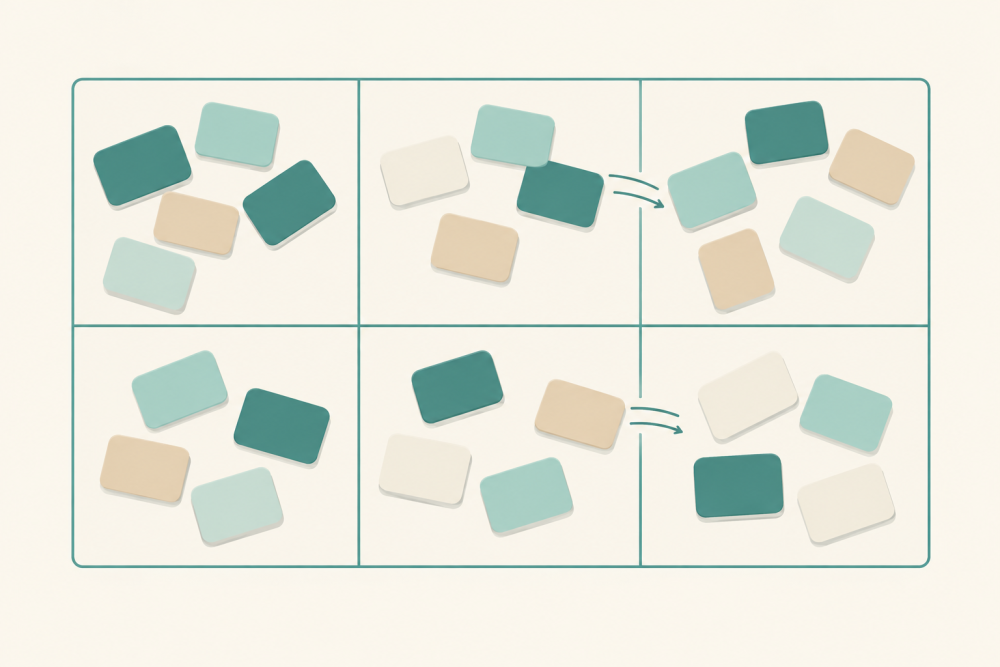
Worked -ed sets: asked, played, wanted
/t/:asked,walked,watched,laughed, after the voiceless /k/, /tʃ/ or /f/./d/:played,opened,moved,lived, after a vowel or voiced consonant./ɪd/:wanted,needed,started,decided, after /t/ or /d/, since the ending cannot attach without a vowel between the two stops.
Say the triplet: asked, played, wanted. Only the third has two beats. Spelling is a bad guide: asked carries the letters ed and keeps one syllable, while wanted needs the vowel, because ask finishes on /k/ and want finishes on /t/.
The same switch for -s and -es: books, pens, watches
/s/after a voiceless non-sibilant:books,cats,desks,months, where the /s/ lands straight on the consonants before it, with no vowel between them./z/after a vowel or a voiced consonant:pens,dogs,hands,days./ɪz/after one of the six sibilants /s/, /z/, /ʃ/, /ʒ/, /tʃ/, /dʒ/:watches,pages,buses,boxes.
Spelling misleads both ways. Sibilants normally take -es, yet pages takes only -s and still ends in /ɪz/. months looks as if it needs help and does not, so two month-suh is the ending split open. The sibilant list has six members: watching only for s misses the /tʃ/ of watches and the /dʒ/ of pages.
Spelling traps: used, closed and loved
closedis one syllable, with /d/ after /z/:The office closed at six.lovedis one syllable too, with /d/ after /v/.usedhas two readings: the past of use ends in a voiced /z/ after a vowel, while be used to ends voiceless in /s/:I used the old laptopandI am used to the noise.
used is a lexical exception rather than a rule, the only item here learned as a list. A few -ed adjectives keep /ɪd/ the same way, as in a learned colleague, while the verb keeps the regular ending.
The 24-item sort drill
Read a column aloud, then check it against the header; target 60 seconds for all 24.
| /t/ | /d/ | /ɪd/ | /s/ | /z/ | /ɪz/ |
|---|---|---|---|---|---|
asked | played | wanted | books | pens | watches |
walked | opened | needed | cats | dogs | pages |
watched | moved | started | months | hands | buses |
laughed | lived | decided | desks | days | boxes |
Endings fail in sentences, so move the same items into four frames.
- Narrating:
Yesterday I asked, waited and booked. - Describing:
The files were moved, closed and checked. - Pluralising:
Two boxes, five pages, six months. - Question tags:
You watched the buses, didn't you?
Read each frame three times: for accuracy, at speed, then while recording; the microphone is the test.
How to check yourself in ten seconds
- Count the vowel symbols in the dictionary transcription:
wantedhas one between two consonants,closedhas none. - Record the word alone, then in a sentence. A beat that appears only in the sentence is a vowel inserted under pressure.
- Use rhyme.
walkedrhymes withtalked,playedwithstayed,watchedwithmatched,wantedwithhaunted; a one-syllable partner means a one-syllable ending.
Two self-corrections cover most errors: turning the /t/ of asked into /ɪd/ adds a beat, and dropping the /ɪz/ of watches removes one.
A two-week routine that takes five minutes
- Days 1 to 3, narrating: six sentences about yesterday, all ending in /t/.
- Days 4 to 6, describing: six sentences with /d/ endings, using
closed,movedandopened. - Days 7 to 9, pluralising: say what is on your desk with /s/, /z/ and /ɪz/ plurals in one breath.
- Days 10 to 14, mixed: the four frames above at speed, recorded and compared with day one.
Play day one and day fourteen back to back and count the extra beats: a drop from six to two is progress you can hear, and it names the column still needing work.
Frequently asked questions
how to pronounce english words correctly
Start from the last sound, not the spelling. Decide whether it is voiced or voiceless, then let the ending agree: /t/ or /d/ after most bases, /ɪd/ only after /t/ and /d/, and /s/, /z/ or /ɪz/ for plurals. Learning how to pronounce English words correctly at this level is a decision made before speaking, and it takes about a second once the rows are familiar.
what is the best way to learn english pronunciation
The best method gives you a check you can run alone: a dictionary transcription to compare against, a recording to play back, and one target sound per week rather than a new accent. Accuracy first, speed second, one ending family at a time, because mixing -ed and -s in one week hides which is failing.