
Opening a Bank Account in English: Branch Scripts, Phone Support and the Words Behind Them
A complete, country-aware guide to how to open a bank account in english: the order of the branch and phone conversation, the documents and proof of address, ten banking words decoded, and a dialogue to read aloud twice.

On this page
A first bank appointment is rarely hard because of the vocabulary, but because you cannot see which question is coming next. This guide treats how to open a bank account in english as one conversation with a fixed order: the lines for each step, ten words that keep coming back, and a dialogue to read aloud.
The Order the Conversation Takes
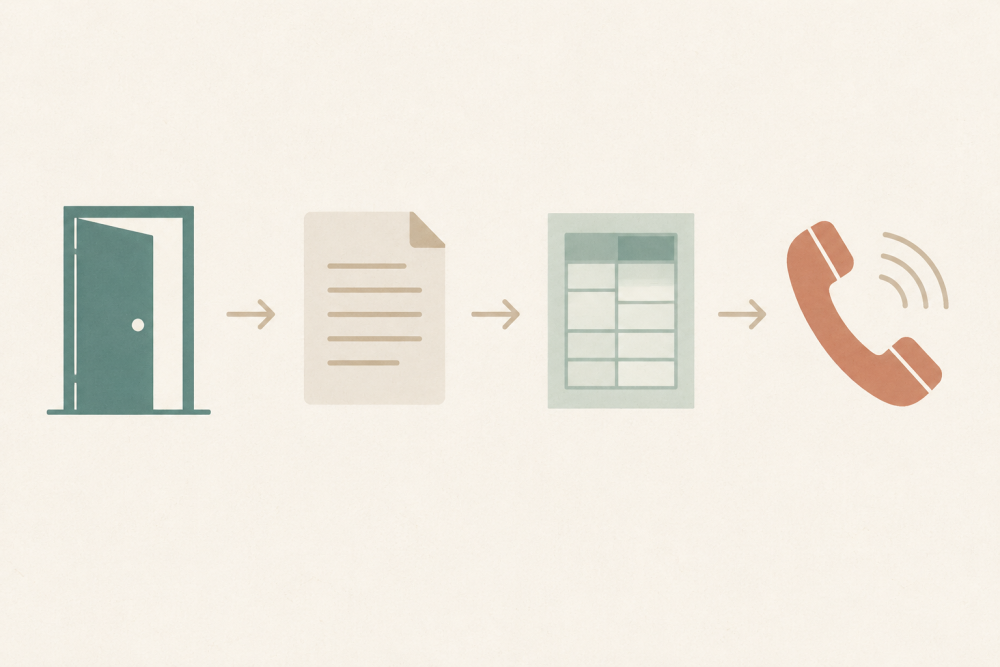
Nearly every branch follows the same six moves:
- You state your purpose, at the counter or on the phone.
- Someone checks who you are.
- They confirm your address and how long you have been here.
- You choose an account type.
- They explain the terms: fees, overdraft, limits.
- You sign, or finish an online check, and the card is posted.
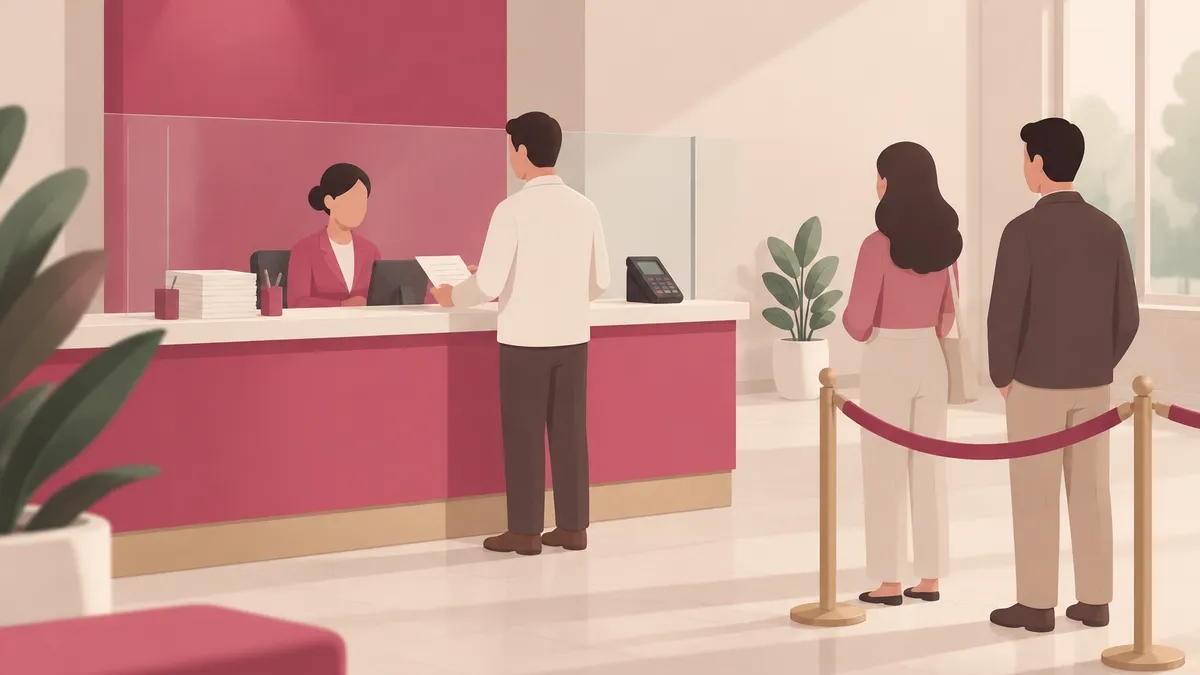
The teller, which Cambridge Dictionary defines as a person employed in a bank to receive and pay out money, is working through a form, not testing your grammar.
Opening Lines: Purpose, Desk and Timing
One clear sentence is enough to start.
Good morning. I'd like to open a current account, please.Do I need an appointment, or can I wait?
I'd like to is softer than I want. If you hear Take a seat and someone will call you., ask How long does it usually take?
Documents and Proof of Address: What They Ask to See
Proof of address is a document showing your name and where you live. Ireland's Citizens Information service says you need one photo ID plus one address document, that the same document cannot serve both purposes, and that the names must match.
I have my passport and a utility bill in my name.I only have the bill as a PDF on my phone. Is that acceptable?
Requirements differ. The United States Office of the Comptroller of the Currency says a bank must collect your name, date of birth, address and an identification number, and in the UK, applicants must live in the country and be 18 or over.
Account Types in Plain English
In the United States the everyday account is a checking account; Cambridge Dictionary cross-references it to the British current account.
| Account | What it is for, and what to ask |
|---|---|
| Current or checking | Daily spending; is there a monthly fee? |
| Savings or deposit | Money left to earn interest; what is the rate? |
| Joint | One account, two people; what do we both bring? |
| Student | Cheaper for studying; do I qualify? |
| Basic | Simple, few extras; what is not included? |
UK savings pages show an AER, the interest you might earn over a year. In Germany, section 31 of the Payment Accounts Act gives every consumer lawfully resident in the European Union the right to a basic account within ten business days.
Ten Words That Decide the Conversation
Learn what each noun does in a sentence, not its legal definition.
| Word | What it means when they say it |
|---|---|
| proof of address | A document showing your name and address. |
| overdraft | Money you owe the bank briefly when your balance goes below zero. |
| direct debit | A company collects from your account; the amount can vary. |
| standing order | Your order to pay a fixed amount at regular times. |
| IBAN | International Bank Account Number, used across borders. |
| sort code | A number identifying a bank branch. |
| interest rate | The percentage paid on savings, or charged on borrowing. |
| monthly fee | A fixed charge for holding the account. |
| statement | A record of money paid in and out. |
| ATM limit | The most cash you can take out in one day. |
In the UK, the Direct Debit Guarantee gives a full refund if an error is made. When a word lands badly, do not nod: Sorry, I don't know that word. Could you explain it in simple terms?
The Questions They Ask You
These are identity and anti-money-laundering questions, not small talk: Ireland's Citizens Information service states that the requirement comes from anti-money-laundering law.
Where do you live?-I rent a flat on Green Street.How long have you been here?-About three weeks. I'm here on a work visa.What do you do?-I'm a nurse at the city hospital.Will money be paid in?-Yes, my salary, every month.
If a question goes beyond what you know: I'm not sure how to answer that. Could you tell me what you need?
Phone and Online: Verifying Who You Are
On the phone you cannot see the form: a recorded menu, then a person asking you to confirm your name, date of birth and address, and sometimes a code sent to your phone. Online applications replace the teller with a photo of your ID and a video check.
I'd like to open an account over the phone. Which option should I choose?Could you say that again more slowly, please?Could I have a reference number for this call?
Write your address and date of birth down before you dial, and ask for a callback if the line is bad: Sorry, the line is breaking up. Could someone call me back on this number?
Practice: The Dialogue Twice
Read it aloud, then use it as a template.
You: Good morning. I'd like to open a current account, please.
Teller: Do you have an appointment?
You: No. I have my passport and a utility bill in my name.
Teller: What will you use the account for?
You: My salary will be paid in, and I'll use it for bills.
Teller: This account is free, but there is a charge if you go overdrawn without agreeing it first.
You: That is clear. How long until the card arrives?
Teller: About five working days. You can use the app before then.
The second pass is where the learning happens: cover every teller line, keep only your own, and answer the missing question aloud.
- Read the dialogue twice, once slowly and once at speed.
- Cover the teller lines and answer the questions you cannot see.
- Record yourself and listen for your repair lines.
Frequently asked questions
how to open a bank account in english
Work in the order the appointment runs: purpose, identity, address, account type, terms. Prepare one sentence per step, and carry four repair lines: a slower repeat, a simpler word, which document to bring, and a reference number.
Then check the local rule before you go. In Ireland you need photo ID plus a separate address document with a matching name.
how to open a bank account dialogue in english
The dialogue has four moves: state the purpose, offer the documents, answer the questions about work and income, then ask about the fee and the card. Keep each turn to one sentence so the teller can follow the form.
Practise in two passes: read the exchange aloud, then cover the teller's lines and rebuild the questions from memory. Once you can produce the questions, the conversation stops being a surprise.