
Linking Words When You Speak English: Natural Rhythm Without Slowing Down
Linking words when you speak English is a rhythm skill, not a spelling rule: three links, twelve marked phrases, one slow-fast-slow drill, and an honest test of what an English pronunciation app free of charge can and cannot hear.


On this page
Your individual words are correct. You know the stress, you can say the sounds, and yet the sentence arrives in pieces: one word, a small gap, the next word, another gap. The listener understands you, but the sentence sounds like a list rather than a thought.
Linking closes those gaps. It is not a new set of sounds and not an accent: it is what happens at the boundary between two words when you stop treating that boundary as a wall.
Why each word sounds separate when your pronunciation is already correct
Most pronunciation work is organised word by word, which is a reasonable way to fix a sound and a poor way to build a sentence. In connected speech there are no clear-cut borders between words; the British Council's teacher material describes speech as a continuous stream of sounds, produced with economy of movement rather than maximum clarity.
Taught to be accurate word by word, you learned a habit that is right in a vocabulary drill and wrong in a conversation. You insert a pause where the language has none, and the pause is what your listener hears as slow.
This article is about producing the link, not hearing it: fast English is decoded by the ear, your own speech is timed by the mouth. If your problem is comprehension, this drill is not the fix.
The three links worth learning first
English has more connected-speech features than three, but these carry most of the work, and BBC Learning English groups them the same way.
Consonant to vowel. When one word ends in a consonant sound and the next begins with a vowel sound, the consonant moves across and becomes the first sound of the next word. The BBC's pronunciation workshop calls this catenation and teaches it with one pair: an egg sounds like a single word. an apple is a-napple, and turn it off is tur-ni-toff. Nothing is added and nothing is dropped; the final consonant gets a new job.
The same consonant twice. When a word ends with the consonant that starts the next word, say one sound, not two: big game has one /g/ in the middle, best time one /t/.
Vowel to vowel. Two vowels cannot sit side by side without a seam, so English puts a glide in it. After a rounded vowel, as at the end of go, the glide is /w/: go on becomes go-w-on. After a spread vowel, as at the end of the or my, the glide is /j/: the end becomes the-y-end. The glide is subtle: it is not a word you add on purpose.
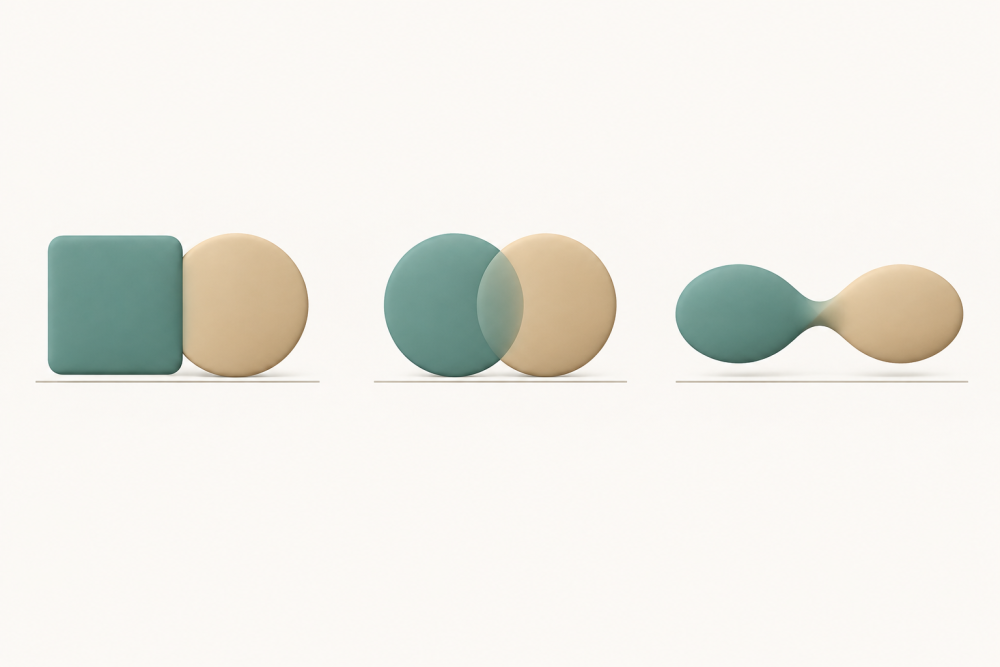
Link by sound, not by spelling. an hour links because hour begins with a vowel sound even though it begins with the letter h; a house does not, for the same reason in reverse. The letters are not the input. The sounds are.
Twelve phrases with the link marked
Read the phrase column, not the type column; this is the working list for the drill below.
| Phrase | What joins |
|---|---|
turn it off | consonant to vowel |
an apple | consonant to vowel |
pick it up | consonant to vowel |
this evening | consonant to vowel |
big game | same consonant |
best time | same consonant |
good day | same consonant |
black cat | same consonant |
go on | vowel to vowel, adds /w/ |
two apples | vowel to vowel, adds /w/ |
the end | vowel to vowel, adds /j/ |
my aunt | vowel to vowel, adds /j/ |
The slow-fast-slow drill: three recordings of one sentence
The drill is deliberately boring: you are making one sentence automatic, not collecting sentences.
- Choose a phrase from the table and put it inside a short sentence you would actually say, for example
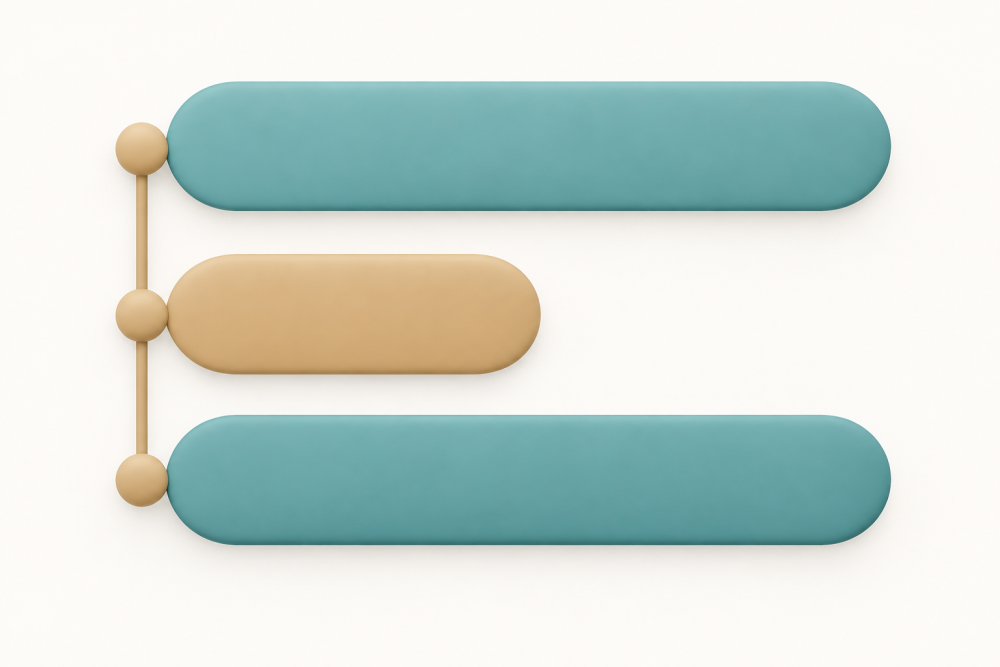
I need to turn it off before the meeting. - Record a slow pass. Say every word clearly, keep the link, and ignore how unnatural it sounds. The join should be audible, not fast.
- Listen once and ask one question: did the two words touch, or was there a gap?
- Record a fast pass at the speed you would use with a friend. Do not add speed by dropping sounds; add it by removing pauses.
- Record a third pass at the slow speed, with the fast pass still in your ear.
- Compare pass one and pass three. They should differ in one thing: the number of gaps.
Listen for the words before the join, not only the join: most linking failures are a word collapsing because the speaker spent all the effort on the boundary. If pass three sounds identical to pass two, change the sentence.
A five-minute daily routine you can run on any paragraph
You do not need a textbook, a partner or new material. Take a paragraph you already have: a news item, a page of a novel, a form.
- Minute one: read it silently and mark every place where a word ending in a consonant meets a word beginning with a vowel.
- Minutes two and three: read it aloud slowly, honouring the marks. It will feel exaggerated; that is the point.
- Minute four: read it aloud at conversational speed and let the marks disappear into the rhythm.
- Minute five: record the fast pass, listen once, write down the single join that failed.
Five minutes of this beats thirty minutes of phrase lists, because a paragraph gives you what a list cannot: an unstressed word on either side of the join. Links live in the weak parts of a sentence.
When not to link: names, numbers and the noisy room
Linking is a default, not a law. Three places need a clear boundary more than a smooth one.
A proper name comes first. Introducing yourself, or booking a table under a name, separate it from the word before it and say it slightly slower. A listener who mishears a name has to ask, and asking costs more than the pause.
A number that matters comes second: a phone number, a flat number, a price, a time. eight eight run together is one sound, not two numbers. Group numbers in pairs and pause between the pairs.
A noisy room comes third. In a quiet room a listener reconstructs a swallowed consonant from context; in a cafe or on a bad line, they cannot. The British Council notes that speakers adjust articulation to the audience, and a noisy room is an audience that needs more of the consonant, not less.
The two mistakes that turn a link into a mumble
The first is dropping the final consonant instead of moving it. an apple is a-napple, with the /n/ clearly present; it is not a apple with a shrug. If you cannot hear the consonant on your recording, the link has not happened, it has only been faked by speed. Repair: say each word alone, then join them, consonant audible each time.
The second is swallowing a whole unstressed syllable. It happens in the small grammar words, where the join gets so smooth that the word vanishes rather than links. The sentence survives; the grammar does not. Repair: say the small word once at slow speed as a full word, then let it shrink in the fast pass, but not to nothing.
Both come from one confusion: linking is not the removal of information, it is the removal of silence.
What an English pronunciation app free of charge can and cannot hear
An app is useful at one point in this routine: a second recording of the same sentence and an opinion about it. In HiBay you practise with an AI speaking partner and get feedback on pronunciation, grammar and vocabulary, and there is IELTS speaking practice if you are working towards that exam. For linking, record the marked sentence, read the pronunciation feedback, check whether the join produced a word you did not intend.
What no app can tell you is whether a listener in a noisy room understood you, or whether a link sounds natural in your target accent. Those need a person. Treat the app as the second pair of ears in steps three and six, not as the authority on your accent.
Frequently asked questions
Does linking words make English harder to understand?
For a listener used to careful speech, yes, briefly: linking removes silence that was doing some of the work of separating words. That is a listening problem and it fades with exposure. For your own speech the risk is smaller. A link that moves a consonant makes a word easier to say and no harder to hear, because the consonant is still there, only in a new position. A link that deletes it is not linking at all.
The test is whether a listener can still identify the words.
How long should I practise linking each day?
Five minutes is enough, and the ceiling matters more than the floor. The limiting factor is not minutes but repetitions of one sentence: three passes, one comparison, then a new sentence. Twenty sentences in a day teach twenty beginnings; one sentence for three days teaches an ending.
Stop when the third pass sounds the same as the second. That is a plateau, not a failure, and the next sentence will move you further than a tenth repetition.