
The Interview Weakness Question in English: Three Safe Answers and the Ones That Sink You
The weakness question is one of the most common interview questions in English and the one candidates prepare worst. Three complete answers for three seniority levels, the two filler answers interviewers discount, the follow-up traps, and a 45-second check.


On this page
Most candidates lose the weakness question before they answer it. The question is short - What is your greatest weakness? - and the two replies that surface first are the two interviewers have learned to discount: I'm a perfectionist and I work too hard. Both are heard as a strength in disguise, and a strength in disguise gives the interviewer nothing to check.
This guide treats it as one of the most common interview questions in English, and as the one where the exact wording decides whether you sound prepared or rehearsed. It gives three complete answers - early-career, mid-level and senior - each written to be spoken in about 45 seconds. Then it covers the two filler answers, the follow-up questions that test whether your answer was prepared or invented, and a four-point check you can run on your own recording before the interview.
Why the two classic answers are heard as non-answers
I'm a perfectionist describes a standard, not a weakness. Every candidate can claim it, no manager has ever seen it cost an hour, and the interviewer cannot ask a useful follow-up. The same happens with I work too hard: it describes effort, which is the thing the employer is buying.
The test is simpler than it looks. A weakness answer needs a cost that another person could have observed without reading your CV - a late draft, a handover that needed two days of questions, a decision that waited for you. If the sentence would fit on a recruitment poster, it is not an answer to this question.
There is a second reason to avoid both: they are the two lines interviewers hear most often, so they signal that the answer was picked up rather than thought through. The wording below is designed to be specific enough that no one else could have written it for you.
What makes a weakness answer safe: real, bounded, managed
A safe answer has three parts, and each part does a separate job. The first proves the weakness is real; the second proves it is not your whole job; the third proves you are already working on it. Missing any one of them turns the answer into either a confession or a boast.
| Condition | What it means | A sentence that shows it |
|---|---|---|
| Real | A colleague could describe the cost without your CV | I take too long on first drafts. |
| Bounded | You can say where it shows up and where it does not | It shows up when a document goes to a client, not in day-to-day work. |
| Managed | You can name a rule you already follow | I set a 40-minute limit for the first draft and send the rough version first. |
Choosing the weakness matters as much as phrasing it. Avoid anything the job description lists as a core requirement - I'm not good at presenting is a safe answer for an analyst and a disqualifying one for a sales role. Avoid personality labels that cannot change in a year, such as I'm disorganised. The useful zone is a real working habit with a visible cost and a fix you can describe in one sentence.
One question filters most bad choices: Could a colleague describe this cost without seeing my CV? If the answer is no, the weakness is still an adjective, and the interviewer will hear it as one.
Three model answers at three seniority levels

The three answers below are constructed practice material, not anyone's real work history. Each follows the same order - cost, action, checkable result - and each is about 70 words, which is roughly 45 seconds at a calm speaking pace. Replace the facts with your own before you use one.
Early-career: the detail-first draft
I take too long on first drafts because I try to get every detail right before anyone sees the work. On my last two reports I set a 40-minute limit for the first draft, sent the rough version to my manager, and rewrote only the parts she flagged. The reports now go out a day earlier than before, and I still check the details - I just check them after someone has seen the structure.
What makes this one work is that the cost is measurable and the fix is a rule, not an intention. A junior candidate who says I'm too detail-oriented gets a nod; one who says 40 minutes for a first draft gets remembered, because the number is easy to repeat to a hiring panel.
Mid-level: the handover problem
I used to keep handovers in my head, so when a colleague covered my accounts they had to ask me questions for two days. I now write a one-page handover note for every account I own, and I update it before I go on leave rather than during it. The last time I was out for a week, my colleague ran the accounts without calling me, and the two questions she did have were answered by the note.
At this level the interviewer is listening for whether you can describe a process, not just a habit. The answer names the artefact - a one-page note - and the moment it is updated. That detail is what separates a managed weakness from a hopeful one.
Senior: the delegation cost
My weakness is that I still take back work I should leave with the team. When a deadline is close I edit the deliverable myself instead of coaching the owner through the last version. It saves an hour that week and costs the team a learning cycle. I now run a review with the owner instead of an edit, and I keep my own edit for the final 24 hours only. On the last two releases the owners presented the work themselves.
A senior answer has to survive the obvious objection: if you are senior, why has nobody fixed this? The 24-hour rule is the reply. It admits the behaviour has not disappeared and shows the boundary that keeps it from damaging the team.
The follow-up traps, and how to stay specific
Almost every interviewer follows up, and the follow-up is where prepared answers fall apart. The three below are common because each one tests a different thing: whether the weakness is real, whether the answer was yours, and whether the fix is working.
| Follow-up | What it is testing | An answer that holds |
|---|---|---|
But is that really a weakness? | Whether you will retreat into a strength | It costs about a day on each report, so yes - it is a weakness I manage, not one I have removed. |
Can you give me another one? | Whether the first answer was prepared or borrowed | The second one is the same pattern: I hold on to work I could hand over. |
How is it going now? | Whether the fix is real and still running | Better on reports, still uneven when a deadline is close - that is why I keep the 24-hour rule. |
The trap is the second question. Many candidates hear another one and produce a second disguised strength, which confirms the first answer was performance. A better move is to name the pattern behind both answers, as in the table, and then stop. One weakness explained well is stronger than three that sound like a list.
Phrasing the fix in English without over-promising
English gives you a range of commitment levels, and the wrong one is easy to pick under pressure. I have completely fixed this is not believable, because nobody believes a weakness disappears. I'm much better at it now has no evidence attached.
I have completely fixed this.- too absolute to be true, and impossible to verifyI'm much better at it now.- a claim with nothing behind itI have a rule that limits it to the final 24 hours.- a boundary the interviewer can check
Three patterns carry most of the work: I now ... for a change you have already made, I keep ... for a rule you still follow, and The last time ..., ... for evidence. Keep the tense honest - use the present for what you do now and the past for what happened once.
Avoid always, never and completely in this answer. They invite the interviewer to find the exception, and the exception is usually easy to find.
Practice: record 45 seconds, then check four things
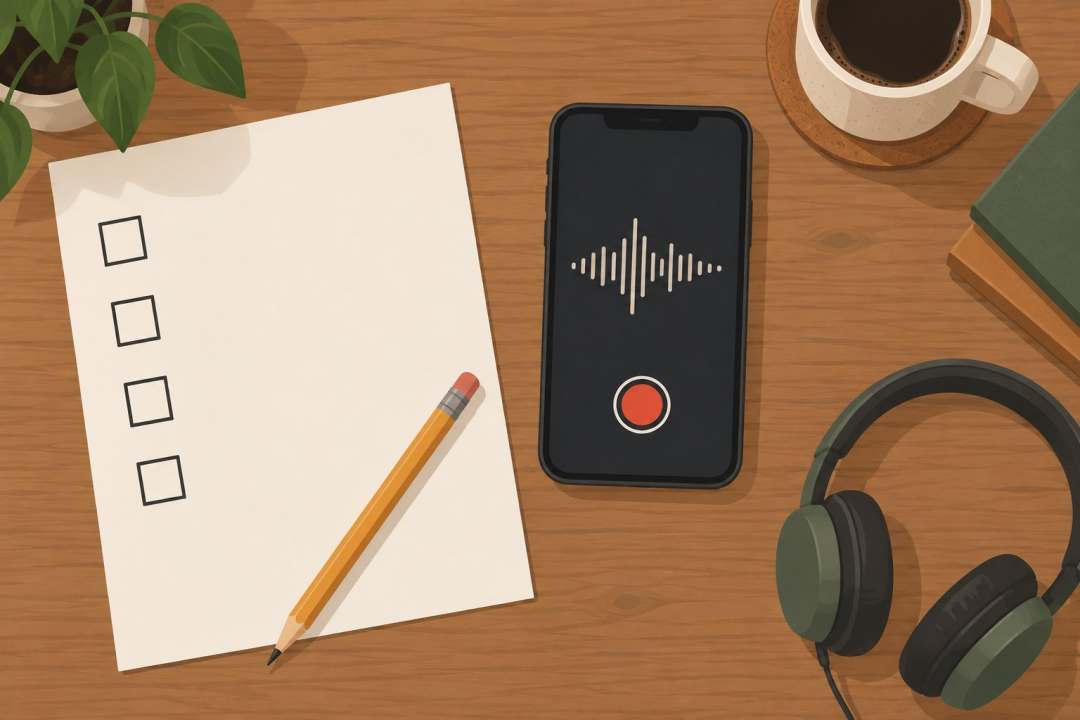
Reading an answer silently proves nothing, because the weakness question is judged on how it sounds when someone is listening. The routine below takes one sitting and one recording.
- Pick the model answer closest to your level and rewrite the facts so they are true for you. Keep the order: cost, action, result.
- Record it once, without stopping, and aim to finish inside 45 seconds. If you run over, the action or the result is usually carrying too much detail.
- Listen once without the script and answer the four checks in the table below from what you heard, not from what you meant.
- Change one thing only - usually the weakest of the four - and record again. Two recordings are enough for one session.
| Check | Pass sounds like | Fail sounds like |
|---|---|---|
| Cost is named | One sentence a listener could repeat back | A description of your standards |
| Time is bounded | A limit you can state as a number or a moment | Sometimes or in some situations |
| Action is specific | A rule you already follow | A plan for next month |
| Result is checkable | Something a colleague could confirm | I think it's better now |
If a check fails twice, do not add a new weakness. Rewrite the sentence that failed, because the structure is usually right and the wording is what the interviewer hears.
Frequently Asked Questions
How do I answer the weakness question in English?
Name a real cost, bound it, and describe the rule you already follow. In practice that means one sentence for the weakness, one for where it shows up, and one for what you now do about it - then stop. The three model answers above show the shape at three levels. Avoid the two filler answers, and rehearse the follow-up questions, because the follow-up is where a memorised answer becomes obvious.
Is it bad to say I work too hard as a weakness?
Yes, in most interviews. I work too hard describes effort, not a cost, so the interviewer hears it as a strength you are pretending to apologise for. It also gives no answer to the obvious follow-up: what did working too hard actually break? If overwork is genuinely your problem, name the consequence - I answer messages on Sunday and then start Monday tired - and say what rule limits it. That version is a weakness; the first one is a compliment.
What to do before the next interview
Choose one of the three answers, replace its facts with yours, and record it once today. Then record it again after changing a single sentence. Two recordings will tell you more than another hour of reading, because this question is answered out loud.
The UK National Careers Service interview guidance, read on 29 October 2026, recommends preparing examples from your own experience and answering with the STAR method, and it notes that reflecting on the harder questions afterwards helps you improve next time. It does not publish a script for the weakness question, which is why everything above is constructed practice material rather than a quotation - and why the facts in your version have to be your own.