
How to Do a Presentation in English: Plan, Rehearse, and Handle Questions
Prepare a clear workplace presentation with a speaking outline, original signposting examples, and a rehearsal method that includes questions. Explain your evidence, check unclear passages, and agree on a realistic next step.


On this page
If you are working out how to do a presentation in English, start with the message your listeners need to understand. A polished slide cannot explain an unclear recommendation, and a memorized introduction will not prepare you for a follow-up question.
Use this guide to prepare a short workplace presentation, explain your reasoning, and rehearse questions. The examples are original practice material, not a report about a real company. Adapt them to your audience and use information you are allowed to share.
Step 1: Decide What Your Audience Should Do Next
Write one sentence that describes the purpose of your presentation. For example: “I want the team to agree on the next step for our project.” Then ask what your listeners already know and what they need from you. A colleague reviewing your work may need detail; someone making a decision may first need your recommendation and its reason.
The British Council's business presentation guidance recommends considering your audience, giving the talk a clear structure, and practicing your delivery. The preparation method below turns those ideas into a short rehearsal you can inspect; it does not promise a particular result or a fixed improvement deadline.
Step 2: Put Your Main Point on a Cue Card
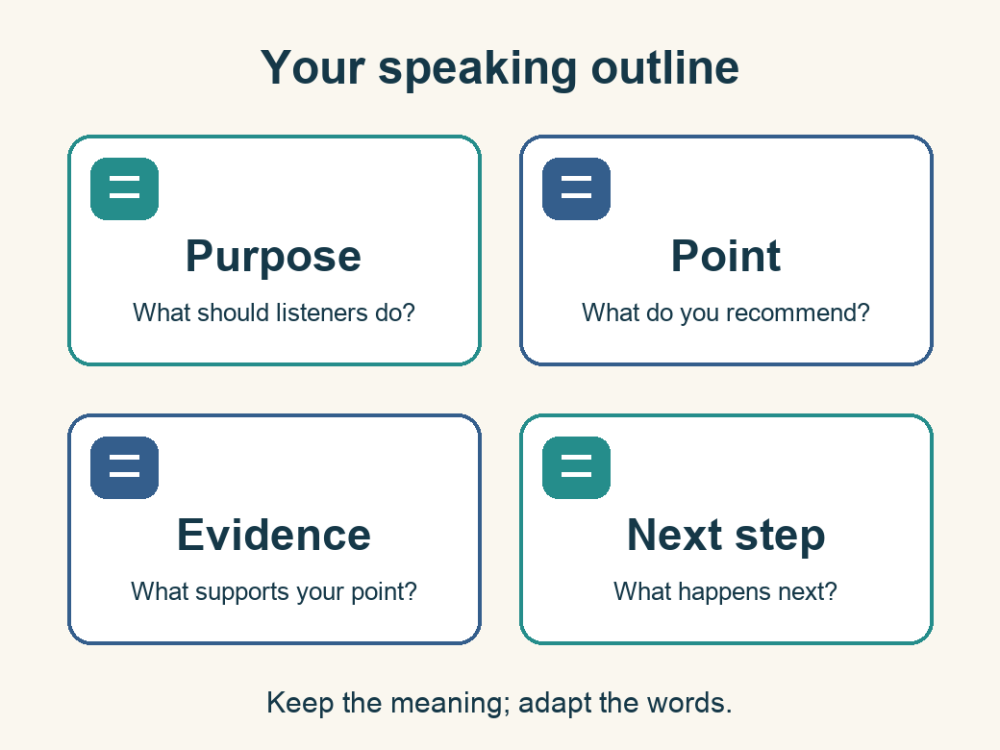
Build a small speaking outline: your purpose, your main point, the evidence you can explain, and the next step you want to propose. Keep enough detail to remind yourself of the meaning without writing every sentence you intend to say.
For an original practice example, imagine recommending a trial of a new meeting format. Your main point could be: “I recommend trying a shorter weekly update.” Your reason could be that routine updates are taking time from discussion. Explain what you actually observed before proposing a change. In a real presentation, check your evidence and acknowledge what it does not establish.
Step 3: Give Listeners a Route Through the Talk
Open with the topic and tell listeners where you are taking them. An example is: “Today, I will explain the problem with our current update and suggest a way to test a different format.” When you move to another point, name the connection so people can follow your reasoning.
These original English phrases are examples to practice and adapt. They are not a complete script or expressions you must use in every presentation.
| Purpose | Example phrase | What to check |
|---|---|---|
| Introduce your purpose | “The aim of this presentation is to explain our options.” | Does the next part actually explain those options? |
| Move to evidence | “Let me show you what we observed.” | Can listeners identify the source and its limits? |
| Explain a visual | “This chart compares the two approaches.” | Have you named what is being compared? |
| Propose a next step | “I suggest we test this approach and review the results.” | Is the proposed action clear and realistic? |
The British Council's design presentation listening activity provides a separate spoken example with audio and a transcript. You can use it to notice how a speaker introduces a purpose and connects design choices to an audience. Our example sentences above are independently written.
Step 4: Explain What a Visual Shows
If you use a chart, name the measure, the period, and the groups being compared before drawing a conclusion. Separate the observation from your interpretation: a change in a chart does not by itself tell you why it happened. Check units, labels, and sources, and remove a visual if you cannot explain it accurately.
Practice one sentence that describes the visual and a second that explains why it matters to your recommendation. Then look away from your notes and try those sentences again. Keep confidential figures, names, and customer information out of a public or AI practice session.
Step 5: Rehearse an Explanation and a Follow-Up Question
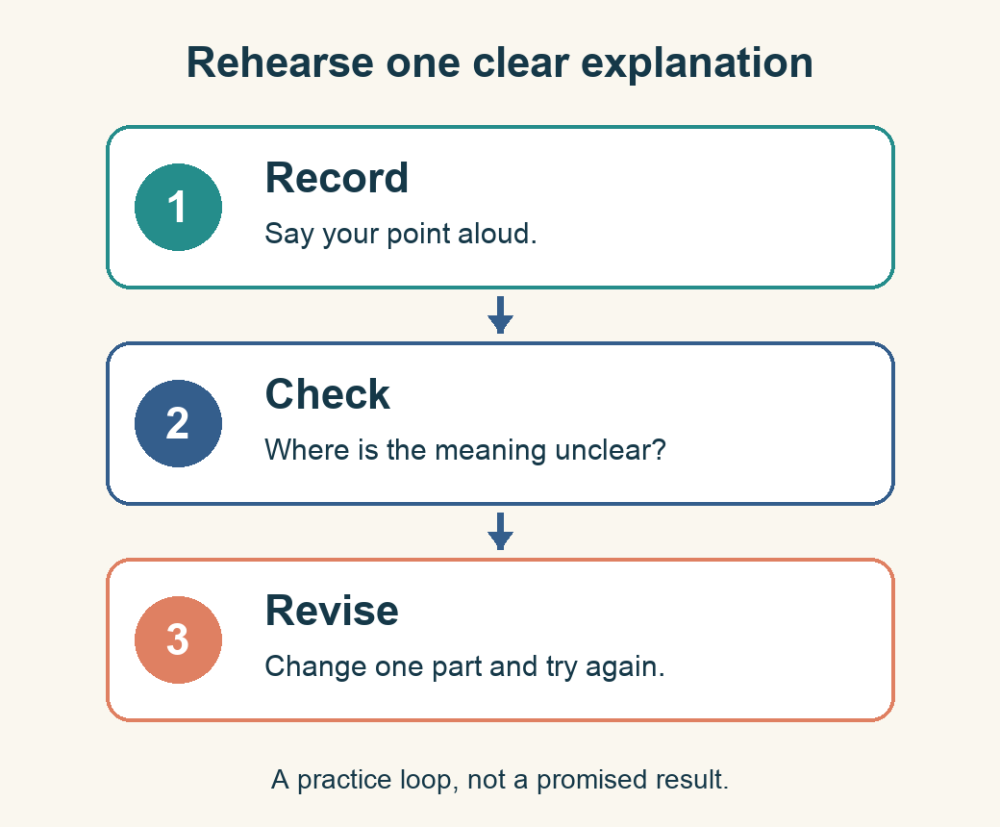
Record a run-through if your device and permissions allow it. Listen for the point at which your meaning becomes difficult to follow. You might notice an unexplained term, a rushed transition, or a conclusion that is missing its reason. Revise that part and make another attempt. A transcript can help you locate a passage, but check it against the recording before treating a transcription difference as a speaking error.
Ask a willing practice partner to summarize your recommendation and ask a follow-up question. You can also use an available AI conversation mode for a short exchange. HiBay's current App Store description describes AI speaking practice and feedback on pronunciation, grammar, and vocabulary. Check what your chosen mode supports; that description does not establish a dedicated presentation evaluator or guarantee that a real audience will understand your talk.
Step 6: End With a Clear Request
Return to your main point, explain the next step, and invite questions. For the meeting example, you could say: “I recommend testing a shorter update. If the team agrees, I will prepare a proposed agenda for us to review.” Make the commitment only if it is yours to make.
For related situations, continue with our guides to business English speaking practice and English job interview questions and answers. A presentation needs its own practice, but clear explanations and requests are useful across these settings.
How Much Rehearsal Does This Presentation Need?
Use the actual speaking slot and the decisions you need to explain as your starting point. Time a run-through with your slides or notes, including the opening and closing. If it runs long, decide which detail the audience can read afterward and which explanation they need to hear. Do not solve the timing problem by rushing every sentence.
Make the next rehearsal answer a specific question. Can a listener state your recommendation? Can you explain the evidence without reading a paragraph? Can you respond when someone asks why you chose that approach? Your answers tell you what to work on next. If you have a teacher or a colleague who understands the subject, ask for feedback on both the English and the reasoning. An AI response can suggest wording, but it cannot confirm that your proposal is accurate, authorized, or suitable for the people who will hear it.
Frequently Asked Questions
How can I practice giving a presentation in English before the real one?
Prepare a short speaking outline, give the explanation aloud, and ask a partner to summarize your main point. Use a recording when permitted to identify one unclear passage, revise it, and try again. Include a follow-up question in your rehearsal so you practice responding as well as delivering prepared sentences.
What should I say if I cannot answer a question during my presentation?
Say what you know and what you need to check. For example: “I do not have that figure with me. I will check the source and get back to you.” Agree on a realistic follow-up if you can, and ask the person to clarify the question when its meaning is uncertain. Do not invent an answer to keep the presentation moving.
Should I memorize my whole presentation in English?
Start by understanding the point of each section and practicing how to explain it from brief notes. You may choose to rehearse particular wording for an important definition, quotation, or formal opening; check any required wording against its source. Also practice continuing after an interruption or a forgotten sentence, so your preparation includes returning to the meaning as well as delivering familiar words.
How do I present a chart clearly in English?
First name what is measured, the time period, and any groups the audience needs to compare. Describe the observation before offering an interpretation, and identify the source and relevant limitations. An original practice sentence is: “The chart shows completed tasks for each team during the same period.” Replace the description with your actual measure and explain how it supports your point without claiming that the chart proves more than it does.
Start with the presentation you actually need to give. Write your purpose, explain one point with evidence you can discuss, and rehearse the question you find hardest to answer. Use HiBay's available speaking practice as one place to try your wording, then check the explanation against your notes and your audience's needs.