
When a Customer Is Angry: What to Say in English
An angry customer on a late order is a language problem with a deadline. Here is how to speak customer in English under pressure: four de-escalation scripts, the three sentences that escalate a call, and a five-step drill you can run with a colleague.


On this page
An angry customer on a late order is a language problem with a deadline. This guide shows how to speak customer in English under pressure: four de-escalation scripts, the three sentences that escalate a call, and a five-step drill to run with a colleague.
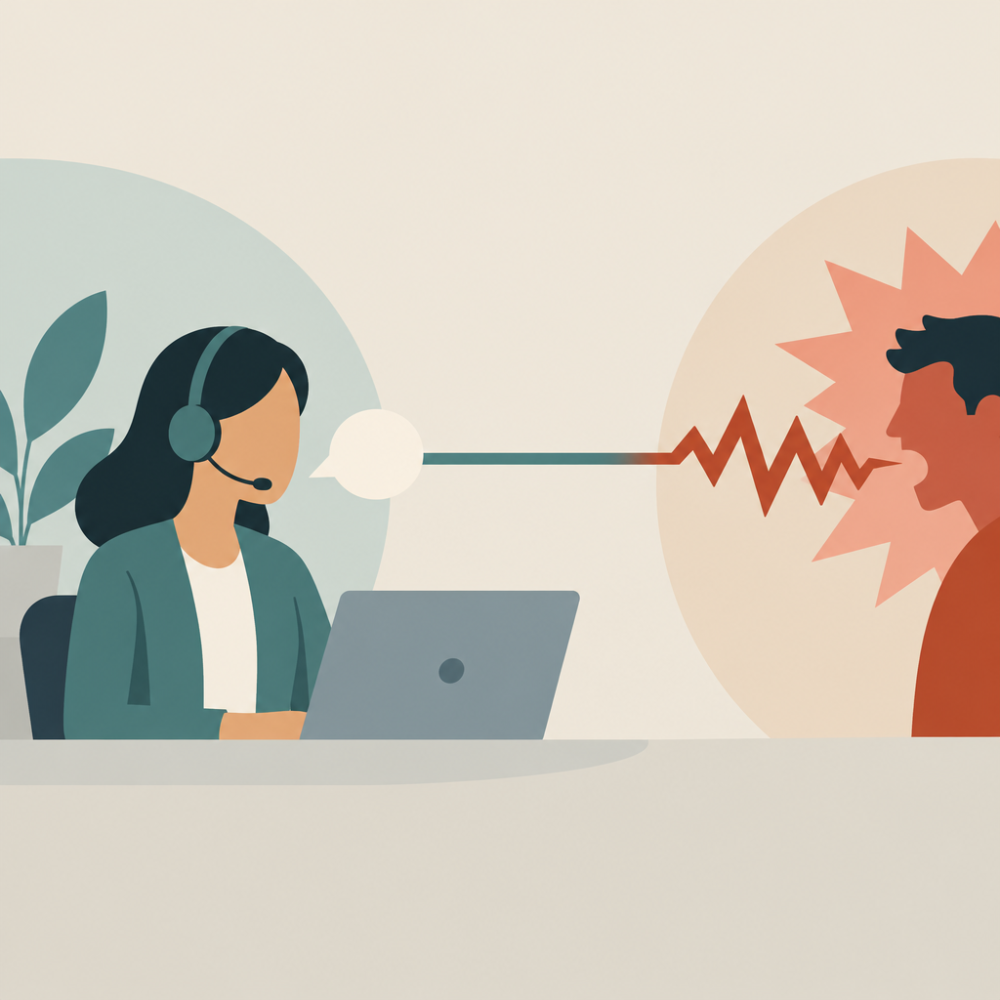
A customer whose order is three days late is rarely angry about grammar. They are angry because they lost control of something they paid for and nobody has said what happens next. The failures in these calls are almost never vocabulary failures. They are sentences that answer a question the customer did not ask.
Why angry-customer English fails: the three sentences that escalate a call
Three short sentences do most of the damage, and all three are defensible. That is not our fault. may be accurate and is useless to the person waiting for a parcel. You need to calm down. is an instruction about the customer's behaviour at the moment they feel ignored. There is nothing I can do. is often true about one thing, a refund or a date, and false about everything else you could still do.
| The escalation sentence | The replacement |
|---|---|
That is not our fault. | Let me find out what happened and who can fix it. |
You need to calm down. | You have been waiting three days. I would be angry too. |
There is nothing I can do. | I cannot release the parcel today, but I can start a trace now. |
Each replacement keeps the facts and removes the fight: no promised result, just attention, ownership and a next move.
How to speak customer in English: acknowledge the impact first
The search phrase how to speak customer in English sounds like a question about vocabulary. It describes one moment instead: the seconds after the customer explains what went wrong, when you choose between defending the company and describing the damage in their words. Acknowledging impact is not agreeing with every claim. It is repeating the consequence in their words before you explain anything.
Script one, a late delivery, replacing We dispatched it on time, so it is the courier's problem.
You paid for next-day delivery on the third, and the parcel still has not arrived. That is a real problem, and I would be annoyed too.
The sentence names a specific loss and stops before promising anything. What changes is the customer's job: before the acknowledgement they must prove the problem is real, so they repeat it louder; after it they only have to decide what they want.
Apologise for the situation, not for a fault you cannot confirm
English separates two apologies that many languages merge. I am sorry this happened to you. apologises for the situation. I am sorry we sent the wrong item. accepts fault for a specific act. Use the second only when the fault is confirmed, because in English it admits a fact rather than offering sympathy.
Script two, a wrong item, replacing Are you sure you ordered the right size?
The replacement arrived damaged as well. That is the second time, and that is not what you paid for. I am sorry this keeps happening. I have asked the depot to check what left the warehouse, and I will come back to you today.
The apology that fails hardest is I am sorry you feel that way., which relocates the problem into the customer's feelings. I apologise for any inconvenience caused fails more quietly, because it is so standard that it sounds like a template.
Give the next step, the owner and the time
A next step needs three things in one breath: the action, the owner and a clock time. Script three is a second contact after a broken promise, replacing I told you this last week, there is nothing new.
I know I promised you a callback on Monday and it did not happen. That is on me. I have the trace open now, I am the person handling it, and I will call you by 4 p.m. today whether or not I have an answer.
The clause learners drop is the one customers remember. "Whether or not I have an answer" turns a promise into a schedule; without it, a callback by four o'clock is only a hope.
Saying no in English without sounding like a dismissal
A refusal in English has four parts, in this order: what you cannot do, why in one clause, what you can do instead, and when the customer will hear from you again. Script four, a billing error, replacing That is our policy and I cannot change it.
I cannot reverse the second charge today, because the payment is still pending at your bank. I can raise the reversal now, and I will confirm it by Thursday.
The word "because" carries more weight than the word "sorry" here, and the "can" clause is what separates a refusal from a wall. Two habits to drop: opening with "unfortunately", which apologises for speaking rather than for the problem, and closing with "that is our policy", which hands the customer an authority they cannot argue with.
Spoken versus written: the same four lines, and the words you must not mirror
The four moves do not change between channels; their length does. On a call your voice carries the tone. In writing the customer has only your words, so keep one idea per message in chat and one question at most per line.
I can see the delay on the tracking page.
I am sorry you have had to chase this.
I am tracing it now and will update you by 3 p.m. today.
In email, keep a subject line with the order number, an acknowledgement in the first two lines, and the promise with a date and a timezone. In either channel, watch the words you borrow from the customer: "always" and "never" invite a counter-example, and "obviously" tells them they were wrong to ask.
Never mirror an insult back, not even to show that you heard it. When a customer says your company is a joke, skip the sentence and keep the problem: I am not going to defend the company today. What I can do is get the parcel moving. If the abuse is aimed at you, name the boundary once and return to the task: I want to get this fixed for you, and I need us to keep the call respectful. Can we go back to the delivery date? If it continues, end the call as a decision rather than a threat, then send the reference number that day.
Ending the contact: recap, reference number and the follow-up promise
The last twenty seconds are the part a customer repeats to their own manager, so close with three items: the facts you agreed, the reference, and the next contact.
To recap: the parcel is being traced, the delivery fee comes back if it has not arrived by Friday, and your reference is CS-4471. I will email you today at the address on the order, and I will call on Friday morning if there is no movement.
Send the same three items in writing the same day, because a reference belongs in the recap rather than in a footer. Citizens Advice advises consumers to note the date and time they got in touch, the person they spoke to and any case reference number. Time commitments are part of the process too: the UK Financial Conduct Authority's consumer guidance says regulated financial firms must acknowledge a complaint in writing unless it is resolved within three business days, and generally give the outcome within eight weeks. Quote only times you can keep.
Practice: a five-step drill with a colleague
Fifteen minutes, one colleague, a stopwatch and the four scripts on paper.
- Read the three escalation sentences aloud, then say each replacement without looking at the table.
- Your colleague reads one customer line from the list below in a flat voice and starts the stopwatch.
- Answer for ninety seconds using all four moves: acknowledge, apologise, next step, close.
- Swap roles and run the same line again; the second attempt is usually worse, which is the point.
- Replay once, replacing only the escalation sentence you produced by accident.
Customer lines to read out loud, without acting, because a real queue rarely sounds dramatic:
This is the third time I have called about this order.
Do you understand what this has cost me?
I want to speak to someone who can actually help.
Your company is a joke.
Score four points, one mark each. Tone: did you stay level and slow? Ownership: did you name an owner, and was it you? Time: was there a clock time in your answer? Closing: did you recap and give a reference? Three out of four is a good first run; two means the script was too long, so shorten it.
For volume rather than polish, run the same four moves against an AI speaking partner that scores the attempt. HiBay offers AI conversation practice with feedback marked against IELTS and TOEIC speaking criteria, and the report names the move you dropped, the way a colleague with a stopwatch would.
Frequently asked questions
How can I practise talking to customers in English?
Use your own work as the material. Take one real interaction from this week, write down the sentence you could not say, and rebuild it as an acknowledgement, an apology, a next step or a close. Then say it out loud with the real order number and deadline in it, because the sentence is the easy part and the pressure is the hard part. Fifteen minutes on one situation teaches more than an hour of switching topics.
What do I say when the customer asks for a refund I cannot approve?
Separate the two halves of the request: the refund you cannot approve, and the problem you can still work on. Say what you cannot do, why in one clause, what you can do instead, and when they will hear from you: I cannot authorise that amount today, but I can send it for approval now and you will have an answer tomorrow. If the answer is a hard no, say it once in plain words and put the alternative beside it, because a refusal without an alternative is heard as a door closing.