
Everyday English for Immigrants
New to an English-speaking country? This guide covers how to open a bank account in english, how to talk to neighbors, how to call customer service and how to talk to a landlord, with ready-made sentences and free practice sources published by GOV.UK, the British Council and BBC Learning English.

On this page
If you have just moved to an English-speaking country, the English you need is rarely the English in a textbook. It is the sentence you say at a bank counter, at a neighbor's front door, or on the phone while a recorded voice asks you to press a number. This guide covers that everyday language: how to open a bank account in english, how to greet the people next door, how to reach a human being on a customer service line, and how to talk to a landlord when something needs fixing.
Every claim about a service or a rule below comes from the organisation that runs it, and each source is linked so you can check it yourself. No school, course or app was tested in person for this page.
Start with the Conversation You Cannot Postpone
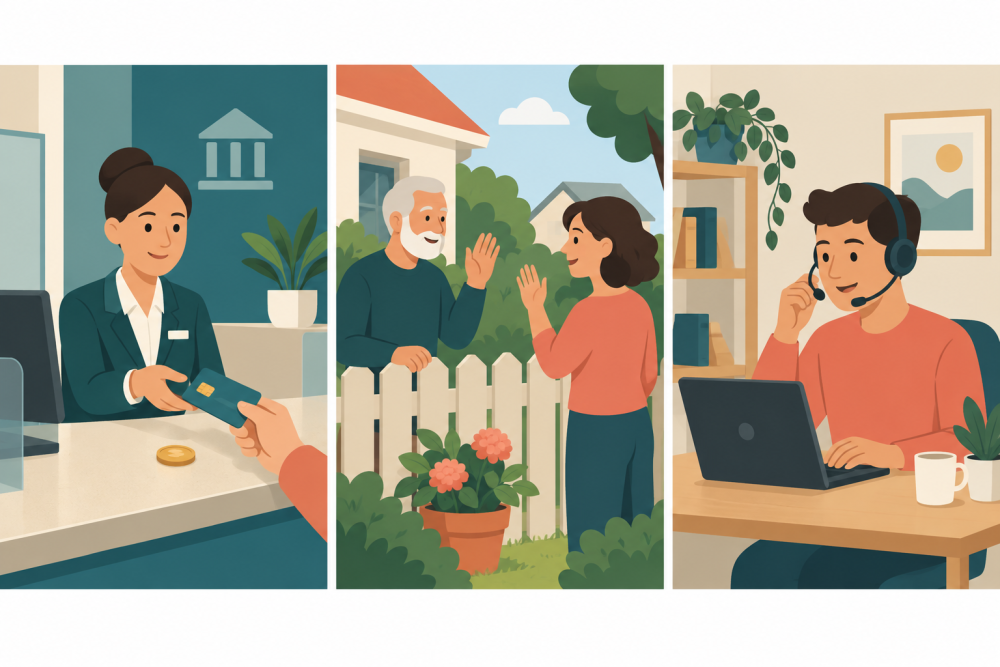
Most newcomers meet the same three situations in the first month: money, neighbors and a phone line. That order helps, because the first has paperwork you can prepare, while the other two depend on listening.
Pick the situation you expect this week, write one sentence for it, and say it out loud before you go anywhere. One prepared sentence changes the tone of a counter conversation, because the person behind the desk can hear that you are trying even when your grammar is incomplete.
Opening a Bank Account: What the Counter Conversation Sounds Like
Opening an account is a procedure, so prepare it like an appointment. MoneyHelper, the guidance service funded by the UK's Money and Pensions Service, explains that a basic bank account is free to set up and to use for day-to-day payments, and that it does not include an overdraft or a cheque book. The same guide says most banks will ask for identification and proof of address, and that you can usually apply online, by phone or in a branch. It adds that help is available if you have no fixed address, and that you must be at least 16, or over 18 at some banks, to open one. See the MoneyHelper page on basic bank accounts.
Because each bank sets its own requirements, prepare a short question to ask at the desk rather than a list to memorize: the request (I would like to open a current account. Could you tell me what I need to bring?), the practical question (I am new here. Do I need to make an appointment, or can I wait?), the repair move (Could you write that down for me, please?) and the slowdown move (Sorry, could you say that again more slowly?). Practise them in that sequence, with a pause after each one, because that pause is where a real conversation waits for your answer.
Meeting Your Neighbors: Small Talk That Opens a Door
Neighbor talk is short and repetitive by design, which is good news for a learner. People ask how long you have lived there, where you came from, and whether you like the area. None of it needs new grammar; it needs one answer you can repeat comfortably.
If you are wondering how to talk to neighbors in english without sounding like an interview, ask rather than explain. Hello, I am your neighbor from number 12. I just moved in. followed by Do you know what day the bins are collected? gives the other person something easy to answer. Write the names you learn into your phone the same evening, with the house number beside them.
Calling Customer Service: Getting Past the Menu
Phone calls are harder than counters because you cannot see a face or read a sign. Decide the outcome before you dial: a reference number, a repeat visit, or a refund. Then hold one opening sentence ready, because the first fifteen seconds usually decide whether you are transferred.
Say who you are, what you want, and what you have in front of you: I am calling about a charge on my card that I do not recognize. I have my account number and the date of the payment. If a recorded menu offers options you cannot follow, say Sorry, could you repeat the last part? I did not catch the reference number. Write the number down while the person waits; that is normal, and it prevents a second call.
Renting a Home: Talking to a Landlord About Repairs
In a rental conversation the useful English is a clear description of a problem and a request for a date, not polite small talk. Describe what is wrong, where it is, and when it started, in that order: The heating in my flat has stopped working. It stopped on Monday, and the thermostat shows no power.
Then ask for a time and confirm it back, using Could you tell me which day someone will come? and So that is Thursday afternoon, is that right? Repeating an agreed day out loud is the cheapest way to catch a misunderstanding before it becomes an argument.

Free English Lessons and Practice You Can Start This Week
In England, GOV.UK states that if you are over 16 and have left school you normally do not have to pay for English or maths up to GCSE level, and that English for speakers of other languages (ESOL) courses are normally discounted or free, depending on your employment status and how long you have been resident in England. The same page points to the National Careers Service course finder and lists further education colleges, adult education centres, and some libraries and community venues as places where the courses run. See the GOV.UK guidance on improving your English, maths and IT skills.
The GOV.UK District Provision Tool lists BBC Learning English and the British Council among the national English-language support for England, and both are free to use. If you are searching for free english lessons for immigrants uk, those two are the easiest starting points: the British Council LearnEnglish resource library offers grammar and vocabulary guides with thousands of activities, and BBC Learning English's 6 Minute English publishes short audio episodes with transcripts, which is what the listening habit above needs.
If you prefer learning on a phone between appointments, searching for english for immigrants online returns thousands of options, and the useful filter is not popularity but whether the material gives you a transcript and something to say back. Two other HiBay guides cover the speaking side of working life: English job interview questions and answers and business English speaking practice.
A Five-Sentence Script You Can Reuse Anywhere
One script covers most counters, doors and phone lines: a greeting and your name, what you want, what you have with you, one question about the next step, and the answer confirmed back. Written out: Good morning, my name is Ana. I would like to open an account. I have my passport and a letter with my address. What do I need to do next? So I fill in this form and wait, is that right? The wording changes with the situation; the shape does not.
Frequently Asked Questions
how to open a bank account in english
Say what you want first, then ask what to bring: I would like to open a current account. Could you tell me what I need to bring? Most banks ask for identification and proof of address, so bring both if you have them.
MoneyHelper's guide states that basic bank accounts are free to set up and use, that you can usually apply online, by phone or in a branch, and that there is help if you have no fixed address. Preparing the four-move dialogue above, rather than a list of banking words, is what gets a newcomer through the appointment.
how to open a bank account dialogue in english
Build the dialogue as four moves: greeting and request, the question about documents, the answer you do not fully understand, and the request to repeat or write it down. A working version runs Good morning, I would like to open an account. then What do I need to bring? then Sorry, could you say that again more slowly? and finally Could you write that down for me, please?
Practise the four moves out loud with a pause after each one, because the pause is where the other person answers, and it trains you to keep going instead of stopping at the first unfamiliar term.
how to talk to neighbors in english
Use a short, repeatable opening and then ask a practical question: Hello, I am your neighbor from number 12. I just moved in. Do you know what day the bins are collected? A question about the building or the street is easier to answer than a question about you.
Write the names you learn down the same evening, with the house number beside them. Remembering a name on the second meeting carries more goodwill than a grammatically perfect sentence.
how to call customer service in english
Decide the outcome before you dial, then open with three pieces of information: who you are, what the problem is, and what you have in front of you. I am calling about a charge on my card that I do not recognize. I have my account number and the date of the payment.
If the menu or the accent defeats you, ask for a repetition and note the reference number while the agent waits: Sorry, could you repeat the last part? I did not catch the reference number. Asking twice is normal on a support call, and cheaper than calling back to explain everything again.
how to talk to a landlord in english
Describe the problem in three parts and then ask for a date: The heating in my flat has stopped working. It stopped on Monday. Could you tell me which day someone will come? Repeat the agreed day and time back before you hang up.
Photos sent with a short written message make the conversation shorter, because the landlord can see the problem instead of asking you to describe it twice. Keep every message in one thread, so the agreed date is in writing if you need it later.