
TOEIC Vocabulary List and Practice
A TOEIC vocabulary list works as a checklist, not a syllabus: ETS publishes the test format, an examinee handbook and sample questions rather than a fixed word list. This guide builds a topic-based list from the thirteen content areas the handbook names, then gives a three-step drill that moves each phrase into recall.


On this page
A TOEIC vocabulary list is one of the most searched study aids for the test, and also one of the easiest to use badly. TOEIC Listening and Reading is produced by ETS, and the official material ETS publishes is a test format, an examinee handbook and sample questions. There is no official word list. Every numbered list you download was compiled by a teacher, a publisher or an app maker who decided which words matter, and that decision is worth checking before you spend three months on it.
This page describes what the ETS material does say about vocabulary, how to build your own list around the topics the test actually uses, and one drill that moves words from recognition to recall. The factual claims below come from ETS pages and developer listings read on 27 October 2026, linked so you can check each one. There is no ranking of word lists, no claimed score increase and no hands-on testing report.
What the Test Says About the Vocabulary You Need
The Examinee Handbook opens with a sentence worth reading twice. The official handbook states that the test does not require specialized knowledge or vocabulary beyond that of a person who uses English in everyday workplace activities. That single sentence sets the scope of the vocabulary work: ordinary workplace English, used accurately.
The format explains why. ETS describes the test as a two-hour, 200-question paper with a Listening section of 100 questions in 45 minutes and a Reading section of 100 questions in 75 minutes. Inside the Reading section, Part 5 and Part 6 test words and word partners directly, while Part 7 asks you to read notices, emails and articles and answer questions about what they say. Each section is scored from 5 to 495, and the two scores add up to the total of 10 to 990 that employers quote.
So the vocabulary that pays is the kind you meet in an office, a hotel or a shipping notice: not rare words, but ordinary ones used precisely. A question can turn on whether a form asks you to confirm your attendance or cancel your reservation, and both are common words.
Why You Will Not Find an Official TOEIC Vocabulary List
ETS lists its preparation material as an examinee handbook, sample tests, and an official online learning and preparation course built from workplace scenarios and real test questions, ordered through a local EPN office. A word list is not part of that set.
ETS also does not release test forms or answer keys. The handbook explains that forms are reused across test administrations and protected by copyright, and that the raw-score conversion tables built for each form are not published either. The practical consequence is simple: a list that claims to be compiled from real test questions cannot be checked against an official source, however useful it may still be as practice material.
Treat every list, including the one you build, as a checklist rather than a syllabus. A checklist shows you where your gaps are. A syllabus tells you what will be on the test, and nobody outside ETS can honestly hand you that.
Build Your List from the Test's Own Topic List
The handbook answers the most useful question for anyone assembling a list: it names the settings the questions are drawn from. The TOEIC content outline lists corporate development, dining out, entertainment, finance and budgeting, general business, health, housing and corporate property, manufacturing, offices, personnel, purchasing, technical areas, and travel.
Those thirteen headings make a better structure than an alphabetical list, because the test asks about situations rather than definitions. Take one heading a day and collect fifteen or twenty items in it, each one a phrase rather than a single word. In purchasing that means items such as send the invoice, track the shipment and order office supplies. In offices it means confirm your attendance at the board meeting and forward the memorandum. In personnel it means fill out a job application, meet the requirements and earn a promotion.

Two habits make the collection usable. Record the phrase you saw rather than the isolated word, because the test often tests the partner: you book a reservation but you confirm an appointment. Then note one paraphrase for each item, because Part 7 rarely repeats the exact wording of the passage. If the passage says the meeting has been postponed, the question may say the meeting was put off.
Choosing Between a 600-Word Core and a Longer List
Study material is often sold by size, from a few hundred words up to several thousand. The number describes the pack, not your result. A long list mostly adds items that may never appear in your test form, and it consumes weeks you could spend on the thirteen topics.
A workable order is to cover every topic with the most frequent phrases first, then extend a topic only when a timed sample test shows you losing questions in it. With three weeks to prepare, a few hundred practised phrases spread across all thirteen headings will serve you better than a thousand words you have never said out loud.
A Three-Step Drill That Moves Words into Recall
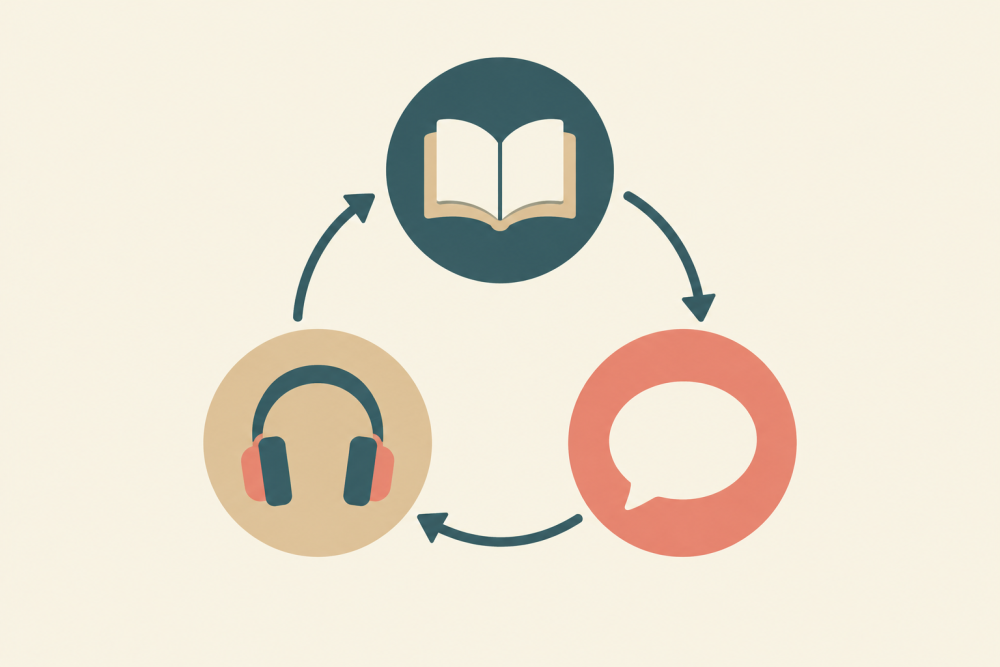
Reading a list produces recognition. The test needs recall under time pressure, and recall comes from using the phrase three ways.
Step one is to read the sentence the phrase came from and copy it out. Step two is to hear it: the free sample test from ETS includes the audio for the Listening section, and free audio with transcripts is published by BBC Learning English, which lets you hear normal speaking speed while you read along. Step three is to say your own sentence aloud, record it, listen back once, and note the single thing you would change.
When a phrase still feels uncertain, check it in a dictionary that shows word partners and pronunciation, such as Cambridge Dictionary. The check takes ten seconds and settles the question permanently, which is faster than re-reading the list.
Where to Practise for Free
Free official practice exists. The ETS sample test and the examinee handbook are both free downloads, and the ETS Global pages note a free practice test for the Listening and Reading sections as coming soon. The online preparation course is the paid item, ordered through a local EPN office.
If you want to rehearse listening questions in a browser, this site's TOEIC Listening Practice Test Online walks through the listening section, and the way raw answers become a reported score is explained on the TOEIC Listening and Reading Score Scale page. For the speaking part of the exam, sample answers with an examiner-style breakdown are covered on a separate page.
App descriptions deserve the same care as word lists. The ELSA Speak listing states that exam preparation for IELTS, TOEFL, TOEIC and EIKEN is available with ELSA Premium, and describes saving words and sentences from lessons into your own study sets. The HiBay listing describes more than a hundred scenarios with tasks at several difficulty levels and real-time checks for grammar and vocabulary while you speak. Neither description is a TOEIC question bank and neither states a score outcome, so treat both as places to use your phrases aloud rather than as replacements for the list.
Frequently Asked Questions
How can I practice TOEIC vocabulary and listening questions for free?
Start with the free ETS sample test, which includes the Listening audio, and the examinee handbook, which carries sample questions for every part. ETS Global additionally lists a free practice test for the Listening and Reading sections as coming soon. For vocabulary in context, free audio with transcripts such as the six-minute BBC Learning English episodes let you hear phrases at normal speed, and a phone recorder is enough to check whether you can say them back under time pressure.
How many TOEIC vocabulary words should I learn before the test?
There is no official number, because ETS publishes neither a word list nor the test forms and answer keys. Aiming at a total is less useful than covering the thirteen content areas the handbook names and practising the phrases you meet in each. In practice, a few hundred phrases spread across all thirteen areas, checked against one timed sample test, tells you far more about your readiness than any count of words you have read once.