
Answering 'Tell Me About a Conflict With a Colleague' in English
One of the most common interview questions in English is also the one candidates answer worst: a five-part, blame-free structure for the conflict-with-a-colleague question, twelve professional phrases, a full annotated sample answer, and a two-minute recording drill.


On this page
The conflict question is where a good interview answer most often falls apart, and rarely because the candidate cannot speak English. It falls apart because the story is either so vague that nothing happened in it, or so blunt that the interviewer quietly adds a note about temperament. The question sounds like an invitation to describe a fight. It is really an invitation to describe a repair.
Why interviewers ask about conflict at all
Public careers guidance is consistent here: behavioural conflict questions assess problem solving, interpersonal skills, conflict resolution, communication, leadership, collaboration, teamwork, logical reasoning and the ability to stay calm. All of those show up in a small story, which is why the strongest answers are modest. A deadline that slipped. Two people who read the same brief differently. A review comment that landed badly. The interviewer is not grading the size of the disagreement. They are grading whether you can separate the issue from the person, say what you actually did, and show that the same thing would go differently next time.
It is also one of the most common interview questions in English, and borrowed stories do not survive one follow-up.
The five-part shape of a conflict answer
Five parts, in this order. The order matters more than the wording, because it keeps blame out of the first ten seconds.
- Situation in one sentence: where you worked, what the project was, what was at stake.
- The disagreement itself: what you saw differently, phrased as a difference in reading, not in character.
- What you did before reacting: the pause, the private message, the fifteen minutes you asked for.
- The conversation: what you asked, what you heard, what you proposed.
- The outcome and what changed: how it ended, and the one thing different afterwards.
For a ninety-second answer, ten seconds for the situation, fifteen for the disagreement, fifteen for the pause, thirty for the conversation and twenty for the outcome is workable. Candidates who run long almost always run long in part four.

Run the five parts as a checklist while the interviewer finishes the question, which is when non-native speakers lose the thread.
Twelve phrases that keep the story professional
Every phrase below is ordinary workplace English, said at normal speed.
| Phrase | What it signals |
|---|---|
I raised it with him privately first. | You did not escalate before trying |
I wanted to understand where he was coming from. | Curiosity before judgement |
We read the deadline differently. | A difference in interpretation, not intent |
I put my concern in writing. | A record without public confrontation |
I took his point on the risk. | You can be moved by an argument |
We agreed to disagree on the wording. | A bounded, closed disagreement |
I suggested we test both versions. | You turn opinion into evidence |
We agreed on a two-week trial. | You close with a decision, not a feeling |
We met each other halfway on the scope. | Compromise on substance |
We cleared the air the next morning. | You repair the relationship, not just the task |
I looped our manager in only when we were stuck. | Escalation as a last resort, with a reason |
Looking back, I would have raised it a week earlier. | Reflection with a specific correction |
Two are worth knowing as idioms. To agree to disagree means to accept different opinions and stop persuading each other; to clear the air means to remove bad feeling between people. Both describe a closed loop, which is the impression to leave.
A full sample answer, annotated
One complete answer, about ninety seconds at a natural pace. Deliberately small: one slipped deadline, one conversation, one rule changed.
Last spring I was working on a client onboarding project with a colleague from our data team. We had agreed to hand the dataset to the client by Friday, and on Wednesday afternoon I found out that one of the three parts would not be ready until the following week. I was frustrated, because the client had already scheduled a training session for Monday.
Situation and stakes in two sentences, with no adjective aimed at the colleague.
I did not reply in the group chat. I wrote down the two options I could see, sending the two finished parts on Friday and the third one later, or moving the whole handover, and I asked him for fifteen minutes that afternoon. I opened by saying I was not there to assign blame, I just wanted to understand the delay.
The pause is explicit, and naming the options shows preparation rather than reaction.
He explained that the source system had changed its export format and he had spent two days rebuilding a script. He had assumed I knew. That was the real disagreement: he treated the delay as a technical detail, and I treated it as something the client needed to hear immediately.
Nobody is careless and nobody is unreasonable, which is the whole trick.
I suggested we split the handover and test it with the client. He agreed, on one condition: that I would be the one to tell the client the third part was late. I said yes, and I wrote a three-line email that afternoon that we both signed off on.
He sets a condition and the narrator accepts it; an answer where you win every point reads as a warning sign.
The client accepted the split, and the training session went ahead with two parts. We finished the third part the following Wednesday, four days late, and we agreed that from then on any change to an export format would be flagged to the project owner the same day. Looking back, I would have asked for that flag two weeks earlier, when the first version of the script was rebuilt.
A real cost, a rule that outlived the project, one honest regret: that separates a story from a boast.
How this one of the most common interview questions in English goes wrong
Three failure modes account for most weak answers.
The first is naming the person. Public guidance is blunt: stick to facts rather than personalities, and do not identify individuals by name or disclose company information. Use the role instead and describe behaviour rather than character. The colleague from our data team is enough. Add a nickname and the interviewer starts evaluating your judgement rather than your story.
The second is claiming you have never had a conflict. It sounds like a virtue and lands as inexperience or evasion. Almost everyone has disagreed about priorities, method or scope; the English word suggests something escalated.
The third is telling a story you never resolved. That is not a failure of the candidate, but a story that stops at the argument leaves the interviewer holding the risk. If it genuinely went nowhere, say what you did to contain it and what you would do differently; do not pretend it ended well.
Adapting the same story for a disagreement with your manager
The manager version takes the same five parts with two changes: the private conversation comes earlier and shorter, because waiting looks like silent resistance, and you bring two or three ways forward rather than a complaint, so the manager chooses between routes.
Wording matters. I asked for ten minutes to talk through the trade-off beats I disagreed with the plan. If the decision stands, the useful closing line is that you understood the reasoning and would flag the risk if it appeared.
A two-minute recording drill and a three-question self-check
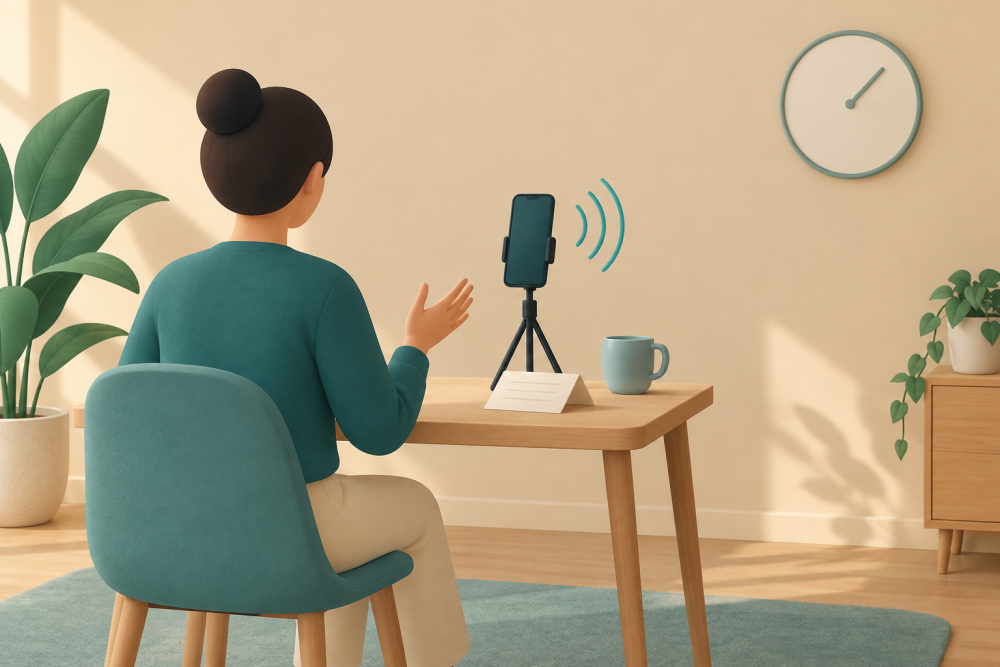
Record the answer once on your phone, without notes, and do not stop when you stumble. Then listen back with three questions only.
- Did I name a person, or describe a role?
- Did I say how it ended, in one sentence I could defend?
- Did I say what changed afterwards?
If it fails one check, fix that part and record again. Two rounds is enough; five produces a performance, and interviewers hear performances. For a second opinion, run the answer as a spoken conversation with an AI practice partner and read the feedback.
Frequently asked questions
What if I have never had a conflict with a colleague?
Then answer with a disagreement instead, and say so in the first sentence. Most people have disagreed about method, priority or scope without ever having what they would call a conflict; the word is broader than the feeling. A sentence such as We never fell out, but we did not read the brief the same way keeps you honest and still gives the interviewer a story.
How long should a conflict answer be?
Sixty to ninety seconds is the safe range, roughly one hundred and fifty to two hundred words spoken. Under forty-five seconds the interviewer has to prompt you for the outcome, which reads as unfinished. Over two minutes the detail works against you, because the interviewer starts tracking the grievance instead of the repair.